



- Home
- /
- High Courts
- /
- Madras High Court
- /
- There Is Corruption In Judiciary,...
There Is Corruption In Judiciary, Judges Need Not Be Treated As Holy Cows: Madras High Court
Upasana Sajeev
27 May 2026 7:24 PM IST
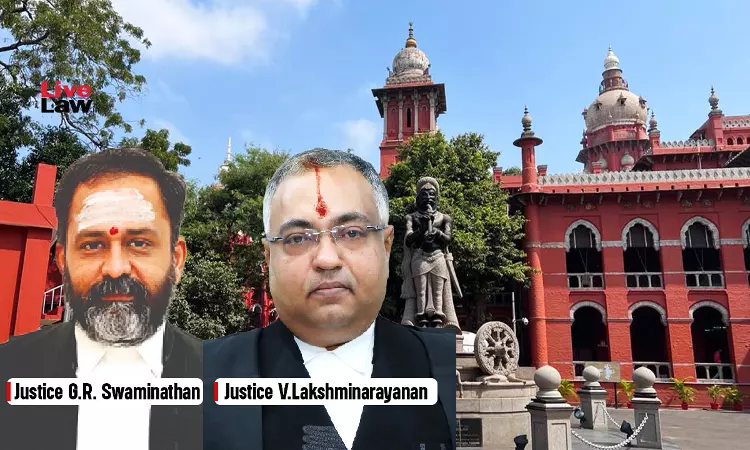
While dismissing a plea seeking to ban the Tamil movie “Karuppu” for allegedly portraying the judiciary in a bad light, the Madras High Court has remarked that there is corruption in the judiciary and judges should not be treated as holy cows. In its order, which was published today (May 27), the bench of Justice GR Swaminathan and Justice V Lakshminarayanan noted that it had...
This is a premium content
Available exclusively to
Our subscribers
Subscribe Premium 
INR 1099+GST
Your support helps us to bring you more content at
an affordable subscription scheme !!!
All payment options available
While dismissing a plea seeking to ban the Tamil movie “Karuppu” for allegedly portraying the judiciary in a bad light, the Madras High Court has remarked that there is corruption in the judiciary and judges should not be treated as holy cows.
In its order, which was published today (May 27), the bench of Justice GR Swaminathan and Justice V Lakshminarayanan noted that it had come across instances of judicial corruption and such “black sheep” were regularly shown the exit door by the full court of the Madras High Court.
"None can deny there is corruption in the Judiciary. There were and are corrupt Judges..we do know and have come across instances of judicial corruption. The Full Court of the Madras High Court regularly shows the exit door to such black sheep," the court observed.
The court also added that corruption was often facilitated by members of the bar and the high court always kept a vigilant watch to catch the corrupt and deal with the situation appropriately.
“Corruption in Judiciary cannot be committed without some members of the Bar becoming privy to the corrupt. The vigilant watch by the High Court is the sustaining stream to catch the corrupt and to deal with the situation appropriately,” the court said.
“Judges need not be treated as holy cows. Justice is not a cloistered virtue; she must be allowed to suffer the scrutiny and respectful even though outspoken comments of ordinary men (Lord Atkin),” the court added.
The petitioner had moved the court to ban or regulate the movie. He had submitted that in one of the scenes in the movie, a judge had been shown as being involved in bribery and consuming drugs. He argued that such scenes were against the constitution and damaged the reputation of judges. He argued that the director of the movie, Balaji, had criticised the Indian judicial system without any application of mind.
While the court agreed that the system was portrayed in an exaggerated manner, it also noted that it was usual in Tamil cinema to portray everything melodramatically. Calling it artistic license, the court said that an artist is entitled to present a situation in his own way. The court said that a documentary or presentation could be tested on a stricter standard, but an artistic production would be weighed on a different scale and in such cases, the artist has greater leverage and freedom.
“A film is a creation of art. An artist has his own freedom to express himself in a manner which is not prohibited in law and such prohibitions are not read by implication to crucify the rights of an expressive mind..If intellectual prowess and natural or cultivated power of creation is interfered without the permissible facet of law, the concept of creativity paves the path of extinction; and when creativity dies, values of civilization corrode,” the court added.
The court added that Article 19(1)(a) of the Constitution gives citizens the right to freedom and expression, and such freedom means the right to express one's opinion by words of mouth, writing, printing, picture, or in any other manner. The court added that this right included the freedom of communication and the right to propagate or publish opinions.
Further, the court noted that in the present case, the movie had been cleared by the Central Board of Film Certification for public viewing. The court held that when the CBFC did not view the movie as contempt of court and had given certification, a writ petition cannot substitute its opinion.
Though the petitioner insisted that the court proceed with contempt against the movie makers, the court held that the movie makers had not scandalised or lowered the authority of an actual court. It was observed that the makers of the movie had portrayed the judges and lawyers of an imaginary court as corrupt, and not the entire judicial system.
Thus, finding no case for banning or regulating the movie, the court dismissed the plea.
Counsel for Petitioner: Mr.M.Senthilkumar
Counsel for Respondent: Mr.M.Murali Government Advocate, Mr.K.Srinivasamoorthy Senior Panel Counsel for Central Government
Case Title: RS Tamilvendan v The Secretary and others
Citation: 2026 LiveLaw (Mad) 219
Case No: WP 20286 of 2026
Tags

Upasana Sajeev
Upasana Sajeev is a Principal Correspondent with LiveLaw, covering Madras High Court

