



- Home
- /
- High Courts
- /
- Madras High Court
- /
- Defamation Decree Touches Upon...
Defamation Decree Touches Upon Reputation, Legal Heirs Of Deceased Defendant Can Pursue Appeal: Madras High Court
Upasana Sajeev
8 April 2026 10:30 AM IST
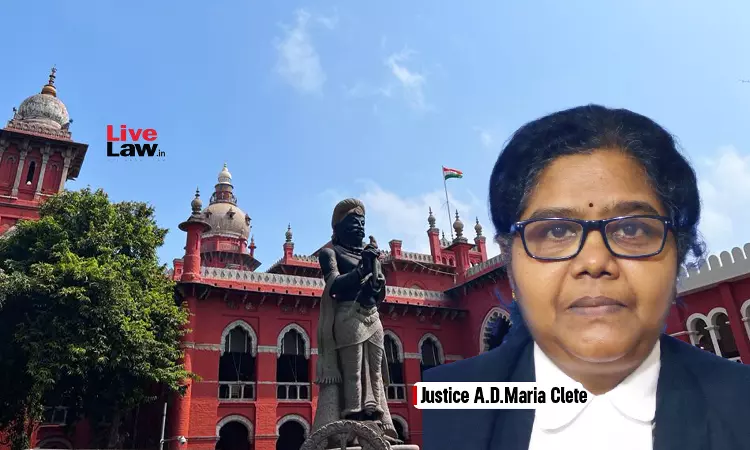
The Madras High Court recently observed that a decree of defamation touches upon the character and reputation of a person against whom it is passed, and such stigma would continue even after the person's death. The court added that the legal representatives, in such a situation, would want to remove the stigma and could continue the proceedings.Justice AD Maria Clete observed as...
This is a premium content
Available exclusively to
Our subscribers
Subscribe Premium 
INR 1099+GST
Your support helps us to bring you more content at
an affordable subscription scheme !!!
All payment options available
The Madras High Court recently observed that a decree of defamation touches upon the character and reputation of a person against whom it is passed, and such stigma would continue even after the person's death.
The court added that the legal representatives, in such a situation, would want to remove the stigma and could continue the proceedings.
Justice AD Maria Clete observed as under,
“A decree in a defamation suit does not merely impose a monetary liability; it also contains a finding touching upon the character and reputation of the person concerned. Such a finding may continue to carry a stigma even after that person's death. In that situation, the legal representatives may have a genuine interest in removing that stigma and protecting the reputation of the deceased,” the court said.
The court was hearing an appeal filed by Dhandapani against the order of the Subordinate Judge and the District Judge directing him to pay Rs 75,000 as damages to Balaji in a suit for defamation.
Balaji had instituted the suit claiming damages of Rs 2 Lakh from Dhandapani on the ground that he had defamed him. Balaji had argued that Dhandapani had engaged him as a lawyer in a suit, but since Dhandapani did not cooperate, the final decree application came to be dismissed for default. Thereafter, Balaji appeared for Dhandapani in appeals and conducted them successfully.
Balaji informed that though the entire case bundle was returned to Dhandapani, he had given a complaint to the legal service authority accusing him of misconduct. The complaint was ultimately closed on finding that the documents were available in court records. Balaji had argued that this complaint was false, malicious, and defamatory and caused injury to his professional reputation. He had thus sought damages. The Subordinate Judge decreed the suit, and it was confirmed by the District Judge.
Dhandapani had thus approached the High Court with a second appeal. However, during the pendency of the appeal, he died and his legal heirs were brought on record. The primary issue that the court considered was whether the second appeal could continue after the death of the sole defendant.
The court noted that an action for defamation was personal and would not survive after the death of a person as per Section 306 of the Indian Succession Act, except when the cause of action affects the estate of the deceased.
The court noted that when the lis is still at the stage in which the relief claimed is personal, the cause of action would not survive. However, if adjudication has ended in a decree involving pecuniary liability, it would become an enforceable liability against the estate of the deceased and the cause of action would survive to the limited extent of execution.
In the present case, the court noted that the courts had decreed the suit, which would take the form of a debt payable out of the estate of the deceased. Thus, the court noted that even though the original cause of action was personal, the proceedings could not be treated to be abated altogerthe and the legal representatives could be brought on record.
The court also noted that since the decree of defamation affects the character and reputation of the person, the legal representatives may have a genuine interest to remove the stigma. Thus, the court concluded that the second appeal would survive.
With respect to the merits of the case, the court noted that the complaint lodged by Dhandapani was closed by the Legal Service Authority. The court noted that the closing of the complaint, by itself, would not mean that the complaint was malicious or false, amounting to defamation.
The court noted that Dhandapani was a person with limited education and not familiar with English. The court thus noted that it was plausible for Dhandapani to be anxious about the whereabouts of his documents and approach the concerned authority for redressal.
The court noted that when a person makes a complaint before the proper authority in good faith, it would be protected under the doctrine of qualified privilege. The court added that a litigant, approaching a judicial or quasi-judicial authority, with a complaint against an advocate cannot be made liable for defamation in the absence of malice.
“It is well settled that, when a person makes a complaint in good faith to the proper authority for redressal of a grievance, such communication is protected under the doctrine of qualified privilege. Therefore, a litigant who approaches a judicial or quasi-judicial authority with a complaint against an Advocate cannot, in the absence of malice, be made liable for defamation merely because the complaint was ultimately not accepted,” the court observed.
The court also noted that there was no publication in the present case as the complaint was given to the proper authority. The court concluded that the communication was without malice and protected under qualified privilege. The court also noted that the alleged communication had not caused damage to Balaji.
Thus, considering all the factors, the court was inclined to allow the appeal and set aside the order of the courts below directing Dhandapani to pay Rs 75,000 as damages.
Counsel for Appellant: Mrs. R. Meenal
Counsel for Respondent: Mr.P.Mani
Case Title: Dhandapani (Died) and Others v. Balaji
Citation: 2026 LiveLaw (Mad) 153
Case No: SA No. 324 of 2014

Upasana Sajeev
Upasana Sajeev is a Principal Correspondent with LiveLaw, covering Madras High Court

