



- Home
- /
- High Courts
- /
- Madras High Court
- /
- Deity Cannot Be Left Remediless...
Deity Cannot Be Left Remediless Merely Because It Doesn't Vote: Madras High Court Flags Delay In Removing Encroachment On Temple Land
Upasana Sajeev
4 March 2026 12:27 PM IST
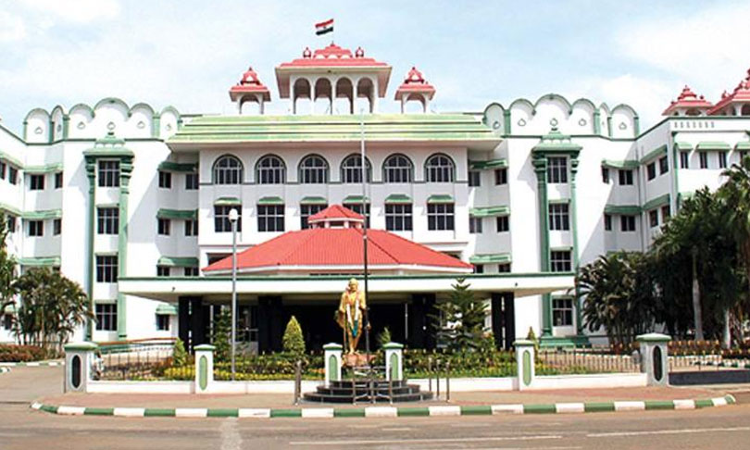
The Madras High Court has criticised the delay on the part of the state in complying with court orders and removing encroachment of around 507 acres of temple land. The bench of Justice P Velmurugan and Justice B Pugalendhi observed that constitutional governance should not be subordinate to electoral expediency. The court remarked that merely because a deity did not have voting rights,...
This is a premium content
Available exclusively to
Our subscribers
Subscribe Premium 
INR 1099+GST
Your support helps us to bring you more content at
an affordable subscription scheme !!!
All payment options available
The Madras High Court has criticised the delay on the part of the state in complying with court orders and removing encroachment of around 507 acres of temple land.
The bench of Justice P Velmurugan and Justice B Pugalendhi observed that constitutional governance should not be subordinate to electoral expediency. The court remarked that merely because a deity did not have voting rights, it should not be left remediless. The court added that it had a parens patiae jurisdiction, and when judicial orders are stalled by organised resistance, the rule of law itself stands tested.
“The poor deity has no voting right. On the other hand, the mighty encroachers have valuable votes. In a democratic polity, electoral arithmetic sometimes appears to influence administrative resolve. But constitutional governance is not subordinate to electoral expediency. A deity, recognised as a juristic person in law, cannot be left remediless because it does not participate in elections. The deity may not vote, but the Constitution speaks. The Court is exercising its parens patriae jurisdiction. But, when judicial orders are stalled by organised resistance, then the rule of law itself stands tested,” the court said.
The court was dealing with a contempt petition filed by A Radhakrishnan against state officials, officials of the Hindu Religious and Charitable Endowment Department, and officers of temples for failing to remove encroachment of temple property.
Radhakrishnan had filed a plea in 2018 seeking removal of encroachment, approximately 500 acres, in Karur District. While disposing of the plea, the court had directed the authorities to initiate appropriate proceedings under the HR & CE Act and to remove the encroachment within 6 months. Since the order of the court was not complied with, the present contempt petition was filed.
The court directed the personal appearance of HR & CE Commissioner, HR & CE Joint Commissioner, Superintendent of Police. The court was informed that the HR & CE had filed applications under the Act and steps had been taken to remove the encroachment. However, the eviction was being postponed due to law-and-order concerns and non-cooperation from the authorities.
The court took note of the reports by the Superintendent of Police who informed that whenever attempts had been made to undertake eviction process, there was severe protests by members including by sitting MP, political leaders and other protestors. It was also reported that the encroachers had even attempted self-immolation. It was informed that cases had been registered in all these cases.
The court observed that there were legal remedies available to such persons to challenge judicial orders and the orders of the court could not be nullified by organised obstruction by such extra-legal means.
“There are legal remedies exist to challenge judicial orders. They cannot be nullified by organised obstruction and by such extra-legal means. It is a sad state of affairs that some of the protestors who are legal professionals themselves and who are people's representatives have also resorted to such activities,” the court said.
The court noted that there had been a steady decline in the extend of temple lands. The court explained that temple properties are not the commercial assets of the State and they are given by generations of devotees to sustain religious worship and charitable services. The court added that if the temple properties kept diminishing year after year, it was not just a mere clerical anomaly but reflected a systemic erosion.
The court noted that though revisions and special leave petitions were filed, they were dismissed and thus, there were no legal impediment to act upon the orders of the court. The court thus concluded that there was wilful contempt.
However, the court refrained from imposing punishment on the contemnors as it noted that convicting the individual officers may by itself not restore additional acreage. Thus, considering the larger object of recovering the temple lands, the court ordered that all the pending civil suits relating to the subject temple property be disposed of as expeditiously as possible, preferably within 6 months.
The court also directed the officials of the HR & CE department to file comprehensive reports every 3 months detailing the lands recovered, proceedings initiated, suits filed, stage of litigation and the eviction steps taken. The court also directed the Superintendent of Police, Karur to ensure adequate police protection for the officials implementing the court order.
The court made it clear that compliance with judicial orders was not optional and the state machinery was expected to act with firmness and constitutional fidelity.
Counsel for Petitioner: Mr. A. Radhakrishnan Party-in-person
Counsel for Respondents: Mr. N. R. Elango, Senior Counsel for Mr. N. Ramesh Arumugam, Government Advocate and for Mr. T. Senthilkumar, Additional Public Prosecutor, Mr.R.Baranidharan, Mr.A.K.Sriram, Senior Counsel for Mr.P.Athimoolapandan Standing Counsel, Mr.K.Govindarajan, Mr.Veera Kathiravan Additional Advocate General Assisted by Mr.P.Subburaj, Special Government Pleader, Mr.V.Chandrasekar, Mr.C.K.Chandrasekar for Mr.P.Athimoolapandan Standing Counsel
Case Title: A Radhakrishnan v. P Madhusudhanreddy IAS and Others
Citation: 2026 LiveLaw (Mad) 101
Case No: Cont.P(MD)No.371 of 2024
Tags

Upasana Sajeev
Upasana Sajeev is a Principal Correspondent with LiveLaw, covering Madras High Court

