



- Home
- /
- High Courts
- /
- Madras High Court
- /
- Every Disagreement Between Wife And...
Every Disagreement Between Wife And In-Laws Not Cruelty: Madras High Court Refuses Divorce To Husband
Upasana Sajeev
28 Sept 2026 5:52 PM IST
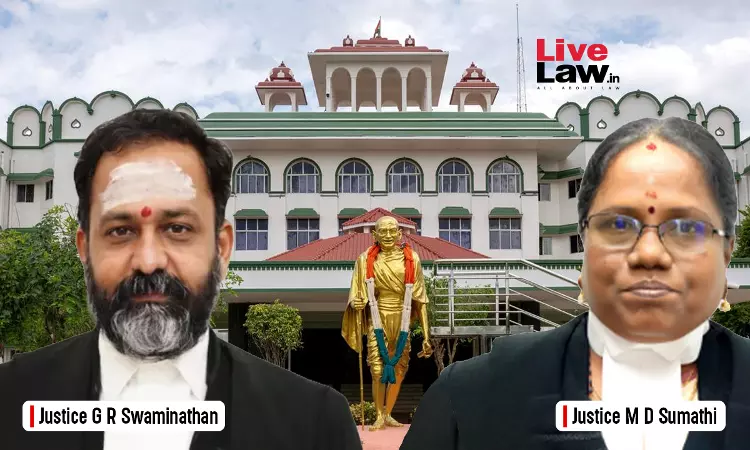
The Madras High Court has held that every disagreement that a spouse has with parents-in-law cannot be termed as cruelty committed by that spouse against the other spouse. [2026 LiveLaw (Mad) 466] The bench of Justice GR Swaminathan and Justice MD Sumathi thus refused to grant divorce to a husband on allegations of cruelty. “The evidence further shows that the...
This is a premium content
Available exclusively to
Our subscribers
Subscribe Premium 
INR 1099+GST
Your support helps us to bring you more content at
an affordable subscription scheme !!!
All payment options available
The Madras High Court has held that every disagreement that a spouse has with parents-in-law cannot be termed as cruelty committed by that spouse against the other spouse. [2026 LiveLaw (Mad) 466]
The bench of Justice GR Swaminathan and Justice MD Sumathi thus refused to grant divorce to a husband on allegations of cruelty.
“The evidence further shows that the substantial friction arose around the husband's parents and the wife's relationship with them. The wife, on the other hand, attributed the discord to the husband's excessive dependence upon his parents and their interference in day-to-day matrimonial affairs. Thus, the record discloses a family dispute in which the parents became central to the disagreement. A matrimonial court cannot automatically convert every disagreement between a spouse and the parents-in-law into cruelty committed by the spouse against the other spouse,” the court observed.
The court was hearing an appeal filed by the husband challenging the Family Court's order dismissing his plea for divorce and allowing the wife's plea for restitution of conjugal rights.
The marriage between the parties took place in 2015. According to the husband, the relationship became strained from the early days of marriage itself. He alleged that the wife picked quarrels over washing clothes and insisted that the husband's parents not visit the couple when they were in Bangalore. The husband also argued that he had left for Germany after the birth of their daughter and his daughter's name was officially changed without his approval.
The husband also argued that after he left for abroad, the wife continued to remain at her parental home and, despite requests from the husband's parents, refused to come to the matrimonial home. Thus, the husband had approached the family court seeking divorce on the ground of cruelty and desertion by the wife.
The wife, on the other hand, denied the allegations by the husband. She alleged that the husband was excessively guided by his mother even in day-to-day matters and the wife was subjected to unpleasant treatment by the husband and his family. The wife also submitted that the husband had left for Germany without taking her and the child. Further, the wife had even approached the police station seeking reunion with the husband.
The family court had dismissed the husband's plea, noting that there was no record to show a prolonged and continuous dispute between the husband and wife to such a gravity as to constitute matrimonial cruelty.
The court agreed with the family court and observed that the allegations raised by the husband, either individually or cumulatively, could not be treated as grave and weighty matrimonial cruelty. The court also noted that when the parties were living in Bangalore, their life was peaceful, which would weaken the husband's claim that the entire matrimonial relationship was hostile from the inception.
The court also noted that some of the serious allegations raised by the husband, that the wife had driven the husband's parents out of their home and excluded them from the grandchild's life, were not supported by any evidence.
The court also observed that the wife choosing to stay at her parental home with the minor child, when the husband had gone abroad for work, cannot be termed as desertion. The court further noted that the wife had actually attempted to restore the matrimonial relationship by approaching the police station for reunion. The court noted that the husband was not able to prove that the wife had permanently abandoned the marriage.
Thus, the court confirmed the family court's order and dismissed the appeals field by the husband.
Counsel for Appellant: Mr. P. M. Vishnuvarthanan
Counsel for Respondent: Mr. S. Kumar
Case Title: R v R
Citation: 2026 LiveLaw (Mad) 466
Case No: CMA(MD) Nos. 993 & 994 of 2022

Upasana Sajeev
Upasana Sajeev is a Principal Correspondent with LiveLaw, covering Madras High Court

