



- Home
- /
- High Courts
- /
- Madras High Court
- /
- More To Life Than TRP Ratings:...
More To Life Than TRP Ratings: Madras High Court Restrains Media From Publishing Veeramani POCSO Case Videos
Upasana Sajeev
25 Sept 2026 3:37 PM IST
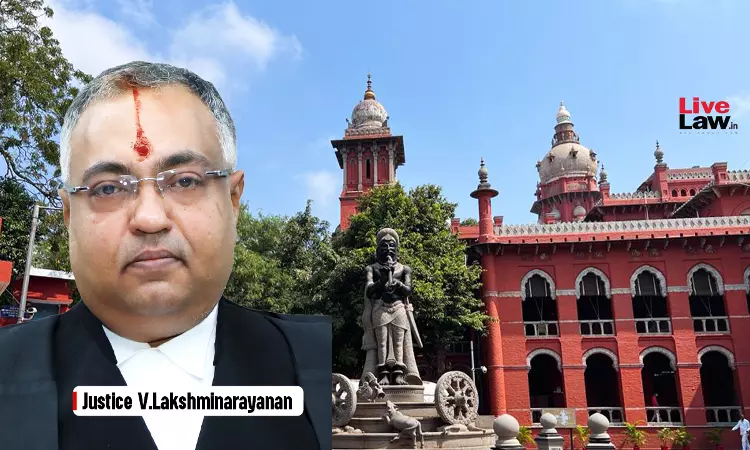
The Madras High Court, on Friday (September 25), restrained media outlets from publishing or broadcasting any video that touches upon the POCSO case registered against granite baron Veermani alias Gem Granite Veeramani.Justice V Lakshminarayanan orally remarked that publishing such material prematurely would have a chilling effect on the other victim children, who might not be willing to...
This is a premium content
Available exclusively to
Our subscribers
Subscribe Premium 
INR 1099+GST
Your support helps us to bring you more content at
an affordable subscription scheme !!!
All payment options available
The Madras High Court, on Friday (September 25), restrained media outlets from publishing or broadcasting any video that touches upon the POCSO case registered against granite baron Veermani alias Gem Granite Veeramani.
Justice V Lakshminarayanan orally remarked that publishing such material prematurely would have a chilling effect on the other victim children, who might not be willing to come forward for the investigation.
The court asked the news channels and others to show sensitivity in the issue and hold debates without telecasting the explicit videos in connection with the case. The court remarked that some things were more important in life than TRP ratings.
"Publishing it prematurely is going to have a chilling effect on the other victims. Won't you look at the sensitivity of the matter. The accused is alleged to have committed a crime against children. If it is going to be published and debated, if I were the victim, I wouldn't have the gall to come for investigation. You can have debates on the issue. It should be debated. But can't you debate without circulation? There is something more important in life than TRP ratings," the court orally remarked.
The court also noted that while the media had a right to report on the incident, which was part of its fundamental right to speech and expression, it did not have the right to hold a media trial. The court reminded the parties that whether the accused had committed the crime or not had to be decided by the court, and it was not for the media to decide the same.
"There cannot be a trial by media. Whether he is guilty or not should be decided by the courts. It's not for the media to decide. Let the children be kept safe. Please show some sensitivity," the court orally remarked.
The court also noted that the investigation in the case was at a crucial stage and the police were looking into whether there were more victims in the case than those already identified. The court added that if the news channels were holding debates with details of the investigation and circulating photos at such a crucial stage, there was a possibility that the victims might not come forward to give statements to the police. The court also remembered how during the 2008 Mumbai Attack, constant reporting by the media on the steps being taken by the Indian defence had actually helped the terrorist group to escape them.
Thus, the court highlighted that the right of the media to report comes with a corresponding duty, not just to the victim children but to the accused also. Though the petitioner had sought for a John Doe order, the court was not inclined to pass such an order, to balance the right of the media. The court thus restrained the media outlets from publishing the videos in connection with the case. The court, however, granted liberty to the channels to discuss the effects of child sexual abuse, without discussing the facts of the present case.
At the same time, the court directed the SIT, constituted by the State government to probe the case, to issue a press release once every week, so that the public is aware of the steps taken by the police in connection with the case.
Background
Veeramani and his two aides were arrested by the Anti-Vice Squad on August 28, over alleged rape of minor girls. The police had stated that the case was registered upon receiving a USB drive by the Intelligence and Technology Police Unit (ITPU) containing video clips which allegedly showed Veeramani sexually assaulting juvenile girls. The police also stated that the investigation revealed that Veeramani had rented a house in Chennai's Teynampet where he lured the victims and sexually assaulted them. The two caretakers of the house, Mahendra Simhan and his wife Shanti, were also arrested along with Veeramani, and the three were lodged in Puzhal prison.
The case was registered for offences under Sections 7,8,15(1), and 21(1) of the POCSO Act, Sections 354(A), 354(C), 201, and 120(B) of IPC and Sections 66(E), and 67(B) of the IT Act.
Tulir, an NGO working to protect and heal children affected by sexual violence, had filed the plea seeking directions to the State Government and the police to take immediate steps to prevent further circulation, publication, and dissemination of video recordings that constitute Child Sexual Exploitation and Abuse Material (CSEAM), and to protect the identity and privacy of the victims of the case.
The NGO informed that the case was registered in October 2025 and the investigation was pending, with the chargesheet yet to be filed. The NGO further argued that on September 24, when the bail applications of two of the accused were to be heard by the Special Court, the CSEAM footage was circulated by India Today and Republic TV, with particulars capable of identifying the victims. The NGO argued that the circulation of such materials, while the investigation was pending, raises serious concerns regarding the custody and confidentiality of the sensitive evidence and poses an immediate and continuing threat to the privacy, dignity and safety of victims.
The NGO further stated that even though there is no express publication of the victim's name, the materials circulated by the news channels would make it easy to ascertain the identity of the victim for persons acquainted with the circumstances. The NGO added that this would constitute a grave and continuing risk to the privacy, dignity, and safety of the victims and called for immediate identification of the source and chain of dissemination of the footage.
The NGO thus argued that the circulation of the footage required investigation to check whether it was to generate publicity and viewership at the expense of the victims' privacy and the judicial process.
The NGO thus sought a John Doe order to remove the content. An interim relief has also been sought to direct an investigation into the unlawful possession and publication of the CSEAM footage and take appropriate action against violators, including India Today, Republic TV, Sathiyam TV and others.
When the matter came up for hearing on Friday, the State Public Prosecutor informed the court that the police have swung into action and were in the process of identifying the persons responsible for leaking the videos. The State also informed the court that appropriate action would be taken against those responsible for leaking the videos and assured the court that the leak was not from the side of the police. The State also informed the court that since some of the videos were already published online, the State police have written to Google and Meta to take down the content.
The Central Government also assured the court that it would take appropriate steps to take down the infringing content.
Meanwhile, India Today submitted that even while holding discussions and debates on the issue, the channel has made sure that the same was in compliance with the POCSO Act and the IT Act. Republic TV informed the court that as soon as they were informed, the channel has taken down the videos.
The court has directed the respondents, including the TV channels, to file their counters and adjourned the hearing to September 30.
Counsel for Petitioner: Ms Deepika Murali, Ms Nivya
Counsel for Respondents: Mr John Sathyan, State Public Prosecutor, assisted by Mr Arun Anbumani, Additional Public Prosecutor, Mr A Kumaraguru, Standing Counsel for Union of India, Mr Rahul Shankar, Mr Amalraj
Case Title: Tulir Charitable Trust v The State
Citation: 2026 LiveLaw (Mad) 463
Case No: WP Crl 2564 of 2026
Tags
Upasana Sajeev
Upasana Sajeev is a Principal Correspondent with LiveLaw, covering Madras High Court

