



- Home
- /
- High Courts
- /
- Madras High Court
- /
- Criminal Law No Tool To Stifle...
Criminal Law No Tool To Stifle Legitimate Political Dissent: Madras High Court Quashes Case Against Annamalai For Alleged Provocative Speech
Upasana Sajeev
25 Sept 2026 10:45 AM IST
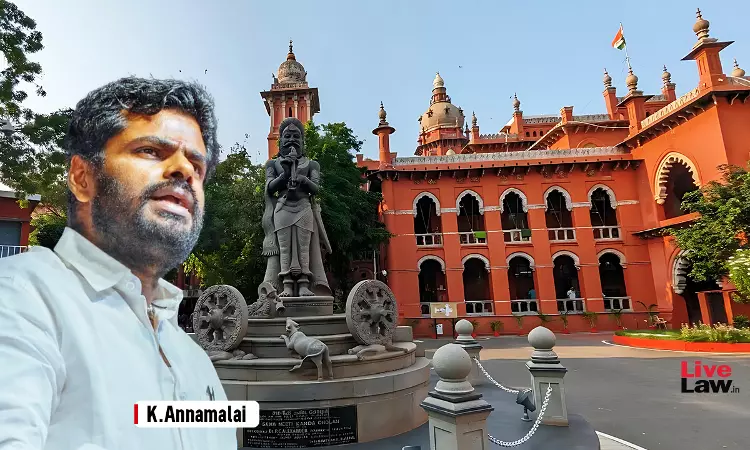
The Madras High Court on Thursday (September 24) quashed a case against former IPS officer and President of We The Leaders Foundation, K Annamalai, for his alleged provocative speech involving freedom fighter Muthuramalinga Thevar. Justice GK Ilanthiraiyan noted that there was no material to show that Annamalai had intended to promote communal disharmony through his speech. The court...
This is a premium content
Available exclusively to
Our subscribers
Subscribe Premium 
INR 1099+GST
Your support helps us to bring you more content at
an affordable subscription scheme !!!
All payment options available
The Madras High Court on Thursday (September 24) quashed a case against former IPS officer and President of We The Leaders Foundation, K Annamalai, for his alleged provocative speech involving freedom fighter Muthuramalinga Thevar.
Justice GK Ilanthiraiyan noted that there was no material to show that Annamalai had intended to promote communal disharmony through his speech. The court also noted that there was no material to show that the speech was capable of inciting violence, promoting communal disharmony or disturbing public tranquillity. The court had previously stayed the trial in the case.
The court thus remarked that criminal process cannot be used to settle political scores or to stifle legitimate political dissent. In the present case, noting that there were no foundational materials, the court opined that permitting the criminal proceedings to continue would serve no legitimate purpose and would amount to permitting the criminal process to be used for purposes other than the bona fide enforcement of law.
“The criminal process cannot be permitted to be used as a weapon for settling political scores or to stifle legitimate political dissent….The materials available on record do not disclose the foundational ingredients necessary to constitute the offences alleged against the petitioner. In such circumstances, permitting the criminal proceedings to continue would serve no legitimate purpose and would amount to permitting the criminal process to be used for purposes other than the bona fide enforcement of law,” the court observed.
Annamalai had approached the court seeking to quash the proceedings pending before the Judicial Magistrate IV, Salem. The case was registered based on a complaint filed by Piyush, from Salem, under Section 190 and 200 of the CrPC.
In his complaint, Piyush alleged that Annamalai, during a press meet, had attributed certain statements to late Muthuramalinga Thevar. It was alleged that Annamalai had stated that Thevar, in one of his speeches in 1956 had said that “If non-believers speak of believer's faith, Madurai Meenakshi, who receives milk abhishekam, shall receive blood abhishekam.” Piyush had alleged that Thevar had never spoken such words and even if the reiteration was authentic, it would constitute a threatening and provocative act.
Based on Piyush's complaint, the Magistrate took cognisance against Annamalai for offences under Sections 153A and 505(1)(c) of the IPC [Section 196 and 353(1)(c) of the BNS] and issued summons to Annamalai. Challenging this, Annamalai has filed the present plea.
Annamalai argued that the complaint did not disclose commission of any offence. It was argued that there was no mens rea on his part to cause harm to public tranquillity. It was argued that Annamalai had only referred a historical incident in the course of political discourse and the statement neither contained any incitement nor constituted a threat or exhortation to any group or person. It was also argued that the Magistrate had taken cognisance of the complaint without affording an opportunity of hearing to Annamalai, which was violative of Section 223 of the BNSS.
Piyush, on the other hand argued that the statement made by Annamalai was wholly fictitious and had inflammatory elements, with the intention of promoting feelings of hatred, ill-will and enmity between believers and non-believers. It was also argued that at the time of making the statement, Annamalai was the State President of BJP and being a person of such political standing, he was aware of the consequences and impact of his statements.
The court noted that Annamalai's speech did not refer to any two or more groups and was made as a political response to the remarks made by a member of another political party. The court also noted that there was no material to show that the speech resulted in any actual or imminent disharmony, enmity, hatred or violence between different groups or communities. The court highlighted that mere reference to a historic incident without any intention to promote enmity was not an offence.
“Mere reference to a historical incident, without any demonstrable tendency or intention to promote such disharmony, cannot, by itself, attract the penal provision under Section 153A of the IPC. Therefore, the essential ingredients necessary to constitute an offence under Section 153A of the IPC are not made out against the petitioner,” the court observed.
Thus, noting that foundational facts had not been established, the court was inclined to allow Annamalai's plea and quash the case against him.
Counsel for Petitioner: Mr. Arun C Mohan
Counsel for Respondent: Dr. V. Suresh For Mr. D. Nagasaila
Case Title: Annamalai K v Piyush V
Citation: 2026 LiveLaw (Mad) 461
Case No: Crl OP No 9798 of 2026
Tags

Upasana Sajeev
Upasana Sajeev is a Principal Correspondent with LiveLaw, covering Madras High Court

