Madras High Court Quashes Criminal Case Against Advocate Over Private Act Inadvertently Streamed During Virtual Hearing
Upasana Sajeev
5 Nov 2026 3:37 PM IST
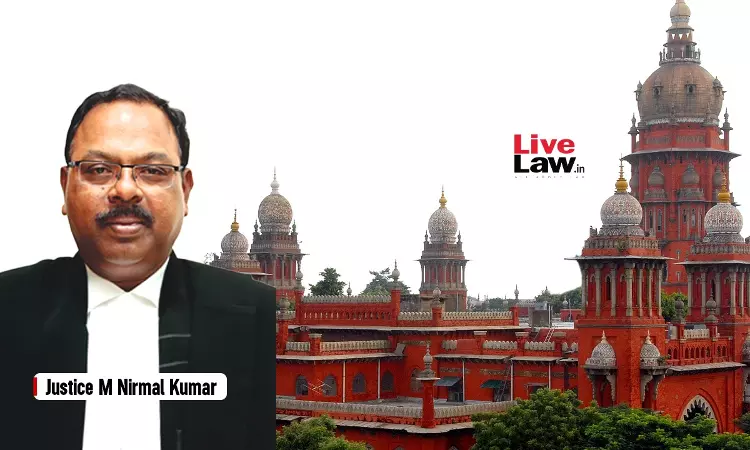
Private act got streamed due to ignorance of technology, Court noted.
The Madras High Court has quashed a criminal case registered against a lawyer after a video clip of him engaging in an erotic act with a woman during the video proceedings of court went viral. [2026 Livelaw (Mad) 534]
Justice Nirmal Kumar noted that the lawyer had not intentionally done the act in public. The court noted that the man had engaged in the act in his private office and it came to be seen on screen because the video conferencing link of the court remained connected in the background. The court remarked that an act done in private had been streamed due to ignorance of technology.
“It is to be noted that the virtual hearing of cases were entertained during the COVOID-19 pandemic, where there was restriction and limited access to the physical court hearings and everyone were in fear of life, with no proper medical treatment. The accidental streaming of petitioner logging into the virtual hearing is also not in dispute. Thus, the petitioner had not committed any act knowingly to cause any disruption to the proceedings, a private act got streamed due to ignorance of technology. More so, when the virtual hearing and usage of electronic device was thrusted due to the prevailing circumstances then, when the entire process was at a nascent stage,” the court noted.


The court added that while it did not approve of the advocate's conduct, it had been dealt with in the contempt proceedings and through disciplinary proceedings by the professional body. The court added that the question before it was whether there were materials to make out a case as per the penal provisions charged against him, which the court answered in the negative.
“It must be made clear that this Court does not approve of the conduct of the petitioner, an advocate, which has been described by the Division Bench in strong terms, and for which he has been dealt with by the Court in contempt jurisdiction and by his professional body. The question in this petition is only whether the specific penal provisions invoked against him are made out on the materials collected by the prosecution, and, for the reasons above, they are not,” the court said.
On December 20, 2021, a video clipping of the lawyer had gone viral on social media. The division bench took suo motu cognisance of the incident and directed the CB CID to register a suo motu FIR. Following this, the FIR was registered for offences under Sections 228, 292(2)(a) and 294(a) IPC and Section 67A of the IT Act.
A final report was filed by the police, as per which the lawyer had sexually harassed the women, who was working as his office assistant and domestic help. It was reported that even before the occurrence, he had used the financial condition of the woman's family to his advantage and exploited her by offering money, a new dress and food and she was subjected to physical and sexual exploitation several times.
The lawyer had filed the present plea to quash the pending criminal case. The lawyer had argued that even if the entire final report and materials were taken at face value, no offence was made out against him. It was argued that the occurrence took place inside a closed room, in the advocate's office and not in a public place. He submitted that he had no intention on his part to insult or interrupt the judicial proceedings.
The court noted that Section 228 punishes whoever intentionally offers any insult or causes interruption to any public servant. The court noted that there was no averment, and no material to show that the lawyer intended to interrupt the proceedings or that he knew his conduct would be displayed in the virtual court.
With respect to Section 294(a) of IPC, the court noted that the provision punishes any obscene act in a public place. The court noted that the petitioner had not switched on the camera knowingly and no participant of the virtual court had spoken of annoyance caused to him or her. The court also noted that the division bench, while initiating suo motu cognisance, had observed that the act done by the lawyer, by itself, was not an offence.
On charges of sexual harassment, the court noted that the evidence did not speak of any unwelcome physical contact, sexual overture, demand or remark by the petitioner. Similarly, the court noted that there were no materials to prove the offences under IT Act or the Tamil Nadu Prohibition of Harassment of Women Act.
Considering the materials, the court was inclined to allow the plea and quash the criminal proceedings pending against the lawyer.
Counsel for Petitioner: Mr. R. C. Paul Kanagaraj
Counsel for Respondents: Mr. R. Rajasekaran Govt. Advocate (Crl.side)