



- Home
- /
- High Courts
- /
- Madras High Court
- /
- High Courts Shouldn't Issue Routine...
High Courts Shouldn't Issue Routine Directions For Early Disposal Of Cases, Must Consider Urgency Involved: Madras High Court
Upasana Sajeev
29 Jan 2026 9:30 AM IST
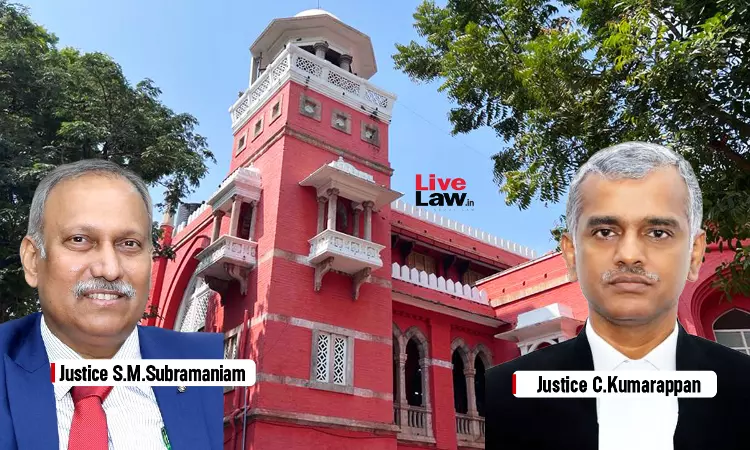
The Madras High Court recently observed that higher courts should not mechanically issue directions to the authorities for early disposal of petitions and should consider the urgency required in each cases. “Therefore, the High Court, while issuing a direction to dispose of the cases by the District Courts, statutory Authorities, etc. has to take into consideration the...
This is a premium content
Available exclusively to
Our subscribers
Subscribe Premium 
INR 1099+GST
Your support helps us to bring you more content at
an affordable subscription scheme !!!
All payment options available
The Madras High Court recently observed that higher courts should not mechanically issue directions to the authorities for early disposal of petitions and should consider the urgency required in each cases.
“Therefore, the High Court, while issuing a direction to dispose of the cases by the District Courts, statutory Authorities, etc. has to take into consideration the urgency required and possibility of disposal of those cases within the timeline, if any, fixed by the High Court,” the court remarked.
The bench of Justice SM Subramaniam and Justice C Kumarappan observed that every court or statutory authority is expected to dispose of appeals, revisions, etc in a systematic manner and in order of seniority. The court added that if it issues directions to dispose of applications and any particular matter alone is disposed of, it would cause prejudice to other persons who are waiting for disposing their appeals.
“Every Court or statutory Authority is expected to dispose of the appeals, revisions, etc., systematically and in the order of seniority and if any preference is required, reasons must be recorded. By securing a direction from the High Court if any particular matter alone is disposed of, it would cause prejudice to the other persons, who are all waiting for disposal of their appeals, revisions, etc. before the Authorities. In other words, a blanket direction may cause prejudice to other persons, who are all waiting for long time for disposal of their cases,” the court said.
The court made the observations in a plea filed by Ponmudi seeking direction to the District Collector, Tiruvannamalai to dispose of his appeal under Section 10 and 10B of the Tamil Nadu Land Encroachment Act 1905.
Ponmudi was alleged to be an encroacher and encroachment proceedings had been initiated against him under the Tamil Nadu Land Encroachment Act, 1905. A notice was issued under Section 7 of the Act and after affording an opportunity, a final notice was issued under Section 6.
Ponmudi filed an appeal against the final notice before the District Collector under Section 10 of the Act. He also filed an application seeking to stay the notice. Since the application and the stay petition were not disposed, he filed the present plea.
The court noted that mere issuance of direction to consider the application could not serve the cause of justice. The court noted that such petitions were routinely being filed in the court an the court was not expected to issue routine directions in these cases.
The court noted that the authorities would have to consider the appeals, revisions etc in a systematic manner by making entries in a register and in the order of seniority. The court noted that any order by the court might cause prejudice to others, who might be awaiting similar relief from the authorities.
In the present case, the court noted that the petitioner had filed the appeal only on November 27,2025 and within one month had approached the court seeking to dispose the appeal. The court noted that the petitioner had not even allowed the authorities to consider the appeal and has not established any right even before the civil court.
Thus, considering the circumstances involved, the court was not inclined to issue any directions and asked the Government to dispose matters in order of seniority ad following the procedures contemplated under relevant law in force.
Counsel for Petitioner: Mr. R. Rajarajan
Counsel for Respondents: Mr. T. Arunkumar Additional Government Pleader
Case Title: Ponmudi v. The District Collector and Others
Citation: 2026 LiveLaw (Mad) 48
Case No: W.P. No. 993 of 2026

Upasana Sajeev
Upasana Sajeev is a Principal Correspondent with LiveLaw, covering Madras High Court

