



- Home
- /
- High Courts
- /
- Madras High Court
- /
- OCI Registration Can Be Cancelled...
OCI Registration Can Be Cancelled For Preaching Religion In India Without Prior Permission: Madras High Court
Upasana Sajeev
28 Oct 2026 1:41 PM IST
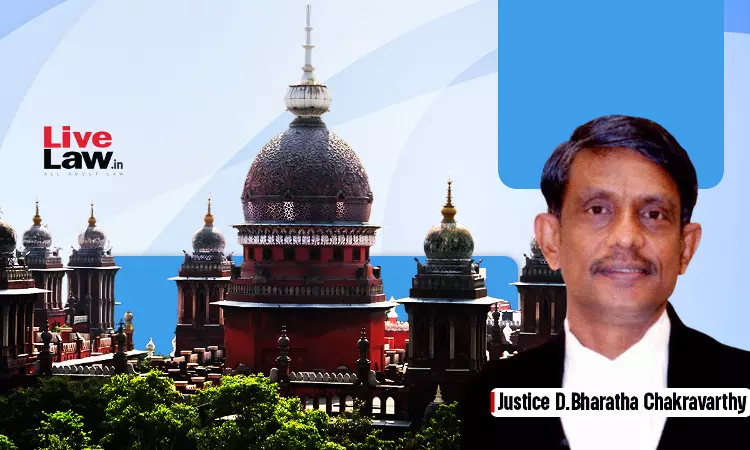
The Madras High Court recently held that a person's Overseas Citizen of India (OCI) registration can be cancelled if the person is involved in preaching or missionary activities without specifically seeking permission for the same. [2026 LiveLaw (Mad) 515] Justice Bharatha Chakravarthy thus refused to grant relief to a man who had come to India on OCI registration and was...
This is a premium content
Available exclusively to
Our subscribers
Subscribe Premium 
INR 1099+GST
Your support helps us to bring you more content at
an affordable subscription scheme !!!
All payment options available
The Madras High Court recently held that a person's Overseas Citizen of India (OCI) registration can be cancelled if the person is involved in preaching or missionary activities without specifically seeking permission for the same. [2026 LiveLaw (Mad) 515]
Justice Bharatha Chakravarthy thus refused to grant relief to a man who had come to India on OCI registration and was engaged in missionary activities.
“There can be no contrary claim if the petitioner violates any provision of law, including S.O.1050(E) issued by the Central Government in exercise of its power under Section 7B of the Act that his OCI registration is liable to be cancelled. If the petitioner preaches and undertakes activities to spread the word of 'God', such activities would fall within the meaning of missionary activity. Therefore, he ought to have obtained special permission in that regard. He has not obtained such permission. Therefore, considering the nature of the allegations made against the petitioner, the cancellation stands justified,” the court said.
The court was hearing a petition filed by a man, John Daniel, challenging an order passed by the Foreigners Regional Registration Officer-cum-Civil Authority, by which his OCI registration was cancelled.
According to Daniel, he was a US citizen and was granted OCI registration on February 2015. He submitted that he used to visit India for personal and family-related purposes. It was submitted that his 92-year-old mother, sister, cousins and other relatives lived in India. He thus claimed that he had been visiting India to meet, support, and attend to the needs of his aged mother as a dutiful son.
Daniel argued that he had not violated any law governing OCI cardholders and denied being involved in any missionary activities or religious conversions. The petitioner also argued that though he had been alleged of conducting conversion, the authorities had not identified any date on which the activities were allegedly undertook or the persons who were compelled. He also argued that he was not given an opportunity to be heard before the order of cancellation was passed.
The Central Government, on the other hand, submitted a set of materials which showed that the petitioner was a missionary attached to an organisation, the Laymen's Evangelical Fellowship. The government also produced posters which showed that the petitioner had been delivering speeches in religious meetings in Andhra Pradesh and other materials relating to the missionary activities undertaken by the petitioner.
The court noted that as per Section 7D of the Citizenship Act 1955, the government could cancel the registration if the cardholder had violated any provisions of the Act or any other law as may be specified by the Central Government by notification in the Official Gazette. The court also noted that as per S.O.1050(E) under Section 7B, the Government had made it mandatory to obtain prior permission to undertake any missionary, public, mountaineering, or journalistic activities.
The court noted that though the petitioner had claimed violation of principles of natural justice, this principle was not a straight-jacket formula, and its application depended on the facts of the case. The court noted that if the authorities had relied on only one or two incidents, the principle could have been followed and petitioner could have been given opportunity.
However, in the present case, the court noted that the petitioner was a professional missionary who spreads the word of 'God' in relation to his religion. The court noted that though the petitioner had denied the allegation, substantial materials had been produced against him indicating that he has consistently been addressing congregations, gatherings and meetings at various places in Tamil Nadu and Andhra Pradesh. The court noted that not just conversion but even a missionary activity would require prior permission from the authorities and the petitioner's claim that he was not involved in any missionary activities was a lie.
Thus, considering all the materials, the court was not inclined to interfere with the order. The court made it clear that the petitioner could apply for a regular visa if he wanted to visit his mother. However, for conducting meetings and religious purpose, the petitioner was to obtain requisite official permission.
Counsel for Petitioner: Mr. R. Shanmuga Sundaram Senior Counsel Assisted by Ms. A. G. Shakeenaa for Mr. R. Vinayaga Vishnu
Counsel for Respondents: Dr. S. Padma Senior Panel Counsel
Tags

Upasana Sajeev
Upasana Sajeev is a Principal Correspondent with LiveLaw, covering Madras High Court

