



- Home
- /
- High Courts
- /
- Madras High Court
- /
- Places Of Worship Act Does Not...
Places Of Worship Act Does Not Protect Encroachment By Temple On Government Land: Madras High Court
Upasana Sajeev
13 Feb 2026 2:26 PM IST
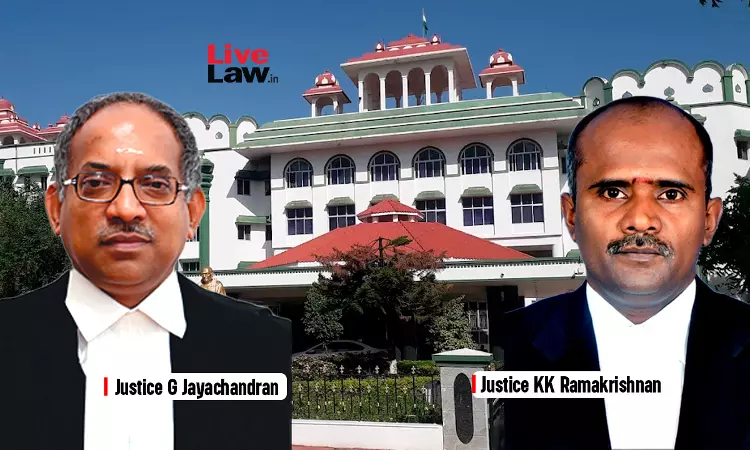
The Madras High Court recently dismissed a plea by the Managing Trustee of Sri Arulmighu Raajakaliamman Temple in Ramanathapuram District of Tamil Nadu, claiming protection for the temple which was allegedly built on an encroached land. Rejecting the claim that the ancient temple was protected under the Places of Worship Act, the bench of Justice G Jayachandran and Justice KK Ramakrishnan...
This is a premium content
Available exclusively to
Our subscribers
Subscribe Premium 
INR 1099+GST
Your support helps us to bring you more content at
an affordable subscription scheme !!!
All payment options available
The Madras High Court recently dismissed a plea by the Managing Trustee of Sri Arulmighu Raajakaliamman Temple in Ramanathapuram District of Tamil Nadu, claiming protection for the temple which was allegedly built on an encroached land.
Rejecting the claim that the ancient temple was protected under the Places of Worship Act, the bench of Justice G Jayachandran and Justice KK Ramakrishnan held that the Act was only meant to protect the religious character of temples and not to protect a structure that was put up on Government land by encroaching.
“Likewise, the Places of Worship (Special Provisions) Act, 1991 is enacted to prohibit conversion of any place of worship and to provide for the maintenance of the religious character of any place of worship, as it existed on the 15th day of August, 1947, and for matters connected therewith or incidental thereto. Neither the intention of the legislation nor any provision in this Act gives protection to a structure put up on the Government Land by encroaching,” the court said.
The court was hearing the plea by N Kumar, managing trustee of the temple. It was alleged that the temple was situated on a bund of water body (Orruni) classified as Orruni Poramboke Road as per the revenue records.
The Commissioner of Ramanathapuram District had issued a notice under Section 128 of the Tamil Nadu Local Bodies Act for removing the encroachment within 7 days. This notice was challenged by the trustee in an earlier litigation arguing that the temple had been in existence even before his birth.
The court however dismissed this petition noting that the trustee should have made appropriate representation to the authorities if he had any reason to continue possession. After dismissal of the plea, the trustee made representation to the Tahsildar, Ramanathapuram seeking patta for the land citing a Government Order issued by the Revenue and Disaster Management Department. He also made representation to the Commissioner, Ramanathapuram, to desist from taking any action of removal, since he had sought for patta and his request is pending consideration.
Meanwhile, the authorities issued final notice under Section 128 of the Act prompting the Trustee to approach the court with the present plea.
The trustee claimed that the temple has been in existence since time immemorial without any hindrance and disturbance. It was also pointed out that the management was paying tax for the temple building and electricity was also being supplied. It was argued that the notice was issued without following the principles of natural justice and thus was violative of Articles 14, 25, 26 and 300-A of the Constitution. Claiming that the temple was protected under the Places of Worship Act, the trustee also argued that the authorities could not proceed with the eviction.
The authorities, on the other hand, resisted the plea and argued that the temple was constructed without permission on a bund of water body which was being used by the public. It was also argued that payment of tax or grant of electricity connection does not grant any right on the encroacher to seek patta.
The authorities also argued that the temple could not seek the benefit of the Government Order since it was for regularising residential encroachment. The authorities further argued that Places of Worship Act would not have any relevance in the present plea.
The court, after hearing the parties, concluded that the temple was constructed without permission on encroached land. Since it was a non-residential structure, the court observed that the Government Order would not be applicable in the present case. The court emphasised that the authorities could not grant patta for a land on a water body obstructing pathway.
The court also noted that the Places of Worship Act would not be applicable in the present case and reliance on the same was misled. Thus, the court dismissed the plea.
Counsel for Petitioner: Mr.Niranjan S.Kumar
Counsel for Respondent: Mr. S. R. A. Ramachandran Additional Government Pleader, Mr.K.Saravanan, Mr.G.Gnanasekaran Government Advocate (Crl.side)
Case Title: N.Kumar v. District Collector and Others
Citation: 2026 LiveLaw (Mad) 65
Case No: W.P.(MD)No.2646 of 2026
Tags

Upasana Sajeev
Upasana Sajeev is a Principal Correspondent with LiveLaw, covering Madras High Court

