



- Home
- /
- High Courts
- /
- Madras High Court
- /
- Madras High Court Dismisses...
Madras High Court Dismisses Sanitation Worker's Challenge Against Privatization, Says Greater Chennai Corporation Should Ensure Minimum Wages
Upasana Sajeev
21 Aug 2025 11:15 AM IST
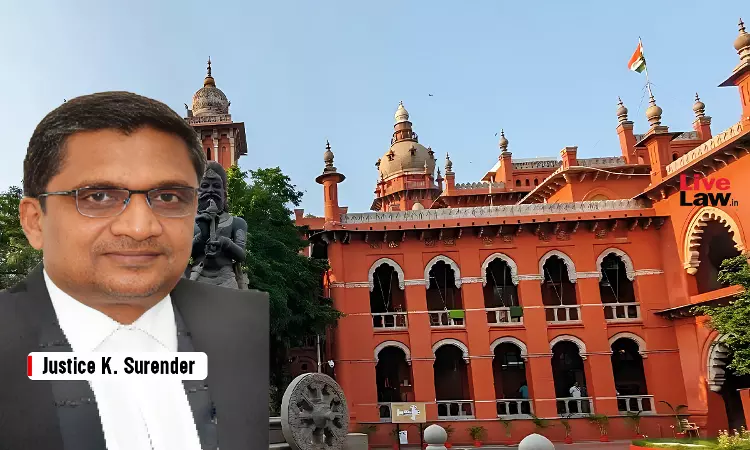
The Madras High Court has rejected a plea by the Greater Chennai Corporation's sanitation worker challenging the Corporation's resolution to outsource the sanitation work in two of its zones to private companies. Justice K Surender noted that privatizing the sanitation work is a policy decision of the government and when the decision did not violate any provisions of law, it could not...
This is a premium content
Available exclusively to
Our subscribers
Subscribe Premium 
INR 1099+GST
Your support helps us to bring you more content at
an affordable subscription scheme !!!
All payment options available
The Madras High Court has rejected a plea by the Greater Chennai Corporation's sanitation worker challenging the Corporation's resolution to outsource the sanitation work in two of its zones to private companies.
Justice K Surender noted that privatizing the sanitation work is a policy decision of the government and when the decision did not violate any provisions of law, it could not be quashed.
“Privatising the sanitary work of the Zones in GCC is a policy decision taken in the interest of improvement of sanitary conditions and also waste management. In the present scenario, when the Government has taken decision to privatise the acts of Solid Waste Management and sanitary work for keeping the city clean, such Resolution which does not violate any provision of law nor unconstitutional, the question of quashing the impugned Resolution does not arise,” the court said.
The court also noted that the change brought in by the government was to improve the quality of the sanitation and Solid Waste Management. The court also added that such economic policies were not amenable to judicial review unless it was contrary to the statutory policies or the Constitution.
“A Full Bench of the Hon'ble Supreme Court in Balco's case, referred to supra held that in any democracy, it is the prerogative of the elected Government to follow its own policy unless any illegality is committed in execution of the policy or such policy is contrary to the law or mala fide. The change brought in by the Government as a policy decision cannot be interfered with by the Courts. Further, such economic policies are not amenable to judicial review unless such policy is contrary to any statutory provision or Constitution,” the court said.
The court made the observations in the plea made by Uzhaippor Urimai Iyakkam which was a General Workers Union organizing the unorganized workers throughout the State. The organization had challenged the resolutions made by the Greater Chennai Corporation through which a decision was taken to outsource the sanitation work in Zone 5 and 6 of Chennai to Hyderabad based company M/s. Delhi MSW Solutions Ltd.
The court was also informed that an industrial dispute with respect to the same issue was referred to the Industrial Tribunal.
The petitioner organization submitted that since the dispute was pending, the Corporation should have taken prior permission for outsourcing the work. It was also argued that the outsourcing has affected more than 2000 workers and their livelihood was in jeopardy.
The petitioner organization also argued that the outsourcing was in the nature of retrenchment and thus the workers should have been given three months notice and the conditions laid down in Section 25N of the ID Act have to be followed. It was also contended that as per Section 33(1)(a) of the ID Act, the Corporation was barred from doing acts which was prejudicial to the workmen in the dispute. The court was also informed that though the private organisations have offered jobs to the workers, the salary offered is less than the minimum wage.
The State and the private company assured that the interest of the sanitary workers would be safeguarded. It was also submitted that the decision to privatize was a policy decision of the Government, and the courts could not interfere in such a decision.
While the court agreed that it could adjudicate on the policy decisions of the Government, the court added that the corporation should have taken steps to ensure that the sanitary worker rights are not infringed in any manner whatsoever. The court added that the private company was bound to do work in accordance with the agreement. The court also noted that by engaging the 2000 workers of the zone 5 and 6, the company was not extending a favor. The court noted that the workers were already trained and working for the GCC since several years.
The court remarked that in a democracy, the elected government was at liberty to take policy decisions, it had a bounden duty to ensure that no section of the people are adversely affected by such decisions. The court added that the Corporation, thus, should have ensure that the sanitary workers working for the private companies were paid minimum wages and their last paid wages by the GCC, if not more.
The court also noted that there was no question of retrenchment since the workers were not terminated from their services.
The court thus directed the State to negotiate with the private company and ensure that the sanitary workers are paid their last drawn wages, if they intended to join the private company.
Counsel for Petitioner: Mr. S. Kumaraswamy
Counsel for Respondents: Mr. P. S. Raman Advocate General assisted by Mr. E. C. Ramesh Standing Counsel, Mr.Vijaynarayanan, senior Advocate for Mr.R.Muthukrishnan
Case Title: Uzhaippor Urimai Iyakkam v. The Commissioner and Others
Citation: 2025 LiveLaw (Mad) 279
Case No: Writ Petition Nos. 29045 and 29050 of 2025
Tags

Upasana Sajeev
Upasana Sajeev is a Principal Correspondent with LiveLaw, covering Madras High Court

