



- Home
- /
- High Courts
- /
- Madras High Court
- /
- Madras High Court To Hear Tomorrow...
Madras High Court To Hear Tomorrow Habeas Corpus Plea Challenging Savukku Shankar's Detention Under Goondas Act
Upasana Sajeev
20 May 2026 12:35 PM IST
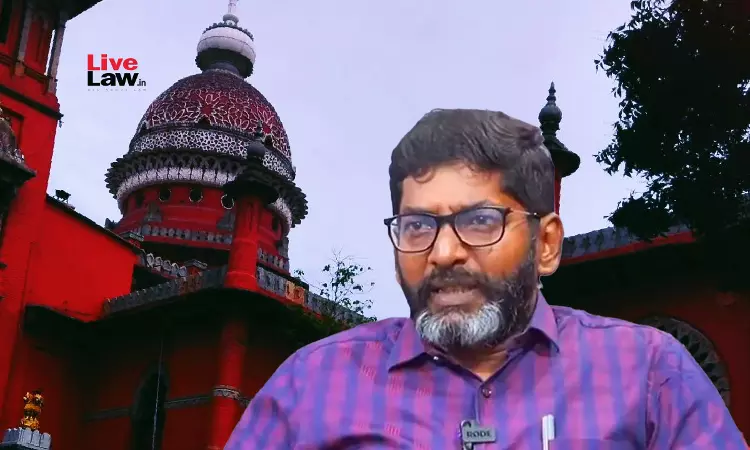
The Madras High Court is likely to hear tomorrow a habeas corpus plea filed by nephew of Youtuber Journalist Shankar alias Savukku Shankar challenging his detention under the Tamil Nadu Goondas Act.When the plea came up before the vacation bench of Justice GR Swaminathan and Justice V Lakshminarayanan today, the Additional Public Prosecutor Muniapparaj requested the court to adjourn the plea by...
This is a premium content
Available exclusively to
Our subscribers
Subscribe Premium 
INR 1099+GST
Your support helps us to bring you more content at
an affordable subscription scheme !!!
All payment options available
The Madras High Court is likely to hear tomorrow a habeas corpus plea filed by nephew of Youtuber Journalist Shankar alias Savukku Shankar challenging his detention under the Tamil Nadu Goondas Act.
When the plea came up before the vacation bench of Justice GR Swaminathan and Justice V Lakshminarayanan today, the Additional Public Prosecutor Muniapparaj requested the court to adjourn the plea by a day, since the new State Public Prosecutor would be appearing in the case. Accepting the request, the court adjourned the plea until tomorrow.
It may be noted that Shankar was classified as a Goonda and detained under the Act by an order of the Commissioner of Police on April 9, 2026. The ground case, based on which the detention order was passed, is an attempt to murder case. Another vacation court has granted Shankar bail in the ground case.
In his plea, Shankar's nephew Bharath submitted that Shankar was innocent and falsely implicated in the ground case. It is submitted that the ground case was foisted against him only to detain Shankar and silence him for his journalistic and whistleblowing activities. It is submitted that the detention order was passed mechanically, without any application of mind.
Bharath submitted that repeatedly implicating Shankar in false and vindictive cases showed that the preventive detention mechanism was being misused for punitive purposes, which was impermissible in law.
It is submitted that even if the ground case was taken to be true, it would, at best, only amount to a law and order issue and would not have any bearing on public order. It is submitted that the allegations were confined to police officials allegedly involved in the occurrence, and there was no material to establish disturbance to public life or any panic affecting the community at large. It is thus argued that a routine criminal allegation has been exaggerated into one affecting public order and the sponsoring authority has improperly invoked the provisions of the preventive detention law.
Bharath also pointed out that due to the Elections and the consequent change of the ruling party and formation of a new government, his representation was not considered and no Advisory Board was set up. Thus, he claimed that there was an urgency in the case, warranting interference by the court.
He also submitted that, though a plea was moved before the Supreme Court, the court permitted him to withdraw the case and approach the High Court.
While the case is pending before the High Court, the Tamil Nadu government has revoked the detention order passed against Shankar. In a government order issued on May 19, the Home, Prohibition and Excise (XIII) Department informed that an advisory board had unanimously expressed the opinion that there was no sufficient cause for detaining Shankar, and as such, revoked the detention order. Shankar was thus ordered to be released unless he was detained under any other law or was serving any sentence after being convicted by the court.
Case Title: Bharath v The Additional Chief Secretary
Case No: HCP 937 of 2026
Tags

Upasana Sajeev
Upasana Sajeev is a Principal Correspondent with LiveLaw, covering Madras High Court

