



- Home
- /
- High Courts
- /
- Madras High Court
- /
- Madras High Court Dismisses Habeas...
Madras High Court Dismisses Habeas Corpus Plea Over Savukku Shankar's Solitary Confinement, Declines To Direct His Surrender
Upasana Sajeev
24 March 2026 2:53 PM IST
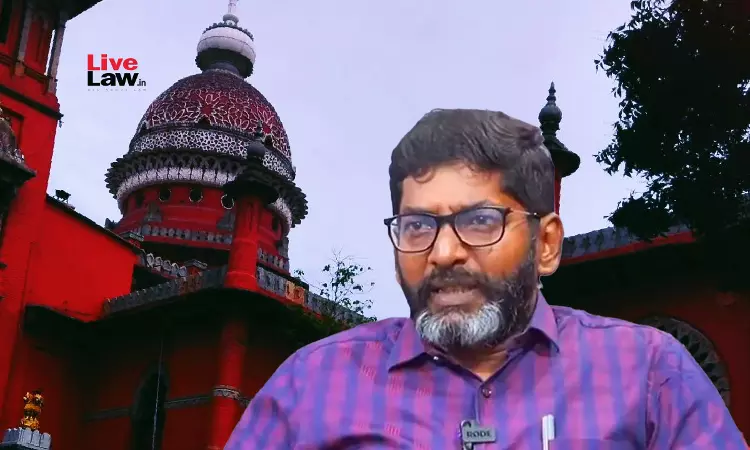
The Madras High Court on Tuesday (March 24) dismissed a habeas corpus petition filed by Kamala, the mother of YouTuber Journalist Savukku Shankar, challenging his solitary confinement in prison during his incarceration in December 2025 in connection with an alleged extortion case. Significant to note that Shankar is currently out on interim bail in the matter.The court also disposed of a...
This is a premium content
Available exclusively to
Our subscribers
Subscribe Premium 
INR 1099+GST
Your support helps us to bring you more content at
an affordable subscription scheme !!!
All payment options available
The Madras High Court on Tuesday (March 24) dismissed a habeas corpus petition filed by Kamala, the mother of YouTuber Journalist Savukku Shankar, challenging his solitary confinement in prison during his incarceration in December 2025 in connection with an alleged extortion case.
Significant to note that Shankar is currently out on interim bail in the matter.
The court also disposed of a petition filed by her seeking specialised medical treatment for him in prison.
The bench of Justice P Velmurugan and Justice M Jothiraman also dismissed as infructuous an application filed by Shankar seeking review of the additional bail conditions imposed on him.
Though the Additional Public Prosecutor informed the court that the interim bail granted to Shankar would expire on 25th March (tomorrow), and he may be directed to surrender before the police, the court made it clear that it could not issue such directions, and it was for the police to take steps against him if he did not surrender.
"How can we issue such a direction. In the interim order, we can maybe say that subject to directions in the main order, but how can we make a direction in the main order regarding the interim order? The main plea itself is disposed of," the court remarked orally.
Shankar was arrested on 13th December in connection with an offence under Sections 296(b), 353(lxc), 308(5), 61(2) and 351(3) of the Bharatiya Nyaya Sanhita, 2023. It was alleged that Shankar had extorted money from a film producer.
It may be noted that in December last year, a division bench of the court granted temporary bail to Shankar, taking note of his health condition and the repeated prosecutions by the State, which infringed his personal liberty.
In January, however, the Inspector of Police, Saidapet, approached the court seeking to cancel the interim bail granted to Shankar. The police argued that Shankar had been misusing the liberty granted by the court and was not in need of continuous medical treatment.
Though the bench had observed that Shankar's conduct had the potential to prejudice the investigation and was outside the ambit of protected speech, the court was not inclined to cancel his interim bail, considering his medical condition. The court instead imposed additional conditions on his bail and called for the setting up of a Medical Board to assess his health condition and file a report. Following the court order, a medical board was constituted by the Rajiv Gandhi Government General Hospital and the report was filed before the court.
The court had also asked both parties to file their submissions/objections regarding the medical assessment report. The State filed its objection, stating that Shankar's claim of requiring continuous specialised medical treatment was only a ruse to escape the clutches of law.
When the matter was taken up after this, Senior Advocate V Raghavachari argued that Shakar had only talked about running a bar illegally, and instead of investigating into the issue, the police had arrested Shankar, who was only a whistleblower. Wondering how the police could assist the criminal, he argued that all the allegations in the second complaint were made only to recall the interim bail granted to Shankar.
With respect to the medical board's report, it was argued that the medical board had not even enquired about Shankar's medical history or about the treatments that he was already taking. He argued that in prison, there were no proper facilities for the treatment of cardiac ailments.
The APP, on the other hand, submitted that the police can give an undertaking that Shankar would be taken to the hospital if he required any kind of treatment. He argued that even after getting interim bail, when Shankar went to the Hospital, he was treated as an outpatient and given tablets, which would show that there was nothing serious about his medical condition.
The APP argued that the investigation was being hindered due to Shankar's conduct, where he was continuously posting videos about the investigation. He also pointed out how Shankar had been making derogatory comments against the investigating officer and calling him names.
After hearing the parties, the court had reserved orders.
Counsel for Petitioner: Mr G. Purushothaman For Mr L. Christopher
Counsel for Respondent: Mr.R.Muniyapparaj Additional Public Prosecutor Assisted by Mr.M.Sylvester John Advocate
Case Title: A Kamala v. Inspector of Police and Others
Citation: 2026 LiveLaw (Mad) 129
Case No: HCP 2754 of 2025
Upasana Sajeev
Upasana Sajeev is a Principal Correspondent with LiveLaw, covering Madras High Court

