



- Home
- /
- High Courts
- /
- Madras High Court
- /
- Spouses Can't Be Compelled To...
Spouses Can't Be Compelled To Continue Broken Marriage For Welfare Of Children: Madras High Court
Upasana Sajeev
13 Oct 2026 1:38 PM IST
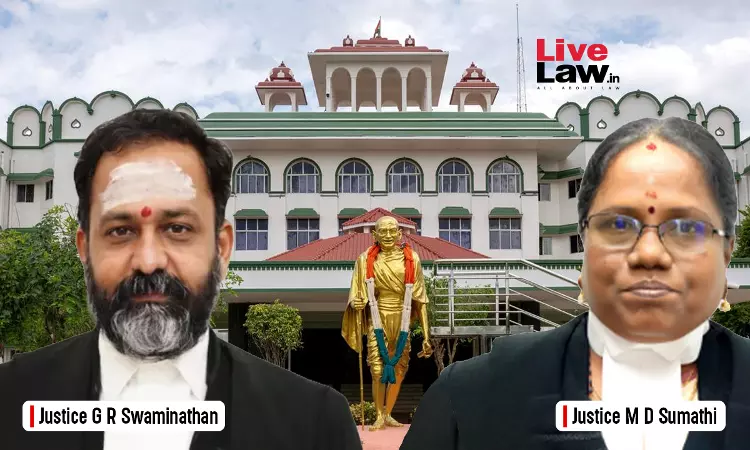
Court said it has to balance the welfare of children with the realities of matrimonial relationship.
The Madras High Court recently held that a couple should not be forced to continue a matrimonial relationship, which has become unworkable, merely for the welfare of the child. [2026 LiveLaw (Mad) 500] “There can be no dispute that the welfare of children is an important consideration in matrimonial proceedings. However, the welfare of children cannot be understood to mean that...
This is a premium content
Available exclusively to
Our subscribers
Subscribe Premium 
INR 1099+GST
Your support helps us to bring you more content at
an affordable subscription scheme !!!
All payment options available
The Madras High Court recently held that a couple should not be forced to continue a matrimonial relationship, which has become unworkable, merely for the welfare of the child. [2026 LiveLaw (Mad) 500]
“There can be no dispute that the welfare of children is an important consideration in matrimonial proceedings. However, the welfare of children cannot be understood to mean that parties should necessarily be compelled to continue a matrimonial relationship which has ceased to be workable,” the court said.
Justice GR Swaminathan and Justice MD Sumathi observed that the court was expected to balance the welfare of the child with the realities of the matrimonial relationship. The court added that when the relationship between the parents loses cordiality and turns into constant discord, the four walls of the home cease to become a home for the child.
The court also remarked that though the child may have all material facilities, if he has to witness his parents standing as strangers under the same roof, he would not get a peaceful life. The court added that the child often becomes a silent sufferer in such a broken emotional environment.
“The child may have toys, comforts and all material facilities, but he cannot have a peaceful sleep, a joyful childhood, or a sense of belonging if every day he has to witness his parents standing as strangers under the same roof. He grows up listening not to lullabies, but to arguments; he sees not affection, but indifference. In such a broken emotional environment, the child becomes a silent sufferer - confused, insecure and torn between two people he loves most,” the court said.
The court thus emphasised that it was not enough to give a house for the child to live in and what the child truly needed was a home built on mutual respect, love and cordiality between parents.
“It is therefore not enough to give a child a house to live in. What a child truly needs is a home, a home built on mutual respect, love and cordiality between his parents. Without that cordial bond between father and mother, there can be no peace in the child's heart, and without peace in his heart, there can be no healthy growth in his life,” the court remarked.
The court was hearing an appeal filed by a husband challenging an order of the Family Court which allowed the wife's plea for divorce and dismissed the husband's plea for restitution of conjugal rights.
The parties had married in 2005 and were blessed with 2 children. The wife had filed for divorce on the ground of cruelty. The wife alleged that from the inception of marriage, the husband had subjected her to physical violence and mental cruelty. She alleged that the husband suspected her fidelity and assaulted and harassed her.
The husband resisted the plea and submitted that he had taken care of the wife and the kids. He submitted that the wife had developed an illicit relationship with his cousin, who had stayed in their house as a guest. He further submitted that the wife had left the matrimonial home with the cousin and, after the husband lodged a police complaint, she came back and assured that she would live with the husband.
The husband also alleged that the wife had caused injury to herself and lodged a false police complaint alleging that the husband had caused cruelty. However, the husband claimed that he was willing to forgive the wife and take her back for the welfare of the children and thus sought restitution of conjugal rights.
The family court noted that though the husband claimed he was willing to accept the wife, the allegations of infidelity had been known to the family members and local community, which would affect the day-to-day matrimonial relationship. The court also noted that there was no possibility of the parties living together and the relationship had reached a stage where continuation was practically impossible. The Family Court thus allowed the divorce plea.
Challenging this order, the husband argued that the finding of the Family Court was based on assumptions and presumptions. He also argued that the Family Court failed to consider the welfare of the children and ought to have provided an opportunity for the parties to resume the matrimonial life.
The High Court observed that the husband's willingness to take back his wife could not, by itself, establish a workable matrimonial relationship. The court made it clear that the matrimonial relationship could not be revived merely by a unilateral expression of willingness when the circumstances disclose that the basic foundation of the relationship has been seriously eroded.
Noting that the mutual trust between the parties had broken in the present case, the court held that the conclusion of the Family Court regarding no possibility of resuming a peaceful matrimonial life could not be faulted. The court held that the Family Court's finding was consistent with the principle that a marriage is founded upon mutual trust, respect, companionship and affection.
Thus, finding no perversity in the order of the Family Court, the court dismissed the appeal and confirmed the Family Court's order dissolving the marriage of the parties.
Counsel for Appellant: Mr. D. Malaichamy
Counsel for Respondents: Mr. M. S. Jeyakarthick
Tags

Upasana Sajeev
Upasana Sajeev is a Principal Correspondent with LiveLaw, covering Madras High Court

