



- Home
- /
- High Courts
- /
- Madras High Court
- /
- Thiruparankundram Hill Row | S.144...
Thiruparankundram Hill Row | S.144 CrPC Was Imposed To Preserve Law & Order, Not To Defy Court Orders: Madurai Collector Tells High Court
Upasana Sajeev
2 Feb 2026 5:13 PM IST
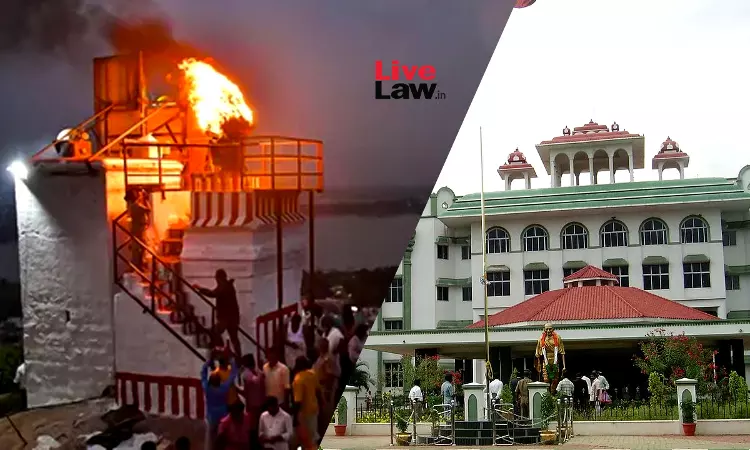
The District Collector of Madurai on Monday (February 2), told the Madras High Court that the prohibitory order under Section 144 CrPC concerning the lighting of the lamp atop the Thiruparankundram Hills was passed not to prevent implementation of court orders but to ensure that "no law and order situation" arises. The submission was made before Justice GR Swaminathan, who was hearing a...
This is a premium content
Available exclusively to
Our subscribers
Subscribe Premium 
INR 1099+GST
Your support helps us to bring you more content at
an affordable subscription scheme !!!
All payment options available
The District Collector of Madurai on Monday (February 2), told the Madras High Court that the prohibitory order under Section 144 CrPC concerning the lighting of the lamp atop the Thiruparankundram Hills was passed not to prevent implementation of court orders but to ensure that "no law and order situation" arises.
The submission was made before Justice GR Swaminathan, who was hearing a contempt petition initiated by the court over non-compliance of an earlier order directing the lighting of Karthigai Deepam at the Deepathoon (stone pillar) atop the Thiruparankundram Hills. The officers also tendered their unconditional apology and requested that the contempt proceedings be dropped.
It may be noted that on December 1, the single judge ordered the management of Arulmighu Subramaniya Swamy Temple to light the lamp at 6pm on December 3rd. A contempt petition was then moved by the Petitioner on December 03, alleging that no arrangements had been made to comply with the order. The judge then permitted the petitioner-devotee, along with 10 more persons, to light the lamp themselves. It also asked the CISF to give protection to the Petitioners.
However, when the devotees went to light the lamp, they were restricted by the authorities. The collector imposed a prohibitory order, and the Commissioner of Police, in view of the prohibitory order, refused to allowthe lighting of the lamp. This prohibitory order was later quashed by the single judge.
Earlier, the court had also summoned senior police and revenue officials and issued a notice to the State for allegedly disregarding the directions by citing policing and public safety concerns over large gatherings.
On December 17, the court had directed the Chief Secretary to file detailed affidavits, by taking a responsible stand, explaining the reasons for non-compliance of the order.
In the previous hearing, the court remarked that there were three types of contempt involved in the present case. Firstly, the disobedience of the court's first order. Second, the issuance of a prohibitory order under Section 144 CrPC, and third, even after knowing that the prohibitory order was quashed the officers had the audacity to resist its implementation.
Criticising the conduct of the officers, the judge said that he could not forgive the District Collector issuing a prohibitory order for frustrating the court's order and the officer resisting the implementation of the order even after quashing the prohibitory order. The court said that the officers, till date, had not shown any remorse.
When the matter was taken up today, the District Collector, the Commissioner of Police, and the Deputy Commissioner of Police had filed their affidavits explaining that there was no willful disobedience of the court order. The court was informed that though the court had permitted only the Executive Officers of the temple to light the lamp, the devotees started coming to the area in large numbers, and the situation went out of hand. The officers explained that the prohibitory order was passed only to prevent possible law and order situation.
Senior advocate V Giri appearing for the officers said, "Persons who have not been given such right started gathering in thousands and wanted to do it (light lamp). Maybe to accompany the Executive Officer. Then situation started getting out of hand...It's easier to now say that the situation could have been handled better. But at that point of time, the crowd had to be controlled otherwise things wouldn't have worked out. At that time, only a prohibitory order could have ensured implementation of court order".
The court, however, orally raised concern about the manner in which one of the officers, the Commissioner of Police, had responded while preventing persons from climbing the hills to light a lamp. Reading from a recent article in a magazine, the court said that the officer had said he was "ready to face the consequence".
To this, Giri and Additional Advocate General J Ravindran and Additional Advocate General Veera Kathiravan submitted that if any officer had made such a statement, the court could directly question in the officer, who was in the court. The counsels submitted that the court could then find out if such a statement was made or in what context it was made.
After hearing the counsels, the court said that while it was convinced with respect to the other officers, it still had concerns with the manner in which the District Collector had acted and passed a prohibitory order despite the court direction. Giri requested the court to grant additional time, permitting the Collector to file an additional affidavit explaining his position.
After hearing the matter for some time the court adjourned the hearing to March 2. The court also dispensed with the appearance of the other officers except the District Collector.
Case Title: Rama Ravikumar and Another v. KJ Praveen Kumar IAS and Others
Case No: CONT P(MD) Nos.3594 & 3657 of 2025 in W.P.(MD)Nos.32317 & 33197 of 2025
Tags

Upasana Sajeev
Upasana Sajeev is a Principal Correspondent with LiveLaw, covering Madras High Court

