



- Home
- /
- High Courts
- /
- Madras High Court
- /
- 'State Not Secular, Tilted Against...
'State Not Secular, Tilted Against Us': Devotees Urge Madras High Court Not To Relegate Thiruparankundram Deepam Issue To Authorities
Upasana Sajeev
17 Dec 2025 5:17 PM IST
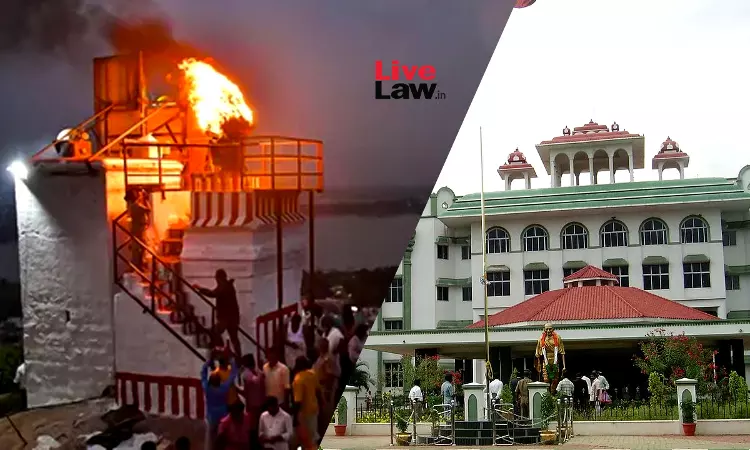
Opposing the appeal preferred by State and Madurai authorities against single judge's order directing lighting of a lamp at the stone pillar in Thiruparakundram Hills, the devotees urged the Madras High Court on Wednesday (December 17) not to relegate them to the authorities as they have "undisguised scorn and contempt towards" their faith. The devotees submitted that the State authorities...
This is a premium content
Available exclusively to
Our subscribers
Subscribe Premium 
INR 1099+GST
Your support helps us to bring you more content at
an affordable subscription scheme !!!
All payment options available
Opposing the appeal preferred by State and Madurai authorities against single judge's order directing lighting of a lamp at the stone pillar in Thiruparakundram Hills, the devotees urged the Madras High Court on Wednesday (December 17) not to relegate them to the authorities as they have "undisguised scorn and contempt towards" their faith.
The devotees submitted that the State authorities were trying to placate one set of rights instead of being secular and if relegated, the devotees did not feel that their rights would be safe in the authorities's hands.
A division bench of Justice G Jayachandran and Justice KK Ramakrishnan was hearing a batch of pleas, including those filed by the Dargah management, challenging a single judge's order directing the temple authorities to light the lamp at the stone pillar.
For context, the single judge had said that the deepathoon(stone pillar) was not located in the area that belonged to the Muslims, and thus lighting the lamp would not affect the rights of the community.
The State authorities including the Hindu Religious and Charitable Endowments (HR&CE) Department also filed an appeal challenging the single judge's order in a contempt plea on December 4th, wherein the judge quashed the prohibitory order under Section 144 CrPC. Another set of Appeals also came up before the court challenging the single judge's order of December 9 in the contempt plea, directing the appearance of the Chief Secretary, ADGP, DCP and impleading the Union Home Secretary.
State needs to be secular and protect my rights: Devotees
During the hearing Senior Advocate S Sriram appearing for respondent Paramasivam said, that the appellant's (State, authorities, dargah) argument that there has never been a practice of lighting lamp anywhere else other that Uchi Pillaiyar temple is a stand which is aimed towards "placating one set of rights and in pursuance of a clear policy or subjugation another".
"State keeps surrendering, reiterating to maintain status quo. Protect yourself. Live for another day. Don't assert your right. This is the stand of the State who is the guardian, who needs to be secular and fiercely neutral to protect my rights under Article 25," he said.
The court however orally remarked that the writ petitioners have not taken the alternative remedy and approached the court, and is now saying that the State has closed mind, adding that the State is open to an alternate remedy.
Sriram however said that the temple's executive officer (EO) and Temple Board which chose to be a spectator, is now asking the devotees to come back to it.
"It's like I've been wounded by same person and remedy can also be given by same person," he added.
Dept speaking in multiple voices, undisguised scorn & contempt towards my faith
Sriram said that the counsel arguing for temple and authorities first said there's no evidence to say it's a deepathoon, then they said that it is a granite pillar; then they said that it is an ASI structure, thereafter that it is a jain structure; and yesterday the Wakf Board argued that it belongs to them. He thus said that the appellants' arguments do not have bonafides and are made only to create a right when none exists.
"This is not a case of State resisting plea of respondents. It's the state in solidarity with the contesting respondents and the department speaking in multiple voices creating a claim. Don't send me to the (HR&CE) Commissioner who has undisguised scorn and contempt towards my faith. I don't think my rights are safe at the hands of the authorities," he said.
Devotees' right of worship part of Article 19, public order plea not a bogey
Sriram said that the right to worship is not to be concised within the confines of Article 25 but it is a dimension of the devotees right to expression under Article 19.
Referring to Justice Chelameswar's opinion in the 2017 KS Puttaswamy judgment Sriram said, "Plea of public order comes from district administration who have not voiced their grievances before the single judge. Plea of public order is not a bogey or an alibi or a gate-pass to avoid scrutiny. In relation to the higher threshold that state needs to answer to the conscience of the court, the formulation is in Shreya Singhal's case".
Duty is on State, which cannot equate itself to citizens
He said that the test is if it is something that should defeat the tempo of life of the community and the potential of realisation of such right ought to be of such an order which affects the lives or way of lives of the community at large.
"I look for pleadings, some kind of elaboration in the grounds of appeal. Except indicating that state has to preserve constitutional order and duty of public order, it is cited as a defence to wriggle out the state's constitutional duty to be a neutral arbitrator. It can't be a mere coinage in grounds of appeal or happenstance to defeat the respondents claim in a writ appeal. It's a duty on the State. Inalienable fundamental right of citizen. The State says rejection of representation is in the context of the representation itself. So therefore don't look at logic or rationale in the order when there was none in the representation. The State can't equate itself with the citizen," he added.
Sriram said that where a practice of religion is interfered by State, Articles 14, 15(1), 19, and 21 would spring into action.
Lighting lamp is "essential practice" of Hindu religion
He said that the State was submitting that right to religion ought to be subordinated by public order.
At this stage the court orally asked, "How are they interfering by saying don't light lamp? Argument of public order is also exaggerated. But your argument also..."
Sriram however said that lighting of lamp is an "essential practice of Hindu religion" and the State was contesting that this right to worship at this particular location is not right under Article 25.
"In one breath they're saying this and in another breath saying it's against public order," he added.
Sriram further said that in writ proceedings, if the state of affairs which are to be agitated is known to both parties, and both parties are aware of the substance in lis, then framing of issues or deficiency/inadequacy in pleading cannot be pleaded as extenuating factor by aggrieved party.
Sriram says the parties were aware of what was sought for in adjudication, including the location. He said that his client, in representation had asked for lighting of lamp at the pillar on top of hill, which as per his understanding was an ideal location in view of the earlier judgments, as it was 15 meters away.
State's mind is closed & tilted towards other side
Sriram further said there is no point in asking respondent-devotees to go back to State for getting permission to light lamp
"The mind of authorities is so closed and tilted to the other side, towards subjugation of this right and enforcement of a non-existent right in behalf of contesting party that I find it unviable to go to that closed mind. The object of moksha deepam and that of lighting karthigai deepam are completely different. One is in prayer, another is in enjoyment of a right, of the bliss of god's grace coming through the lit lamps," he said.
Sriram said that the single judge had not asked the devasthanam to innovate any new practice but only to comply with the liberty that was given to them by adjudication of rival contentions in 1996
"The cause of action leading to filing of suit in 1920 was in the context of Mohammedans claiming ownership over the entire hill. It was in the context of the temple's ownership and possession being disturbed on account of what can be described as creeping encroachment, insidious encroachment that was continuing till 2011. Temple was required to protect its ownership right. There's a paragraph (in 1920 order) noting attemps to have lamp lit at hilltop in 1862 and 1912. For the commissioner to now limit his understanding of custom to the vintage of only 100 years, is a closed mind I can't breach," he said.
Sriram said that this was not a case where a new custom is created but one where the temple and Commissioner did not want to act in pursuance of the liberty in the 1996 order
Sriram said the order by the single judge was reasoned order and it was a "textbook case of exercise of powers of judicial review, not on whims and fancies of the judge".
State trying to complicate issue
He said that the State's entire attempt is to complicate the subject matter and then "sweetening it with an offer of mediation".
"Something was said by Wakf board on apprehension of encroachment. It's the stand of other side claiming entire hill, asking for animal sacrifice. No religion should have colour. This court found that hills were painted in green & ASI was requisitioned into subject matter. The shifting of flag staff, the resistance to allow me to use the 4 steps..." he said.
He further argued that the State was attempting to change the religions nature of the hill going against the provisions of Places of Worship Act.
Sriram referred to Section 3D of the Waqf (Amendment) Act, 2025 which says any declaration or notification of wakf property would be void with respect to protected monument/area. He aid that Dargah can be heard as contesting party but Wakf would not be a party in light of the notification.
He also cited Ancient Monument and Archaeological Sites and Remains Rules 1959, which prohibits certain activities at protected sites.
The court orally asked if it bypass the process. To which Sriram said if there was any other imponderable reconsideration which may yield a result on objective application of mind, then only the matter can be relegated.
He further said that there was no violation of principles of natural justice in single judge's order and if there was strategic ommission/silence during adjudication which has been brought in appeals, it cannot be used as a barometer.
Toxic Mental cruelty
On the offer of mediation Sriram said, "Them wounding and then asking us to come back and discuss is toxic mental cruelty. It's a strategy. Every conciliation ended with petitioner side giving up more, surrendering more, retreating a little back. The authorities under Act who have to preserve me violate me in more grounds than ever done by the contestant during the course of the suit. I'm not safe in their hands. Don't send me back to mediation".
Meanwhile Senior Advocate Valliappan appearing for another devotee Rama Ravikumar said that lighting of Karthigai deepam is an essential religious practice amongst Hindus.
"It's lit for very many reasons. It's a manifestation of God. Secondly, everyone in village can see. Third, at that time there was no electricity, so lighting had its own significance. A mountain can have multiple peaks. There are mountains with dual peak. In this case, there are 2 peaks even as per photographs. Appropriate place for lighting would have been the peak that's occupied by dargah. For some reasons, the temple lost its highest peak. Therefore, next lower peak is selected," he said.
Valliappan said that the appellants have not produced any document or material to show that it's not a deepathoon but a jain pillar or survey stone or granite stone. Valliappan argued that the Deepam can be lit up anywhere because it's an essential religious practice and it is "sacred to Murugan".
Lighting lamp will foster peace
Valliappan said, "Just one day you permit 10 persons to go & light. They can go with police , light & come. It will foster peace. Won't harm anyone. It won't influence the constitutional right of any other religion".
He argued that the 1920 order had said that the plaintiff was owner of the entire hill except that portion which was given to Mohammedans. He says the appellants cannot say they own the entire hilltop.
Valliappan referred to portions from the animal sacrifice order which notes that traditional steps leading upto the Nellithope belongs to the temple.
"This order captures the fact that the Dargah is using the flight of steps to reach Nellithope. Now it's not right for them to say that using the steps to deepathoon will affect their constitutional right. Especially when they're using our steps," he added.
Worshipper has right to approach single judge
On the issue of maintainability of the petition before single judge, Valliappan referred to single judge's order submitting that worshipper has a right to invoke the jurisdiction.
Valliappan cites orders of Supreme Court which says that mere availability of alternative remedy would not oust jurisdiction of HC making it not maintainable.
"The judge did not decide anything new. He went by the earlier orders, the decree and Justice Kanagaraj's order. He went by respective pleadings and certain things which were not argued. We've been arguing for 3-4 days now. Your lordship may give some reason which we may not have imagined. But for that we can't go to the SC and attack the judge. Judge knows what to do," he added.
Mediation cannot be at mercy of anybody
On mediation he said "If your lordship wants mediation, we're okay. But it can't be at the mercy of anybody. Your lordship can keep the matter pending mediation. No difficulty. As long as peace exists. What disturbs me greatly is not the objection from the wakf or the dargah. It's the opposition from within that hurts".
Valliappan said Section 63 of HR&CE Act is not applicable to this case as the devotee (Rama Ravikumar) is not seeking a relief for himself
The court however said, "for (Section) 63 you're saying he's not seeking relief for himself. But for writ petition you're saying its individual case. If it's not individual, you should've filed it as PIL before bench".
At this stage advocate general PS Raman remarked, "I'm not sure I heard him correctly. He's saying that he's actually seeking a prayer for entire world. That's what I heard".
To this the court said that it had also heard the same. Valliappan however said that when people didn't perform their duty, the devotee came before the court.
The court also orally said that cannot now go into the Wakf Board's submission regarding mediation as the respondents-devotees have raised an argument that board can't be a party (in light of the area being a protected monument)
The matter is listed on Thursday wherein in the Advocate General is expected to make rejoinder submissions.
Upasana Sajeev
Upasana Sajeev is a Principal Correspondent with LiveLaw, covering Madras High Court

