



- Home
- /
- High Courts
- /
- Madras High Court
- /
- Devotees Have No Legal Right To...
Devotees Have No Legal Right To Light Lamp At Thiruparankundram, Article 226 Power Can't Change Custom: State Tells Madras High Court
Upasana Sajeev
12 Dec 2025 4:31 PM IST
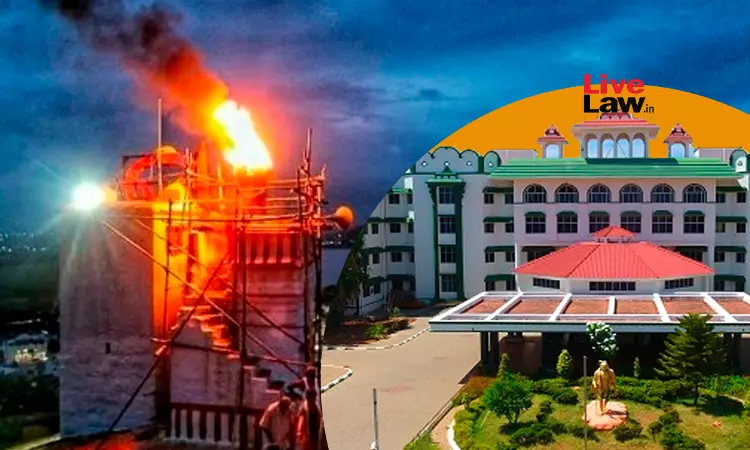
The Tamil Nadu authorities told the Madras High Court (Madurai bench) on Friday (December 12) that devotees who moved the single judge seeking lighting of the lamp at Thiruparakundram Hills could not have claimed the same as a legal right, and Article 226 powers cannot be used to change a custom in existence for a long time. The division bench of Justice G Jayachandran and Justice KK...
This is a premium content
Available exclusively to
Our subscribers
Subscribe Premium 
INR 1099+GST
Your support helps us to bring you more content at
an affordable subscription scheme !!!
All payment options available
The Tamil Nadu authorities told the Madras High Court (Madurai bench) on Friday (December 12) that devotees who moved the single judge seeking lighting of the lamp at Thiruparakundram Hills could not have claimed the same as a legal right, and Article 226 powers cannot be used to change a custom in existence for a long time.
The division bench of Justice G Jayachandran and Justice KK Ramakrishnan were hearing a batch of pleas challenging a single judge's order directing the temple authorities to light the lamp at the stone pillar.
The State authorities also filed an appeal challenging the single judge's order in contempt plea on December 4th, wherein the judge quashed the prohibitory order under Section 144 CrPC. Another set of Appeals also came up before the court challenging the single judge's order of December 9 in the contempt plea directing the appearance of Chief Secretary, ADGP, DCP and impleading the Union Home Secretary.
Devotee does not have legal right
During the hearing Advocate General (AG) PS Raman appearing for the state authorities submitted that the appeals challenged a common order in 5 writ petitions filed by devotees of the Murugan temple in Thiruparankundram which is a very ancient temple.
"The issue was regarding rights of devotees for lighting lamp at temple for Karthigai deepam. The temple itself is situated at the foothill of a small 500 foot hill. There's a dargah also in same hill. Traditionally deepam has been lit at the Uchi Pillaiyar temple. This year also it was done. However representation was made by one Rama Ravikumar to temple authorities seeking permission either for temple authorities themselves or to permit him to light deepam in a different place picked by him on what is being now called deepathoon close to a dargah," the AG said.
He submitted that the petition was not a PIL but a private interest litigation wherein court is concerned with the right of petitioner and statutory and constitutional obligation of respondent authorities.
He said, "Any other issue need not be dragged into the four corners of this room. It's for another battlefield".
The AG further said that after the petitioner's representation was rejected another petition was filed asking for a direction that either temple authorities or the devotee himself may light the lamp.
"What has to be seen is whether there was a right to demand action and whether the authorities were under duty. The fundamental question is existence of deepathoon," the AG said.
He said that since the first round of litigation in 1920, there has been no mention of the deepathoon and the petitioner devotees have to establish that lighting lamp at deepathoon was part of customary practice.
Pointing to the history of litigation the court said that in 1920 trial court had said that certain part of hills belonged to devasthanam and other part belonged to dargah and in appeal this order was reversed. He said that in a PIL filed in 1994 seeking a similar relief where court said that traditionally it's being lit at a place, didn't see any reason to change that position. Again in another plea in 2014 the court said that there was no necessity to move the lighting of lamp to any other place; this order was upheld by division bench.
He said that in the present petition the single judge asked temple authorities to light lamp at what "he described as a deepathoon, which according to him was the correct place where it should be lit".
"Of course he didn't say it should not be lit at the main place but he said in addition to that it should be lit at the other place also. This order is the subject matter of challenge before this court," he added.
AG said that there were 4 courts which had applied their minds to the issue and all reiterated the same position that deepam was being traditionally lit there and not anywhere else. He said that the settled position was that any devotee does not have any legal right to demand that lamp be lit in addition to the place where it was being lit.
A 226 can't be used to change a custom
Pointing to the December 1 order the AG said that while the structure was undoubtedly a stone pillar but questioned if it is a stone lamp pillar.
He said:
"If some kind of historical acceptable evidence was placed before this court through supporting document that at some point before 1920 it used to be lit there..and for some reason it has been changed. There's no proof available before the judge. Assuming without admitting that there was such proof, for past 102 years parties decided to light lamp at a place, can court exercising power under Art 226 say no, in addition to that you've to light it at other place also? If a custom was broken, constitutional right to worship was affected, court can order under 226? But 226 is not intended to change a custom by creating a new custom".
AG said that no one had challenged the temple's property right. "If it was a case involving temple proper dispute, all these would've been relevant. But this issue was purely involving creating a new custom for lighting lamp," he said.
He further said, "Single judge throws out earlier judgment saying that in all those cases, the petitioners wanted to stop existing custom but here they didn't want to stop it.There was not a scarp of paper available before the single judge to conclude that it was a deepathoon. What if after detailed study, it turns out to be something else? It could be a deepathoon also, I'm not the highest law officer of state to say what it is. All I can say is that there was no verifiable evidence before the court".
AG said that single judge concluded that temple management had legal duty and the duty was not discharged.
"In absence of any evidence to show that there's actually something called deepathoon, can judge say that temple did not perform its duty.The only available evidence is the opinion of priests who said that as per Agamas, light should be lit at Uchi Pillaiyar temple. That's the only expert opinion available. Single judge said if traditions were abandoned, temple management has to restore them. What is the tradition? What's the proof of the tradition? This finding is without any factual basis," he said.
He said that as the court's power are extraordinary, "greatest restrain" is therefore called for. AG said if the petitioners wanted to establish right over Deepathoon, they could've taken civil remedy, however court cannot sit under Art 226 and pass declaratory order.
At this stage, Justice Jayachandran orally said, "This matter is perpetually going on from 1920. If we're able to have a permanent resolution or solution. Since 1920 the communities have coexisted. So one day a year at a particular point in the hill, how far a person's right to claim, whether it's unacceptable or unreasonable to some extent without harming the harmony of the place is for the community to come together and decide absolutely".
The AG however said that unfortunately the issue has been escalated and made into a bigger thing.
Vague representation
Meanwhile Senior Advocate G Masilamani appearing for Executive Officer of Arulmigu Subramaniam Swamy Temple said that petitioner may have an interest in the temple and can come to court to protect the right available to him, however no such right can be assumed by the petitioner here.
"If we permit it to happen, we'll be opening a pandora's box. Innumerable number of litigations saying you do this, you don't do this, a lot of cases might come up. Such an order by the court will be binding all over the state. It will create a lot of legal problems. The administration of temple will become a very difficult task," he said.
Masilamani argued that petitioner had sent the representation to the Executive Officer (EO) of the temple and not the Joint Commissioner of Hindu Religious and Charitable Endowments Department (HR&CE) and hence the EO had replied.
He said that the petition in his representation pointed to established custom of the temple, and sought permission for lighting lamp at the Thiruparakundram hills.
"The representation is very vague. He hasn't indicated what he intends to do. He says permission for lighting...doesn't add a different place near the pillar. Uchi Pillaiyar temple is also on the hills. The answer given to his representation is perfectly valid. The order is more clear than the representation. Representation is a camouflage to secure an order of mandamus. In the writ he has sought prayer seeking direction to EO to light Karthigai Deepam at Deepathoon in accordance with court directions in WP 18884 of 1994. There's no such direction," the counsel said.
Masilamani said that what the petitioner had sought in the writ was a deviation from what he had sought in the representation and was not covered by the latter. H said that the petitioner's conduct lacks bonafide.
Non practice of Karthigai deepam on Pillar is the custom
He said that custom has to be established on a positive act, adding that a custom is one which is practiced for a long time.
"From 1862 to 2025 there's no evidence to show that deepathoon was where the Karthigai deepam was lit. Long practice of non practice of karthigai deepam on pillar becomes the custom. He wants practice of a non-practicing custom," he said.
Stating that there was violation of principles of natural justice due to lack of pleadings the counsel said, "In the words of the judge himself, what ought to have been stated or decided has not been stated".
Masilamani said that petitioner wants to take deepam to the doorsteps of the people. "He says the light should be visible to all. But they want to light lamp at deepathoon. Deepathoon is not at the hilltop. Dargah is on the hilltop," he added.
Can't grant lighting of deepathoon as a right
Masilamani says that the single judge had wrongly recorded that deepathoon is located at the top of lower peak; he said that the dargah is situated at one peak and Uchi Pillaiyar temple on the other peak and the deepathoon is located 15 meters away from the dargah. He further said that there was no proof to show that the stone pillar is deepathoon.
He said that if the single judge had a different opinion, he should've placed the matter before Chief Justice to be placed before a larger bench for a decision, but could not have assumed jurisdiction and reconsiderd an issue which has been conclusively settled.
Masilamani said, "Ultimately the finding of judge is based on error of fact. He failed to note that traditional site of lighting temple is at Uchi Pillaiyar temple situated on lower hill. He travelled beyond pleading and did not afford opportunity to respondent to counter new arguments. Single judge was not right in extending the general practice of Hindus to light lamp during Karthigai as a justification order lighting of deepathoon as a matter of right".
He said that the single judge failed to take note of long established customary practice affirmed by several binding judicial decisions, which cannot be displaced by judicial direction and doing so amounts to arbitrary exercise of power.
Masilamani said that the matter did not involve any urgency as the present practice was being followed for almost 175 years. He said that the petitioner should have first approached the HR&CE department and thereafter should have moved court in case of grievance.
Meanwhile senior advocate R Shunmugasundaram appearing for the state department said that it was for the Devasthanam to take a decision and not anybody else.
At this stage Justice Jayachandran orally said, "Some ignition must come from worshippers. Here, a worshipper is coming. Here it's obvious. There's no record to show that the representation was placed before the Commissioner (HR&CE). But on a whole reading of Justice Kanagaraj's order, if a worshipper wants to shift to another place, it's not completely closed. If they give you a representation properly, will you consider it?"
Shunmugasundaram said, "Let the authorities decide. I can't give a word".
He said that if one worshipper asks and if it is allowed then tomorrow thousands of worshippers could come seeking the right.
Justice Jayachandran asked, "You say they did not extinguish their statutory remedy and came directly to court. Court passed an order and you're challenging. Are you ready to afford them an opportunity?" To this Shunmugasundaram said, "I need not concede. It is the position of law".
The court listed the matter on December 15.
Tags
Upasana Sajeev
Upasana Sajeev is a Principal Correspondent with LiveLaw, covering Madras High Court

