



- Home
- /
- High Courts
- /
- Madras High Court
- /
- Centre Has Constitutional Duty To...
Centre Has Constitutional Duty To Aid Indians Working Abroad; Must Frame Policy For Legal Assistance Overseas: Madras High Court
Upasana Sajeev
17 Dec 2025 10:38 AM IST
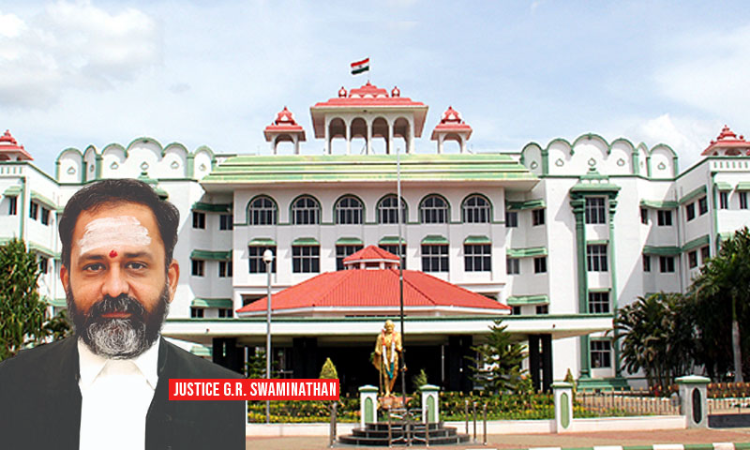
The Madras High Court has directed the Government of India to formulate a comprehensive policy for providing legal assistance to Indian citizens outside its territory. Justice GR Swaminathan observed that the Government had a constitutional duty, and the absence of any legislative framework should not come in the way of such inference. “From the foregoing premises and...
This is a premium content
Available exclusively to
Our subscribers
Subscribe Premium 
INR 1099+GST
Your support helps us to bring you more content at
an affordable subscription scheme !!!
All payment options available
The Madras High Court has directed the Government of India to formulate a comprehensive policy for providing legal assistance to Indian citizens outside its territory.
Justice GR Swaminathan observed that the Government had a constitutional duty, and the absence of any legislative framework should not come in the way of such inference.
“From the foregoing premises and judicial precedents, I infer that the Government of India has a constitutional duty in the matter. The absence of a legislative framework need not come in the way of arriving at such an inference. The constitutional provisions and the Preamble construed in the light of the doctrine of Rajadharma postulate that the Government of India has a duty to provide legal aid to its citizens not only within the territory of India but also outside. I consciously refrain from delineating the details and the nuances. The Government of India is directed to come out with a comprehensive and feasible policy framework in this regard,” the court said.
The court noted that labour migration was a reality in the country, and through this migration of labour across continents, the Government was earning a huge foreign exchange through inward remittances. The court added that when the nation's exchequer was being benefitted, the Government had a correlative and corresponding duty to come to their rescue when there were issues from the overseas employment.
The court was hearing a plea by a woman whose husband died while working in the Republic of Cameroon in Central Africa. Though the husband's company had undertaken to pay a certain sum as compensation for family support, they did not abide by this undertaking, and hence the widow approached the court.
The Additional Solicitor General submitted that consular assistance had been provided as much as possible and that it was not possible to provide any further assistance. He also informed the court that the Under Secretary to the Government had addressed a letter to the High Commission of India in Cameroon, urging them to look into the issue of compensation. He also submitted that funding a legal battle abroad may be an expensive proposition, and that, as per the Legal Services Authority Act, the resources of legal assistance could be used only for assistance within the territory of India.
The court highlighted that India was a welfare state and, as per Articles 38, 39, and 39A of the Constitution, the State had a responsibility to promote the welfare of its people. The court added that, as per the constitution, the State had to secure the constitutional rights of the citizens when they were not in a position to assert and secure them themselves.
“Our Constitution makes it imperative for the State to secure to all its citizens the rights guaranteed by the Constitution and where the citizens are not in a position to assert and secure their rights, the State must come into picture and protect and fight for the rights of the citizens. The Preamble to the Constitution, read with the directive principles, Articles 38, 39 and 39-A enjoin the State to take up these responsibilities. It is the protective measure to which the social welfare State is committed,” the court said.
The court also noted several cases, where the courts had nudged the Government to come to the aid of families, where persons had died abroad. The court further noted that even though there was no legal framework for such assistance as of now, the courts could always look into International Conventions. The court gave the example of Visakha case, where the Supreme Court, in the absence of an existing legal framework, had taken assistance of International Conventions to ensure fundamental rights. In the present case, the court noted that though Indian was not a party to the International Convention on the Protection of the Rights of All Migrant Workers and Members of Their Families' adopted by General Assembly of United Nations in 1990, the convention provided for assistance in compensation matters relating to death of migrant worker.
Apart from the international conventions, the court also cited Indian scriptures that talked about the duty of a King. The court made references to Kautilya, Manu, Shanti Parva of Mahabharata and Buddhist literature, all of which had emphasised that the King had a duty to protect his subjects. The court remarked that the Indian concept of Parens Patriae recognised king as the protection of citizens and parent and in the constitutional scheme, such protector and parent would be the Government at all levels.
Thus, noting the constitutional duty of the Government, the court asked the Government to take the matter at the highest echelons of the Government of Cameroon and pressurise the persons who would have stepped into the shoes of the employer. The court added that legal notice may be issued and mediation efforts could be stepped up, and if necessary, legal battles may be waged. The court underlined that it was for the Government to explore every possibility to redress the petitioner.
Counsel for Petitioner: Mr. A. John Vincent
Counsel for Respondents: Mr. ARL. Sundaresan, Additional Solicitor General of India, assisted by Mr. K. Govindarajan, Deputy Solicitor General of India, Mr. K. S. Selvaganesan, Additional Government Pleader
Case Title: Malarvizhi @ Kottaithai v The Secretary to Government of India and Others
Citation: 2025 LiveLaw (Mad) 486
Case No: W.P.(MD)NO.17073 of 2022
Tags

Upasana Sajeev
Upasana Sajeev is a Principal Correspondent with LiveLaw, covering Madras High Court

