



- Home
- /
- High Courts
- /
- Madras High Court
- /
- Wiping Minor's Tears, Holding Her...
Wiping Minor's Tears, Holding Her Hand Without Sexual Intent Not Sexual Assault: Madras High Court
Upasana Sajeev
25 Aug 2026 5:16 PM IST
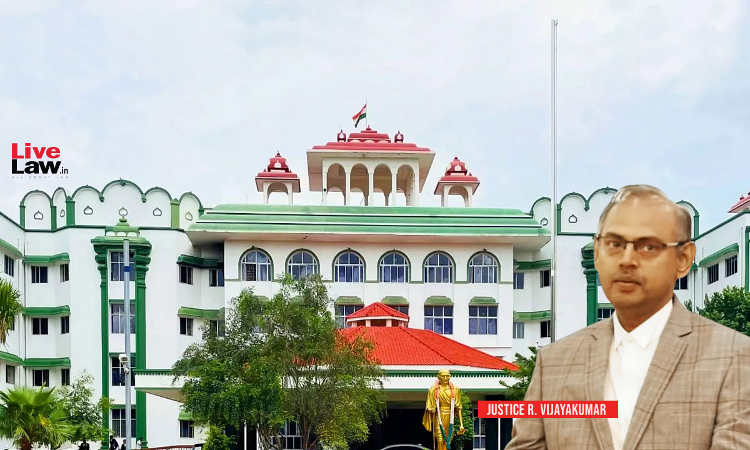
Physical contact during ordinary course of human dealings would not inherently be sexual, Court held.
The Madras High Court recently held that any contact during the ordinary course of human dealings, like taking a hand, touching a shoulder, wiping tears, and consoling someone, would not inherently be sexual, and any sexual intention would have to be gathered through surrounding circumstances. [2026 LiveLaw (Mad) 408] Justice R Vijayakumar thus quashed a criminal case registered against...
This is a premium content
Available exclusively to
Our subscribers
Subscribe Premium 
INR 1099+GST
Your support helps us to bring you more content at
an affordable subscription scheme !!!
All payment options available
The Madras High Court recently held that any contact during the ordinary course of human dealings, like taking a hand, touching a shoulder, wiping tears, and consoling someone, would not inherently be sexual, and any sexual intention would have to be gathered through surrounding circumstances. [2026 LiveLaw (Mad) 408]
Justice R Vijayakumar thus quashed a criminal case registered against a constable who was accused of offences under the POCSO Act, after noting that the man had only consoled the minor girl, with whom he was in a romantic relationship.
“Where, on the other hand, the contact is of a kind that occurs in the ordinary course of human dealings — the taking of a hand, a touch upon the shoulder, the wiping of a tear — the act carries no inherent sexual character, and the intent behind it must be gathered from something beyond the contact itself. It is precisely in such cases that the surrounding circumstances assume decisive importance: the part of the body, the manner and duration of the contact, the place and hour, the words spoken, the conduct preceding and following the act, and the presence or absence of any attempt at anything further,” the court said.
The court was hearing a plea filed by a Grade- II Constable attached to Battalion – III, Armed Reserve. As per the prosecution, the man had a romantic association with the victim for over 2 years. When the girl's parents came to know the same, they admonished her. Later, when the victim was on her way to school, the petitioner arrived in a car and requested five minutes of the victim's time. When she entered into the rear seat of the car and started breaking down in tears, the petitioner held her hand, sought her forgiveness for the difficulties suffered by her and assured her that he would marry her upon completing Class XII and attaining majority.
Based on the above incident, the girl's family had registered a case against him for offences under Sections 7,8,9(b)(iii), and 10 of the POCSO Act.
The petitioner argued that the sum and substance of the accusation was confined to the assurance of marriage upon attainment of majority and the wiping away of tears, and that such conduct, however viewed, does not answer the description of any offence as alleged. The petitioner submitted that though the act of wiping away tears entailed bodily contact, the surrounding circumstances narrated in the final report itself would negate the existence of sexual intent.
The defacto complainant's counsel, on the other hand, argued that since the petitioner touched the cheek of the child, Sections 7,8,9, and 10 would be attracted. It was further argued that though the victim's parents had already registered a complaint, the petitioner persisted in following her, which necessitated the registration of the FIR.
The prosecutor submitted that the sexual intent of at the time of physical contact is a question of fact, which can be resolved only in the course of trial and thus sought to dismiss the plea.
The court noted that Section 7 of the POCSO Act, which deals with sexual assault, is in two limbs: one deals with touching of the vagina, penis, anus or breast of the child, or the causing of such touching by the child; the second limb is a residuary one, embracing any other act involving physical contact without penetration.
The court noted that the provision does not penalise physical contact alone unless it is with sexual intent. Thus, the court highlighted that sexual intent was the foundation for proving the offence.
“The provision does not penalise physical contact simpliciter. Sexual intent is not an incidental feature of the offence but its very foundation, and in the absence of that mental element the actus reus, however established, remains legally inert,” the court said.
In the present case, the court noted that the solitary act of physical contact was wiping away the victim's tears accompanied by holding of hand. The court noted that the setting of the incident was also significant. The court noted that the incident took place in the morning, in a public road in the vicinity of the victim's school while the victim was sitting in the rear seat of the car.
The court also noted that the words attributed to the petitioner were of apology and of assurance and there was no whisper of any attempt, gesture, or utterance of a sexual character. The court added that the contact arose out of an act of contrition and consolation. The court held that reading sexual intent into such an act would be supplying an assumption which the Section forbids from assuming.
Thus, noting that continuing the prosecution would be an abuse of process of law, the court allowed the plea and quashed the criminal case.
Counsel for Petitioner: Mr. R. Pon Karthikeyan
Counsel for Respondents: Mr. P. Samuel Gunasingh Government Advocate (Crl. side), Mr. N. Gurusamy
Case Title: Maheshkumar v State of Tamil Nadu and Another
Citation: 2026 LiveLaw (Mad) 408
Case No: Crl OP (MD) No 1465 of 2026

Upasana Sajeev
Upasana Sajeev is a Principal Correspondent with LiveLaw, covering Madras High Court

