



- Home
- /
- High Courts
- /
- Patna High Court
- /
- 'Person Cannot Oscillate Between...
'Person Cannot Oscillate Between Two Caste Identities To Derive Benefits, Undermines Sanctity Of System': Patna High Court
Rushil Batra
29 April 2026 9:07 PM IST
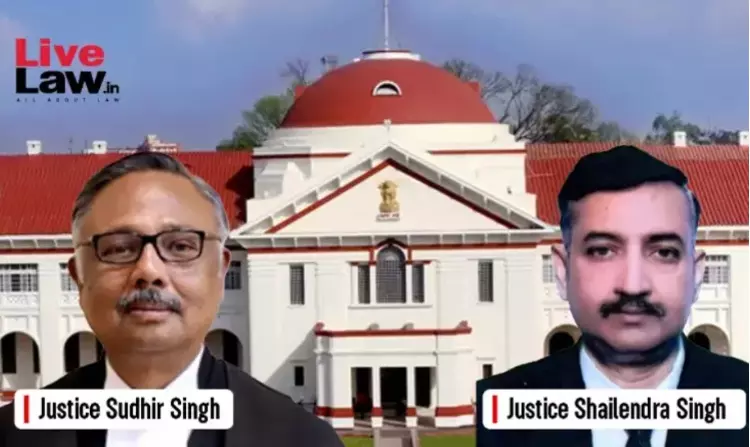
The Patna High Court has held that a person cannot be permitted to take inconsistent stands regarding caste identity to derive electoral benefits, upholding proceedings initiated for disqualification of a Mukhiya elected from an Extremely Backward Class (EBC) reserved seat.A Division Bench of Justice Sudhir Singh and Justice Shailendra Singh was hearing an intra-court appeal against the...
This is a premium content
Available exclusively to
Our subscribers
Subscribe Premium 
INR 1099+GST
Your support helps us to bring you more content at
an affordable subscription scheme !!!
All payment options available
The Patna High Court has held that a person cannot be permitted to take inconsistent stands regarding caste identity to derive electoral benefits, upholding proceedings initiated for disqualification of a Mukhiya elected from an Extremely Backward Class (EBC) reserved seat.
A Division Bench of Justice Sudhir Singh and Justice Shailendra Singh was hearing an intra-court appeal against the judgment dated 09.08.2023 passed by a learned Single Judge dismissing the writ petition filed by the appellant.
The appellant had been elected as Mukhiya in 2021 from a seat reserved for Extremely Backward Classes. Subsequently, a complaint was filed under Section 136(2) of the Bihar Panchayat Raj Act, 2006 seeking his disqualification on the ground that he did not belong to the EBC category.
Pursuant to the complaint, the State Election Commission referred the issue of caste determination to the competent Caste Scrutiny Committee. During the pendency of the proceedings, the Committee, by order dated 12.01.2023, held that the appellant belonged to the Koeri (Kushwaha) caste, and not Dangi (EBC), thereby undermining his eligibility to contest from a reserved seat.
The appellant challenged both the reference made by the State Election Commission and the findings of the Caste Scrutiny Committee, contending that the Commission lacked jurisdiction to refer such disputes and that the Committee's findings were perverse and contrary to government guidelines permitting issuance of caste certificates based on local enquiry. It was further argued that the proceedings before the Caste Scrutiny Committee were vitiated due to violation of principles of natural justice, as the appellant was denied adequate opportunity to present his case and relevant documents were disregarded.
The respondents, however, contended that the issue had been examined by the competent authority, and that the appellant had himself, at different points in time, declared his caste as Koeri in official records and transactions, thereby discrediting his claim of belonging to the Dangi caste.
The High Court noted that the learned Single Judge had undertaken a detailed examination of the records and correctly relied upon foundational documents, particularly land revenue records (khatiyan), which reflected the caste of the appellant's ancestor as Koeri (Kushwaha).
The Court observed that such contemporaneous records carry a presumption of correctness and constitute primary evidence for determination of caste status. It also took note of the appellant's own declaration in a 2018 land transaction, where he identified himself as belonging to the Koeri caste. Rejecting the appellant's plea, the Court held:
“The learned Single Judge has rightly taken note of this aspect and has drawn an adverse inference with regard to the consistency and credibility of the appellant's claim. A person cannot be allowed to oscillate between two caste identities claiming to be Koeri for one purpose and Dangi for another depending upon the benefit sought to be derived. Such conduct not only undermines the sanctity of the system of reservation but also strikes at the root of fairness in public administration”
The Court further clarified that the State Election Commission had not itself adjudicated the caste dispute but had merely referred the matter to the competent authority, thereby acting within jurisdiction. It also held that the guidelines permitting issuance of caste certificates based on local enquiry cannot be interpreted in a manner that allows individuals to adopt shifting caste identities.
Finding that the Caste Scrutiny Committee had duly considered all relevant materials and that the findings of the learned Single Judge were well-reasoned, the Court held that no case for interference was made out in intra-court appeal.
Accordingly, the appeal was dismissed.
Case Title: Manoj Prasad v. State Election Commission (Panchayat) and Ors.
Case No.: Letters Patent Appeal No. 1001 of 2023 (in C.W.J.C. No. 14258 of 2022).
Appearance: Mr. S.B.K. Manglam, Mr. Awnish Kumar, and Mr. Vikash Kumar Singh appeared for the Appellants. Mr. Saroj Kumar Sharma appeared for the State. Mr. Ravi Ranjan and Mr. Girish Kumar appeared for the Commission. Mr. Santosh Bharti and Mr. Apurva Kumar appeared for Respondent No. 4.
Tags


