



Departmental Inquiry Without Witnesses, Documents And Cross-Examination Cannot Sustain Major Penalty: Patna High Court
LIVELAW NEWS NETWORK
8 Oct 2026 6:45 PM IST
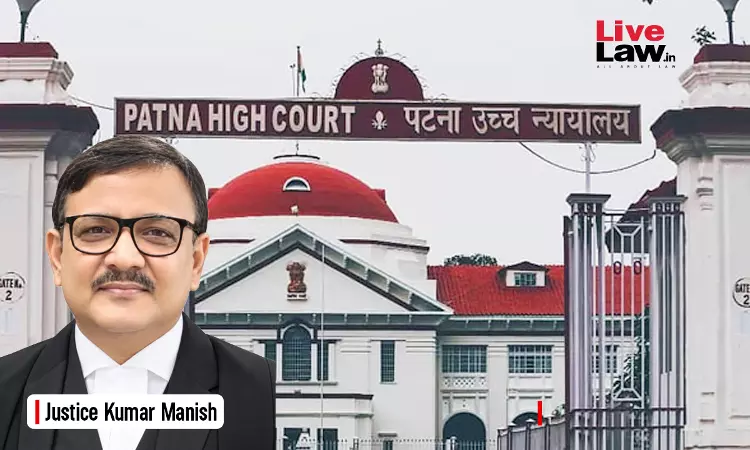
The Patna HC has held that a major penalty cannot be sustained on the basis of a departmental inquiry where no witnesses were examined, documents were not properly furnished or exhibited, and the delinquent employee was denied an effective opportunity of cross-examination.
A Single Judge Bench of Justice Kumar Manish was hearing a writ petition filed by Pawan Kumar challenging an order whereby he was reverted from the post of Executive Engineer to the basic grade of the Bihar Engineering Service, i.e. Assistant Engineer.
The petitioner was posted as Executive Engineer, Tube Well Division, Siwan from April 2013 to July 2014. Following a joint inspection of 13 tube wells, a report alleged excess payments, expenditure of about Rs. 3.54 crore despite none of the tube wells being functional, and preparation of estimates without physical verification.
The petitioner was placed under suspension on 10.11.2014. Three charges were subsequently levelled against him relating to the alleged excess payment, expenditure on the 13 tube wells, and preparation of estimates without spot verification.


The petitioner challenged the departmental proceedings, contending that the charge memo did not contain the mandatory list of documents and witnesses, no witness had been examined during the inquiry, and he had not been given an opportunity to cross-examine any witness.
The Court found that the charge memo did not disclose any list of documents or witnesses as required under Rule 17(3)(ii)(a) and (b) of the CCA Rules, 2005. It further found that the Enquiry Officer had not examined a single witness in either of the two departmental proceedings. The Court also noted that the Technical Examiner Cell of the Vigilance Department had submitted a report finding no financial irregularity on the same allegations, but the said report had not been considered while returning the finding of guilt.
The Court further found that the punishment of reversion had been imposed by combining findings from two separate departmental proceedings, even though no order for common proceedings had been passed under Rule 22 of the CCA Rules, 2005. It observed:
“An Enquiry Officer exercising statutory and quasi-judicial powers is expected to act independently, fairly and in conformity with the procedure prescribed under the applicable Rules. The Enquiry Officer cannot merely proceed on the basis of the allegations contained in the charge or the conclusions recorded in a preliminary inspection report without ensuring that the Department establishes the alleged charge in accordance with the prescribed procedure by according reasonable and effective opportunity to the delinquent employee for defending his case.”
The Court held that the two Enquiry Reports were vitiated by violation of the mandatory procedure under Rule 17 of the CCA Rules, 2005 and the principles of natural justice and could not form the basis for imposing a major penalty. The Court also declined to remand the matter for a fresh inquiry, noting that the proceedings had already continued for a prolonged period and that, given the lapse of time, it would be unfair and unjust to require the petitioner to face the inquiry again.
Accordingly, the Court quashed the order dated 09.05.2018 imposing the punishment of reversion as well as the order dated 06.08.2018 passed in review.
Appearance:
For the Petitioner/s: Mr. Rajendra Narayan, Sr. Advocate; Mr. Sadanand Paswan, Advocate; Mr. Moni Kumari, Advocate
For the State: Mr. Pankaj Kr. Singh, A.C. to G.A.-9; Mr. Brajkishore Pd. Sinha, GA-18; Mr. Arvind Kumar, AC to GA-18


