



- Home
- /
- High Courts
- /
- Patna High Court
- /
- 'Seriously Disputed Questions Of...
'Seriously Disputed Questions Of Fact, Particularly Possession Claims, Cannot Be Adjudicated In Writ Jurisdiction': Patna HC
Rushil Batra
9 May 2026 1:31 PM IST
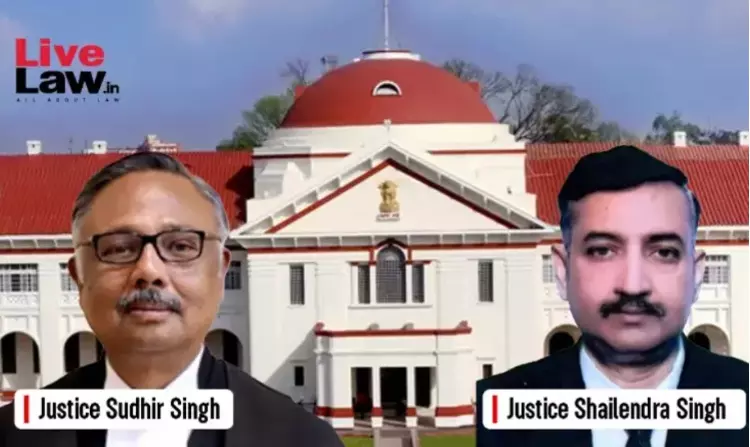
The Patna High Court has reiterated that writ jurisdiction under Article 226 is not meant for adjudication of seriously disputed questions of fact, particularly where rival claims regarding possession of land require detailed examination of evidence and factual determination.A Division Bench of Justice Sudhir Singh and Justice Shailendra Singh was hearing an intra-court appeal challenging...
This is a premium content
Available exclusively to
Our subscribers
Subscribe Premium 
INR 1099+GST
Your support helps us to bring you more content at
an affordable subscription scheme !!!
All payment options available
The Patna High Court has reiterated that writ jurisdiction under Article 226 is not meant for adjudication of seriously disputed questions of fact, particularly where rival claims regarding possession of land require detailed examination of evidence and factual determination.
A Division Bench of Justice Sudhir Singh and Justice Shailendra Singh was hearing an intra-court appeal challenging the judgment dated 20.07.2023 passed by a learned Single Judge in C.W.J.C. No. 4805 of 2020.
Before the learned Single Judge, the writ petitioner had sought a direction restraining respondent no. 10 from interfering with her peaceful possession over certain parcels of land allegedly inherited from her father, along with a direction upon the State authorities to protect her constitutional rights.
The appellant claimed that lands situated at Mauja-Chandpur, Thana No. 270, Khata No. 649, Khesra Nos. 4333-4334 measuring 1 Acre 13 Decimal, and another parcel under Khata No. 1121, Khesra Nos. 4331-4332 measuring 1 Acre 12 Decimal, were recorded in the name of her father, who died on 23.11.1986, after which she came into possession and continued cultivation over the land.
It was further contended that respondent no. 10, namely the District Institute of Education and Training (D.I.E.T.), Tikapatti, Katihar, had been functioning over adjacent land measuring 6 Acre 29 Decimal which had allegedly been donated by villagers. According to the appellant, the institute had subsequently started interfering with her raiyati land and sought mutation of the disputed property through communications addressed to revenue authorities.
The learned Single Judge had disposed of the writ petition observing that the controversy involved disputed questions of fact incapable of adjudication in writ proceedings and directed the petitioner to approach the Collector, Katihar, who was directed to examine the documents, verify physical possession and decide the issue in summary proceedings.
Before the Division Bench, the appellant argued that the learned Single Judge failed to appreciate that the writ petition merely sought protection against interference with peaceful possession and enforcement of constitutional rights. On the other hand, the respondents submitted that the institute had always remained in possession of the land and that recently the appellant and certain “unscrupulous elements” had begun disturbing such possession. It was argued that the dispute could only be effectively resolved through factual verification at the ground level.
Upon consideration of the materials on record, the High Court observed that the controversy was not a pure question of law but was “deeply entangled with disputed questions of fact,” particularly concerning possession over the land in question. The Court noted that both parties were advancing rival claims regarding possession, necessitating detailed scrutiny of documentary evidence as well as verification of actual physical possession.
Referring to the Supreme Court's decision in State of U.P. v. Ehsan, reported in (2024) 14 SCC 269, the Court reiterated that although availability of an alternative remedy is not an absolute bar to writ jurisdiction, courts ordinarily refrain from exercising such jurisdiction where disputes involve seriously contested factual questions incapable of satisfactory adjudication on affidavits alone. The Court observed:
“It is a well-settled principle of law that issues involving seriously disputed questions of fact are not suited for adjudication in writ jurisdiction under Article 226. The writ jurisdiction, though wide in its amplitude, is not designed to resolve factual controversies where the parties are at variance on foundational facts. Proceedings under Article 226 are not intended to substitute a full-fledged trial, particularly in cases where determination of rights hinges upon contested questions of fact requiring detailed evidence. The Writ Court, in exercise of such jurisdiction, does not ordinarily engage in a detailed fact-finding inquiry or attempt to conclusively determine competing factual claims…In the present case, the core issue revolves around the question of possession of the land in question, which is clearly a matter of serious factual dispute between the parties. Each side asserts its own claim, and the resolution of such a dispute would necessarily require a fuller and more appropriate adjudicatory process. In that view of the matter, the learned Single Judge was justified in holding that the writ petition, involving disputed questions of fact not amenable to determination under writ jurisdiction, ought to be pursued before an appropriate forum”
Holding that the core issue in the present case revolved around possession of the land, which constituted a serious factual dispute requiring fuller adjudication, the Court found no infirmity in the approach adopted by the learned Single Judge in directing the appellant to pursue remedies before the appropriate forum.
Accordingly, the intra-court appeal was dismissed.
Case Title: Shyama Devi v. State of Bihar and Ors.
Case No.: Letters Patent Appeal No. 1014 of 2023 in Civil Writ Jurisdiction Case No. 4805 of 2020.
Appearance: Mr. Raghvendra Kumar Singh appeared for the Appellant. Mr. Md. Khurshid Alam appeared for the State.
Tags


