If Punishment Is Quashed For Violating Natural Justice, Disciplinary Proceedings Should Resume From Point Of Error :Patna High Court
Namdev Singh
19 Nov 2026 11:36 AM IST
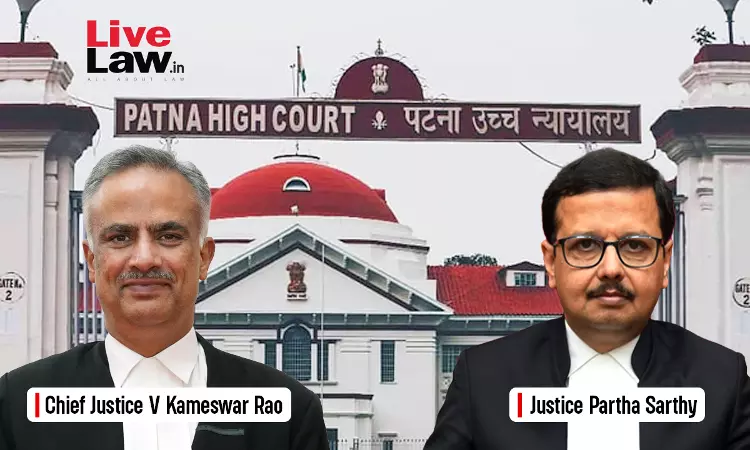
A Division Bench of the Patna High Court comprising Chief Justice V. Kameswar Rao and Justice Partha Sarthy held that when punishment is set aside for violation of natural justice, the matter should be remanded to the Disciplinary Authority to resume the proceedings from the stage of violation rather than granting full relief.
Background Facts
The case arose when an employee working as a Senior Assistant at the State Bank of India was subjected to disciplinary proceedings. Preliminary charges were framed against him to which he submitted his reply. Subsequently, a final charge-sheet was issued, and the employee submitted his reply.
As the Disciplinary Authority was not satisfied with his explanation, an Inquiry Officer was appointed to conduct an inquiry. The Inquiry Officer submitted his report holding the charges against the employee as proved. Thereafter, a second show-cause notice was issued to him.
On 14.11.2009, the Disciplinary Authority imposed the punishment of removal from service. The employee challenged the order before the Appellate Authority, which dismissed his appeal.


The employee approached the Patna High Court by filing a writ petition. The Single Judge allowed the petition and set aside the orders of punishment. The Bank was directed to extend 50% of the monetary benefits for the intervening period along with other retiral benefits.
Challenging the order passed by the Single Judge, the State Bank of India preferred a Letters Patent Appeal before the Division Bench.
It was submitted by the Bank that the Single Judge had erred in not remanding the matter to the Disciplinary Authority to continue the proceedings from the stage where the principles of natural justice had been violated. It was further submitted that the charges against the employee were serious in nature and required an inquiry in accordance with the principles of natural justice.
Reliance was placed on the Supreme Court judgments in Chairman, Life Insurance Corporation of India v. A. Masilamani; Managing Director, ECIL v. B. Karunakar; and U.P. State Spinning Co. Ltd. v. R.S. Pandey, wherein it was held that when an order of dismissal or removal is set aside on account of violation of principles of natural justice, the matter ought to be remanded to the competent authority.
On the other hand, it was submitted by the employee that the disciplinary proceedings had been conducted in violation of the principles of natural justice. It was argued that the charge memo was not accompanied by the list of documents or witnesses. Further, the statement of imputations was also not supplied to the employee.
It was further contended that none of the witnesses, including the authors of the documents relied upon, had been examined to prove the charges against him.
Findings and Observations of the Court
It was observed by the Division Bench that when the employee had approached the Court by filing the writ petition, he was 42 years old and was now around 58 years old. Therefore, he still had some years of service left before attaining the age of superannuation.
It was noted by the Bench that where disciplinary proceedings resulting in the punishment of removal from service are set aside and the charges against the employee are serious in nature, the Single Judge should have remanded the matter to the Disciplinary Authority.
It was held by the Division Bench that remanding the matter would enable the Disciplinary Authority to resume the proceedings from the stage at which the principles of natural justice had been violated and ensure that the charges framed against the employee were properly enquired into.
Accordingly, the Division Bench directed the Bank to extend 50% of the monetary benefits to the employee for the intervening period from the date of his removal from service till the date of his reinstatement. However, the Bank was granted liberty to proceed with the departmental proceedings pursuant to the charge-sheet dated 22.08.2007.
It was clarified by the Bench that the Disciplinary Authority would be entitled to regulate the intervening period between the date of removal and reinstatement. It was also directed that the departmental proceedings be completed preferably within six months.
With the aforesaid observations, the Letters Patent Appeal filed by the State Bank of India was disposed of by the Division Bench.
Counsel for the Appellants : Namrata Mishra, Sr. Advocate; Archana Jha, Advocate
Counsel for the Respondent : Aditya Narain Singh, Advocate; Kundan Kumar Sinha, Advocate