



- Home
- /
- High Courts
- /
- Punjab and Haryana High Court
- /
- 'Trust Is True Seat Of...
'Trust Is True Seat Of Jurisdiction': CJI Surya Kant Inaugurates Chandigarh International Arbitration Centre
Aiman J. Chishti
7 March 2026 9:39 PM IST
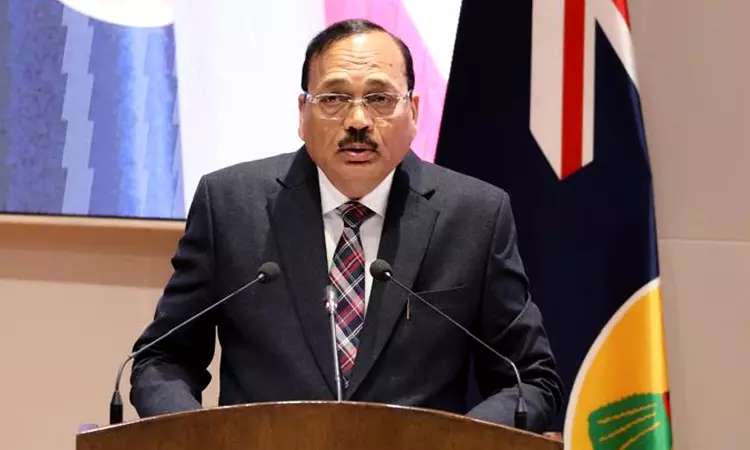
The Chief Justice of India (CJI) Surya Kant on Saturday inaugurated the first edition of the India International Disputes Week (IIDW) and the Chandigarh International Arbitration Centre (CIAC) in Chandigarh, emphasising that India must build credible and reliable dispute resolution institutions to support its expanding role in global commerce.Delivering the inaugural address, the CJI said...
This is a premium content
Available exclusively to
Our subscribers
Subscribe Premium 
INR 1099+GST
Your support helps us to bring you more content at
an affordable subscription scheme !!!
All payment options available
The Chief Justice of India (CJI) Surya Kant on Saturday inaugurated the first edition of the India International Disputes Week (IIDW) and the Chandigarh International Arbitration Centre (CIAC) in Chandigarh, emphasising that India must build credible and reliable dispute resolution institutions to support its expanding role in global commerce.
Delivering the inaugural address, the CJI said that while India has made significant legislative and judicial strides in dispute resolution, global confidence ultimately depends on institutional performance, neutrality, and procedural discipline over time.
Personal Resonance With Punjab & Haryana High Court
Recalling his professional journey, the CJI said the occasion held deep personal significance because he began his legal career in the corridors of the Punjab and Haryana High Court.
“It was here that I began my professional journey — first as a young advocate finding my footing, later as an Advocate General, and finally as a Judge of this august High Court,” he said.
Returning to witness the establishment of a new arbitration institution in the same city, the CJI said, was both “humbling and heartening.”
Chandigarh As A Symbol Of Institutional Design
Drawing a parallel with the planned character of Chandigarh, the CJI noted that institutions, like cities, do not arise by accident but must be deliberately designed and sustained.
He observed that the launch of the CIAC in a carefully planned city such as Chandigarh reflected the same ethos required for dispute resolution — design, discipline and durability.
India At An “Inflection Point” In Global Commerce
The CJI said the theme of the inaugural IIDW — India's Cross-Border Disputes Services: 2026–2030 Outlook for Litigation, Mediation and Arbitration — signalled a forward-looking effort to shape the country's dispute resolution architecture for the coming years.
“A mature economy is not one that avoids disagreement; it is one that resolves disagreement with credibility,” the CJI said.
Building Confidence In Arbitration
Reflecting on India's arbitration journey, the CJI acknowledged that international stakeholders had once approached India's arbitration regime with caution due to concerns about delay, intervention and unpredictability.
However, he noted that legislative reforms and judicial discipline over the past decade have strengthened the framework under the Arbitration and Conciliation Act, 1996.
Amendments to the law have introduced stricter timelines, enhanced neutrality standards and clarified the limits of judicial intervention, while courts have emphasised the principle of minimal interference in arbitral proceedings.
“Ultimately, credibility is not measured by the elegance of a statute but by the confidence it inspires,” the CJI said, adding that investors closely observe whether arbitral awards are enforced predictably and efficiently.
He emphasised that the newly inaugurated Chandigarh International Arbitration Centre must stand for neutrality, efficiency and procedural integrity, rather than becoming merely another administrative institution.
Mediation As A Complementary Pillar
The CJI also underscored the growing importance of mediation within India's dispute resolution ecosystem following the enactment of the Mediation Act, 2023.
He noted that mediation offers a distinct advantage in commercial disputes by preserving business relationships, particularly in cross-border contexts where parties may continue to work together after resolving disagreements.
“Mediation allows resolution without residue,” he remarked, adding that arbitration and mediation should not be treated as competing mechanisms but complementary instruments within a unified dispute resolution architecture.
IIDW Should Become A Platform Of Consequence
Speaking about the India International Disputes Week, the CJI said such gatherings must go beyond ceremonial exchanges and evolve into serious platforms for candid dialogue on complex issues.
According to him, if IIDW continues to encourage comparative dialogue and institutional collaboration, it could become an important forum in the global dispute resolution landscape.
“Institutions Must Be Built Deliberately”
Concluding his address, the CJI said that India's cross-border dispute resolution framework will ultimately be judged not by the number of statutes enacted or centres inaugurated, but by consistent neutrality, predictable enforcement and timely resolution of disputes.
As India seeks to strengthen its position in international commerce, he stressed that trust remains the most critical factor.
“If we do this well, India will not merely resolve disputes — it will command trust. And in cross-border disputes, trust is the true seat of jurisdiction,” he said.
The event marked the formal launch of the Chandigarh International Arbitration Centre and the first edition of the India International Disputes Week, which will host a week-long series of discussions on litigation, arbitration, mediation, digital evidence and emerging issues in dispute resolution.
Aiman J. Chishti
Aiman J. Chishti is a Principal Correspondent with LiveLaw, covering Punjab And Haryana High Court

