



- Home
- /
- High Courts
- /
- Punjab and Haryana High Court
- /
- Concerned Over Rapid Decline In...
Concerned Over Rapid Decline In Kasauli's Green Cover, Himachal Pradesh High Court Restricts Land Purchase By Non-Agriculturists In Solan
Aiman J. Chishti
24 Nov 2026 10:40 AM IST
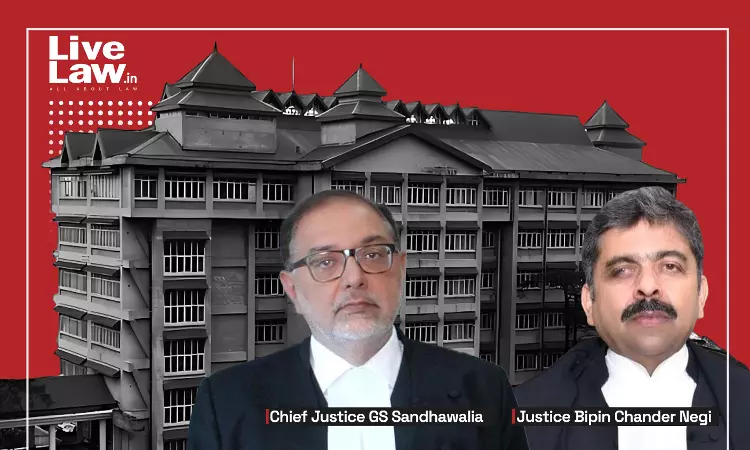
Expressing concern over the rapid depletion of green cover in Kasauli due to commercial construction, the Himachal Pradesh High Court has directed the State not to grant any permission under Section 118 of the Himachal Pradesh Tenancy and Land Reforms Act, 1972 in Solan district without obtaining the Court's approval by furnishing justifiable reasons. Section 118 restricts the transfer of land...
This is a premium content
Available exclusively to
Our subscribers
Subscribe Premium 
INR 1099+GST
Your support helps us to bring you more content at
an affordable subscription scheme !!!
All payment options available
Expressing concern over the rapid depletion of green cover in Kasauli due to commercial construction, the Himachal Pradesh High Court has directed the State not to grant any permission under Section 118 of the Himachal Pradesh Tenancy and Land Reforms Act, 1972 in Solan district without obtaining the Court's approval by furnishing justifiable reasons. Section 118 restricts the transfer of land to non-agriculturists.
A Division Bench of Chief Justice G.S. Sandhawalia and Justice Bipin C. Negi passed the order in a suo motu PIL concerning large-scale excavation and construction activities near Lower Mall in Kasauli.
The Bench observed that rampant grant of permissions under Section 118 had led to large-scale commercial construction in Solan district and that the State Government had failed to bring the situation under control.
While the State strongly opposed the passing of any interim order, the Bench remarked,
“...since we have been constantly dealing with these issues in Public Interest Litigations, we are of the considered opinion that until any extreme orders are passed, the State will not remedy itself, as these permissions have been unabatedly given over the last decades by successive Governments, thus diluting the strict provisions of Section 118 of the Act.”
Taking note of the gross violation of hill-cutting norms, the Court also directed strict enforcement of stop-work notices issued to three builders in Kasauli. In case of non-compliance by the builders, the jurisdictional Station House Officer (SHO) was directed to ensure enforcement of the notices.
The Court further directed the Sub-Divisional Officer (Civil), Kasauli, to ensure inspection of all major construction projects, primarily commercial in nature, considering the rapid reduction of green cover in the Kasauli range.
SDM's Inspection Report
The Sub-Divisional Officer (Civil), Kasauli, appeared in person and filed a status and inspection report. In October 2026, a joint inspection was carried out with officials of the following, the Cantonment Board, the Tehsil, the Town and Country Planning Department; and the Forest Department.
The inspection found excavation going on at a property called “Woodvilla” in Ferozi Village. The roots of existing trees were exposed. The project's representative was directed to stop work, restore the exposed roots and protect the trees.
The developers responded that some branches had been lopped only because high-voltage wires ran close to them, and denied that any trees had been uprooted or cut. The Forest Department counted 35 existing trees and found no felled trees. The report also recorded that the Gram Panchayat had issued no NOC for the property.
Three LLPs, One Project
The Court noted that three builders were carrying out “massive construction and excavation” at the site M/s Reviera Luxury Project Five LLP, M/s Sretan Luxury Project Four LLP; and M/s Jambavati Project Reality Three LLP.
According to the record, the first two firms, both based at the same Mumbai address, received Section 118 permissions in December 2023 and June 2024 to set up housing colonies.
It then bought adjoining parcels from the same family for ₹7.60 crore and ₹1.90 crore. The Director of Town and Country Planning gave the third firm in-principle approval in August 2026 for a plotted development, after relaxing norms. These included reducing the required access road width from 7.5 metres to 5.48 metres.
The Bench said, “The harsh steps are being initiated against the said builders/newly impleaded respondents, as even the Sub-Divisional Officer (Civil), who is present, has admitted that the site in question has been developed to the extent that the greenery and the damage caused to the hill side just below the Radio Tower, can be seen from Shimla at Kasauli, which is at least at a distance of 25 kms by “Crow's flight”. Therefore, the extent of damage to the hill side is but apparent and if one is to lift the “Corporate Veil” the three developers have got necessary permission by setting up different Partnerships for the same project, which the State has conveniently given making Section 118 of the Act a dead letter.”
'Gross Violation' Of Hill-Cutting Norms
After going through the photographs, the Court found a “major deviation” from the Policy Guidelines for Cutting, Conservation and Preservation of Hill, 2025. These guidelines were issued following directions in the pending PIL Kusum Bali v. State of Himachal Pradesh (CWPIL No. 13 of 2021).
The Court noted that under Regulation 4 of the guidelines, no hill cutting is allowed without prior intimation to the competent authority, the maximum permissible slope for construction is 45 degrees, cutting at any one level cannot exceed 3.5 metres, and must be done in steps, slope stabilisation measures must be technically vetted by an institute such as IIT, CBRI or NIT; and vertical hill cutting is not permitted.
It held, “We are of the considered opinion that from these photographs it is apparent that there has been gross violation as such of the Hill Cutting Norms and the necessary requisite permissions do not seem to be in place.”
The Court impleaded the three developers, the Director of Town and Country Planning and the Secretary (Urban Development) as respondents, and issued notice.
CEC Report On Kasauli
The Court also referred to a report of the Supreme Court's Central Empowered Committee on the degradation of Kasauli. The report was prepared in proceedings before the Supreme Court in Writ Petition (Civil) No. 758 of 2025.
The report found that the permissions granted by the Town and Country Planning Department were not communicated to the Forest Department, even where projects involved tree felling, or to the Pollution Control Board, the site plans given to the Town and Country Planning Department and to the Forest Department were different, including in the number of trees to be felled; and extensive hill cutting for resorts and hotels was observed at several locations.
Looking at the photographs attached to the SDM's Action Taken Report, the Bench found that “large scale construction is taking place at various places at Kasauli” and “apparently, there is a blatant violation of the Hill Cutting Norms and the Policy.”
It directed the SDM “to carry on the good work that he is carrying out” and to inspect all major constructions that are primarily commercial. The Court noted that “the green cover in the Kasauli range is being reduced at a very rapid rate, for commercialization purpose.” The State has been asked to respond to the Action Taken Report.
No Consolidated Data On Section 118 Permissions
The Court said that “rampant permissions” under Section 118 in District Solan are “leading to this bane of commercial construction in the shape of flats”. It added that the State “has been unable to take grip of the situation” and has placed no consolidated data on record.
Referring to Section 118 permissions, the Court noted 187 had been granted in the Barog Patwar Circle and 801 in District Shimla over the last decade. It sought Information from the State and how such large-scale permissions were granted, and whether environmental clearances were obtained.
The matter now will be heard on December 07.
Tags
Aiman J. Chishti
Aiman J. Chishti is a Principal Correspondent with LiveLaw, covering Punjab And Haryana High Court

