



- Home
- /
- High Courts
- /
- Punjab and Haryana High Court
- /
- Bail Granted By Magistrate Related...
Bail Granted By Magistrate Related To Accused Vitiated By Bias-in-Law: Punjab & Haryana High Court Cancels Order But Gives Interim Relief
LIVELAW NEWS NETWORK
13 Dec 2025 4:20 PM IST
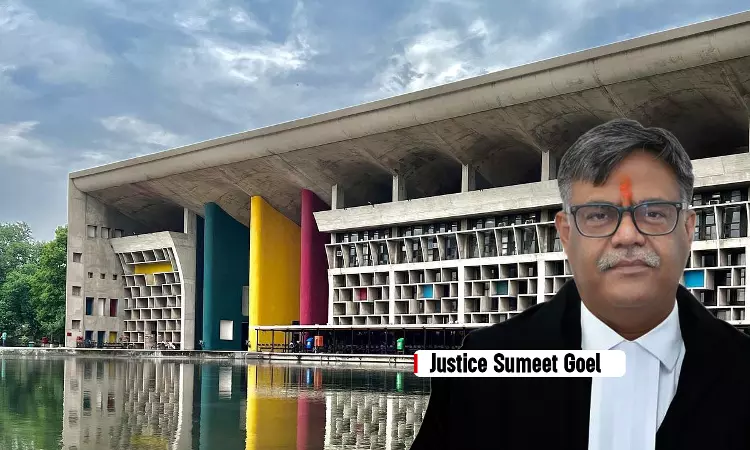
The Punjab & Haryana High Court has quashed a Judicial Magistrate's order granting regular bail to an accused in an intimidation case after finding that the Magistrate and the accused were related—though distantly—holding that such consanguinity created a “real likelihood of bias” sufficient to vitiate the order. Justice Sumeet Goel,"A fact that cannot be lost sight of is...
This is a premium content
Available exclusively to
Our subscribers
Subscribe Premium 
INR 1099+GST
Your support helps us to bring you more content at
an affordable subscription scheme !!!
All payment options available
The Punjab & Haryana High Court has quashed a Judicial Magistrate's order granting regular bail to an accused in an intimidation case after finding that the Magistrate and the accused were related—though distantly—holding that such consanguinity created a “real likelihood of bias” sufficient to vitiate the order.
Justice Sumeet Goel,
"A fact that cannot be lost sight of is that a Judge/Magistrate may possess remote or highly attenuated collateral consanguinity with a litigant, the existence of which may remain genuinely unknown to the concerned Judge/Magistrate. Notwithstanding this bona fide ignorance, the threshold for evaluating the potential existence of perception of biasness/prejudice is the objective standard of the reasonably informed and prudent person."
The Court said, where the Judge/Magistrate is conscious of or apprised of such a connection, which has the potential of creating apprehension of biasness/prejudice in the minds of a reasonable person, the paramount duty of judicial propriety compels an immediate and sua sponte exercise of recusal from the proceedings.
The petitioner-complainant had sought quashing of the 31 December 2023 order of the Judicial Magistrate First Class, Ambala, granting regular bail to respondent-accused Rishabh Walia in FIR No. 485/2023 registered under Sections 195-A, 506 and later 201 IPC (Police Station Mullana, Ambala). The FIR alleged threats by the accused and purported gang-connected callers demanding compromise in another ongoing criminal case.
Allegation Of Judge–Accused Relationship
The petitioner asserted that the Magistrate who granted bail was a relative of the accused and had even taken leave to attend a condolence ceremony in the accused's family. A complaint concerning this allegation had been submitted to the Chief Justice and was under consideration on the administrative side.
Preliminary inquiry conducted by the District & Sessions Judge, Ambala—placed before the High Court in sealed cover—indicated that the Magistrate and the accused did share a distant familial connection. The State's compliance affidavit also described them as “distant relatives (cousins).”
The accused, however, denied any such relationship in an affidavit.
'Real Possibility Of Bias' — Court Invokes Nemo Judex Rule
The High Court emphasised that judicial neutrality demands not only actual impartiality but also the absence of any reasonable perception of partiality. Relying on precedents including Porter v. Magill, R v. Sussex Justices and the Supreme Court's decision in Krishnadatt Awasthy v. State of M.P. (2025), the Court reiterated that proceedings are vitiated if a fair-minded observer would apprehend a real likelihood of bias.
"The credibility of justice administration system and judicial institutions is premised not merely on the effective enforcement of letter of law, but also on the fact that judicial process is inherently fair and is devoid not only of any prejudice(s)/bias but also of any perception of prejudice(s)/bias," it added.
Trust And Fidelity Of Common Populace Is Non Negotiable
The judge said, "the trust and fidelity of common populace in the functioning of judicial institutions is the non-negotiable lifeblood of the justice delivery system, sine qua non for which is, that the adjudication/outcome is perceptibly free from even a shadow of prejudice/bias. The litmus test for bias hinges on an objective standard: Whether a right-minded/reasonable individual, fully apprised of the facts, would come to a conclusion that, due to any pecuniary/personal interest either in the subject matter or the outcome, there existed a 'real likelihood/apprehension of bias' on the judge's part."
If this 'real likelihood/apprehension of bias' is shown to exist; even if the decision were otherwise factually accurate and legally impeccable; the consequent adjudication is deemed vitiated in toto, and stands non est in law. Ergo, it is the taint of perceived partiality/bias/prejudice and not necessarily the existence of actual judicial malice which acts as the fatal flaw, the Court added.
While ruminating a claim of bias/prejudice, a Judge must assess, not only his/her subjective capacity to remain uninfluenced but also critically gauge the objective perception of impartiality that his involvement casts upon the proceedings. To fail this latter test, is to risk eroding the public confidence in the justice administration system, an outcome, far graver than a mere procedural error. As to the determination of the likelihood of bias, what is relevant is the 'reasonableness of the apprehension of bias/prejudice' in that regard in the mind of a reasonable man.
The Court noted that the sealed-cover material showed the Magistrate was aware of the consanguinity.
Even distant relationships that may trigger a reasonable perception of partiality require recusal and Judicial officers must be protected from frivolous accusations, but when credible material exists, the court must act to preserve institutional integrity.
“The litmus test is not whether the Judge believes herself impartial, but whether a reasonably informed observer would think there existed a real possibility of bias,” the Court observed.
Holding the impugned bail order “untenable ab initio,” the Court set it aside pursuant to the doctrine of bias-in-law.
The Court, however, declined to immediately remand the accused to custody, noting that nearly two years had elapsed since the bail was granted and the trial had already commenced. It permitted the accused to remain on bail till 23 December 2025 and directed him to appear before the Chief Judicial Magistrate/Duty Magistrate, Ambala, on or before that date to seek fresh bail, which must be decided on the same day.
Mr. Fateh Saini, Ms. Sangeeta Sharma, Ms. Harshdeep Kaur and Ms. Neetu Rana, Advocates for the petitioner.
Mr. Tarun Aggarwal, Additional Advocate General, Haryana.
Mr. Abhinav Sood, Mr. Arshbir and Mr. Nitesh Jhanjaria, Advocates for respondent No.2.
Title: Akash Walia v. State of Haryana and another
Tags


