- Home
- /
- High Courts
- /
- Punjab and Haryana High Court
- /
- Outsourced Employees Can't Claim...
Outsourced Employees Can't Claim Regularisation Based Long Service Without Employer-Employee Relationship: P&H High Court
Namdev Singh
22 Sept 2026 7:50 PM IST
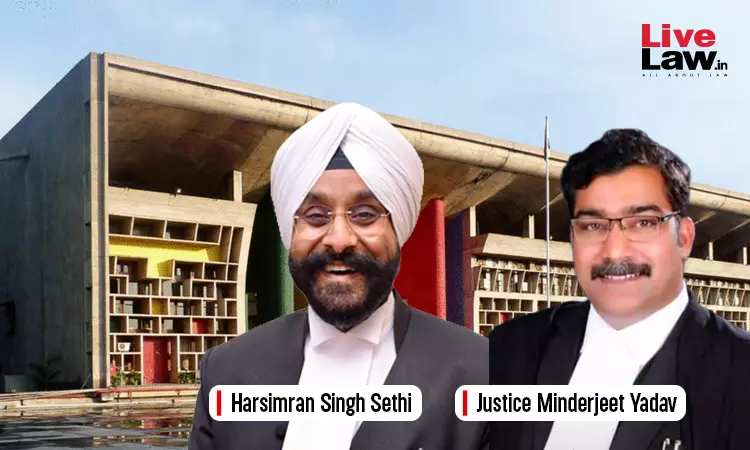
A Division Bench of the Punjab & Haryana High Court comprising Justice Harsimran Singh Sethi and Justice Minderjeet Yadav held that outsourced employees engaged through a private agency cannot claim regularisation of services without any master-servant relationship with the employer. Background Facts The employees (respondents) were working with the PEPSU Road...
This is a premium content
Available exclusively to
Our subscribers
Subscribe Premium 
INR 1099+GST
Your support helps us to bring you more content at
an affordable subscription scheme !!!
All payment options available
A Division Bench of the Punjab & Haryana High Court comprising Justice Harsimran Singh Sethi and Justice Minderjeet Yadav held that outsourced employees engaged through a private agency cannot claim regularisation of services without any master-servant relationship with the employer.
Background Facts
The employees (respondents) were working with the PEPSU Road Transport Corporation (PRTC) through an outsourcing agency, M/s S.S Service Providers. Their appointments were made by the private agency. However, they were posted with the PRTC. The employees were performing duties of Drivers, Conductors etc.
The employees filed a writ petition seeking regularisation. They claimed that an employee who had worked continuously for 10 years is entitled to regularisation. The Single Judge noticed that the appointments were made by an outsourcing agency. However, the Single Judge treated PRTC as the employer for all intents and purposes.
Therefore, it was directed by the Single Judge that the employees should be regularised with the PRTC. It was further directed that other benefits, including the Old Pension Scheme should also be given.
Aggrieved by the same, the PRTC filed batch of appeals before the Punjab & Haryana High Court.
It was argued by the PRTC that there was no master-servant relationship between the PRTC and the respondents. Therefore, the Single Judge was wrong in treating them as employees of the PRTC and granting regularisation.
It was further argued that not even a single document was placed on record to show that the respondents were appointed by the PRTC. Further, there was also no document to show that the PRTC had given them any employee status during their service.
On the other hand, it was argued by the respondents that they were working through a private outsourcing agency. However, they had been continuously working for the PRTC and performing their duties. It was also argued that the Punjab Ad hoc, Contractual, Daily Wage, Temporary, Work Charged and Outsourced Employees' Welfare Act, 2016, supported their claim for regularisation.
Further, reliance was placed upon the Rule 8 of PEPSU Road Transport Corporation Employees (Conditions of Appointment and Service) Regulations, 1981 which describes the method of recruitment. It was submitted that once the outsourcing agency can be brought in to provide manpower, such manpower can be treated as employees of the PRTC.
Findings and Observations of the Court
It was observed by the Division Bench that the master-servant relationship between the PRTC and the respondents had to be proved on the basis of written documents including the appointment order etc. it was observed that the Advertisement was issued by a private agency for recruitment to the posts including Drivers, Conductors etc.
It was observed that the appointment orders of the respondents were issued by the private agency. The only duties performed by the respondents with the PRTC were in pursuance to the contract for providing manpower between the PRTC and the private outsourcing agency. It was noted that there was no appointment order issued by the PRTC at any given point of time during the service career of the respondents.
It was held by the Division Bench that outsourced employees cannot claim the pay admissible on the regular establishment or regularization. Reliance was placed on judgment in The Municipal Council, Rep. by its Commissioner, Nandyal Municipality, Kurnool District, A.P. v. K. Jayaram & Ors, wherein it was held that no such benefit can be made admissible to an outsourced employees even if they have worked for a long duration.
Further, the case of Jaggo vs. Union of India was relied upon wherein it was held that the nature of the work and the reality of the employment must be considered rather than merely relying on labels such as temporary, part-time or contractual.
It was held that merely because the respondents were working at PRTC after being appointed by the private agency, they could not be treated as employees of PRTC. Therefore, they could not claim regularisation of their services with PRTC.
It was further observed that master and servant relationship had to be proved through appointment. Mere working with the PRTC will not be good enough to treat the respondents as the employee of the PRTC. It was also noted that the Agreement between the PRTC and the private agency did not give jurisdiction to the PRTC to invoke disciplinary proceedings and punish such employees.
It was further noted that the provident fund of the respondents who have been employed by the outsourcing agency was managed by the Contractor and not by the PRTC. Also the salary to all the respondents was paid by the Contractor.
Therefore, it was held by the Division Bench that an appointment through a private contractor under an outsourcing arrangement cannot be termed as a temporary appointment by the PRTC so as to claim that the respondents were employees of the Corporation.
Further, Section 6 of the Punjab Ad hoc, Contractual, Daily Wage, Temporary, Work Charged and Outsourced Employees' Welfare Act, 2016, was relied upon. It provides that State entities shall take outsourced employee on contracts with the establishment. If the entity is in a financial position to bear the burden of such contracts on its own, then it can regularize the employees.
It was concluded by the Division Bench that an outsourced employee, who was recruited through an outsourcing agency cannot be treated as an employee of the State so as to claim the benefit of regularisation.
With the aforesaid observations, the order of the Single Judge was set aside by the Division Bench. Consequently, the batch of appeals filed by the PRTC were allowed by the Division Bench.
Case Name: Pepsu Road Transport Corporation vs. Daljeet Singh and Others
Case No. : CM-5935-LPA-2026 and CM-5936-LPA-2026 in/and LPA-1549-2026 (O&M)
Counsel for the Appellants : M.S Bedi , Advocate General, Punjab with Abhilaksh Gaind, Standing Counsel, PRTC and Rakesh Roy, Advocate
Counsel for the Respondent : Rajiv Pratap Atma Ram, Senior Advocate with Arjun Pratap Atma Ram, Advocate and Shreya Kaushik, Advocate