



- Home
- /
- High Courts
- /
- Punjab and Haryana High Court
- /
- Motor Accident Victims Entitled To...
Motor Accident Victims Entitled To No-Fault Compensation Even If Accident Caused By 'Act Of God': P&H High Court
Aiman J. Chishti
12 Nov 2026 10:15 AM IST
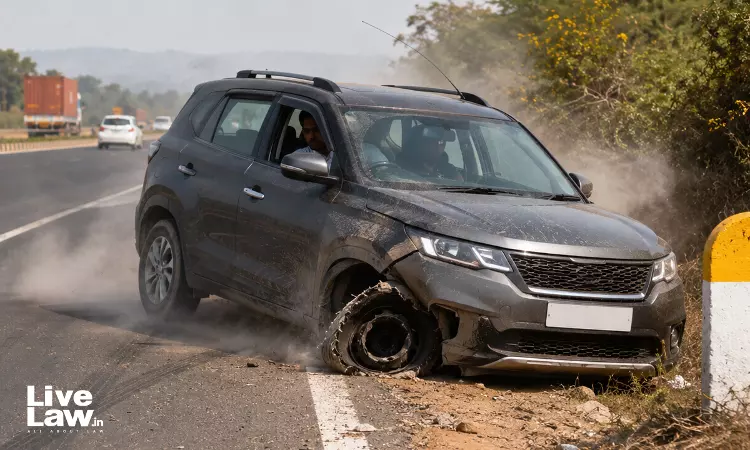
The Punjab and Haryana High Court has held that motor accident victims are entitled to no-fault compensation even where the accident was caused by an “Act of God”. In this case, a mass of ice fell on a car near Dalhousie in 1997. The Court held that the use of a motor vehicle is all that needs to be shown.Justice Parmod Goyal observed, “Once it is proved that deceased...
This is a premium content
Available exclusively to
Our subscribers
Subscribe Premium 
INR 1099+GST
Your support helps us to bring you more content at
an affordable subscription scheme !!!
All payment options available
The Punjab and Haryana High Court has held that motor accident victims are entitled to no-fault compensation even where the accident was caused by an “Act of God”. In this case, a mass of ice fell on a car near Dalhousie in 1997. The Court held that the use of a motor vehicle is all that needs to be shown.
Justice Parmod Goyal observed,
“Once it is proved that deceased and appellants-claimants were travelling in the car when they had met with an accident which may be an 'Act of God', the use of motor vehicle also stands proved so as to invoke no fault liability for payment of compensation. No fault liability shall include even 'Act of God'.”
The Court awarded ₹2.5 lakh each to four family members who were grievously injured, with interest at 6% from the date they filed their claims. It upheld the dismissal of the claim for the death of the car's owner, who was driving at the time.
On March 9, 1997, Dr. Rajiv Rampal was driving his family near Lakkar Mandi, Dalhousie, while snow was falling. According to the claimants, he and his wife had quarrelled, and he kept driving at high speed despite being asked to park. A huge mass of ice fell on the car and pushed it into a deep gorge. Dr. Rampal died, and the four other occupants were grievously injured.
In March 2004, the Motor Accident Claims Tribunal, Amritsar, dismissed all five claims. It held that the accident was an “Act of God”, that no negligence by any driver had been proved, and that the car was the only vehicle involved. The claims had remained pending in appeal since 2004.
Before the High Court, the claimants argued that even if negligence was not proved, the use of the car was proved, so compensation was payable on a no-fault basis under the amended Section 164 of the Motor Vehicles Act, 1988.
No Negligence, But No-Fault Liability Applies
The Court agreed with the Tribunal that negligence had not been proved. It noted that the two injured witnesses were “interested witnesses”, and that “falling of glacier cannot be held to be an act of negligence on the part of driver of offending vehicle”. It then held:
“Therefore, in present case, even though the accident had taken place on account of 'Act of God' i.e. falling of glacier/snow on the vehicle in which deceased and appellants-claimants were travelling, they shall be entitled to compensation under no fault liability as death, and injuries had occurred on account of use of motor vehicle bearing registration No.PID 3086 which was duly insured with respondent-Insurance Company.”
New Section 164 Replaces Three 'Compartments' With Two
The Court explained that before the 2019 amendment, compensation was available under three provisions: Section 140: no-fault compensation, payable once use of a motor vehicle was proved;
Section 163A: structured no-fault compensation, available only to claimants with an annual income of ₹40,000 or less;
Section 166: compensation on proof of fault.
With effect from April 1, 2022, the Court said, the legislature has “simplified payment of compensation to a victim of road accident by dividing into two compartments”: compensation for use of the vehicle, irrespective of fault; and compensation for fault.
The Court noted that earlier, a claim under Section 163A could not easily be converted into one under Section 166, or the other way round. It held that the position is now different,
“Therefore, with amendment even if a petition under Section 166 of 1988 Act fails, the provisions of Section 164 of 1988 Act would come in play and compensation would be payable under no-fault liability irrespective of fact that whether the petition was filed under 164 of 1988 Act or not or whether any application to convert the petition from under Section 166 to 164 of 1988 Act has been preferred or not. The invocation of Section 164 would automatically come in operation on failure of victim to prove rash and negligent driving on the part of offending vehicle but by showing involvement of offending vehicle in the accident.”
Applied To 1997 Accident
On whether Section 164, in force from April 1, 2022, could apply to an accident in 1997, the Court said the issue was “not res integra”. It relied on three Supreme Court decisions, Roopa v. Manager, Orix Auto Infrastructure Service Ltd. (decided on 27.04.2026);
According to the Court, these decisions held that the amendment “is procedural in nature therefore, it is applicable retrospectively and compensation in cases where the accident had taken place prior to 01.04.2022 shall be payable”.
Owner-Driver's Death Not Covered
The insurer argued that Dr. Rampal, as the owner who was driving the car, was not a “third party”. It pointed out that the policy covered only a paid driver, and no premium had been paid to cover the owner. The Court accepted this and held that “this Court has no option except to agree” that no compensation was payable for his death. The appeal by his wife and children was dismissed “even after treating the same under Section 164 of 1988 Act.”
The four appeals by the injured claimants were allowed, each with a lump sum of ₹2.5 lakh and 6% interest from the date of the claim petition.
Aiman J. Chishti
Aiman J. Chishti is a Principal Correspondent with LiveLaw, covering Punjab And Haryana High Court

