



- Home
- /
- High Courts
- /
- Punjab and Haryana High Court
- /
- PMLA | Abuse Of Fiduciary...
PMLA | Abuse Of Fiduciary Structures Warrants Greater Circumspection: P&H High Court Denies Bail In ₹236 Cr Bank Fraud Case
Aiman J. Chishti
3 Sept 2026 4:30 PM IST
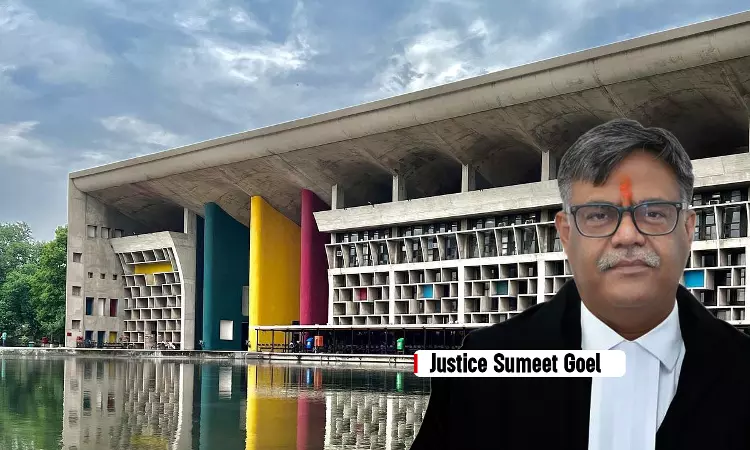
The Punjab and Haryana High Court has dismissed a regular bail application in a money-laundering case arising from an alleged ₹236 crore bank fraud, holding that economic offences involving calculated design, manipulation of records and misuse of corporate or fiduciary structures warrant a more circumspect approach than offences committed in a moment of passion or impulse.Justice Sumeet...
This is a premium content
Available exclusively to
Our subscribers
Subscribe Premium 
INR 1099+GST
Your support helps us to bring you more content at
an affordable subscription scheme !!!
All payment options available
The Punjab and Haryana High Court has dismissed a regular bail application in a money-laundering case arising from an alleged ₹236 crore bank fraud, holding that economic offences involving calculated design, manipulation of records and misuse of corporate or fiduciary structures warrant a more circumspect approach than offences committed in a moment of passion or impulse.
Justice Sumeet Goel said, "Eonomic offence(s) are frequently characterised by calculated design, deliberation, sophistication and a conscious abuse of financial, commercial and fiduciary mechanisms. Unlike an offence which may be committed in a moment of passion, impulse or sudden provocation, an economic offence(s) may, indubitably depending upon its factual matrix, involve a preconceived course of conduct, preparation, manipulation of records or transactions, diversion or layering of funds, creation of fictitious documentation, misuse of corporate or fiduciary structures, concealment of the proceeds or coordinated participation of several persons."
The Court highlighted that the "absence of physical violence, therefore, cannot by itself dilute the seriousness of the alleged criminality or the potential consequences flowing therefrom."
The case arose from ECIR registered by the Enforcement Directorate under the PMLA following a CBI scheduled offence alleging criminal conspiracy, cheating, forgery and diversion of bank funds by M/s Richa Industries Limited (RIL), a textile and pre-engineered building company whose accounts had been declared fraudulent.
The ED's case is that RIL's funds and business assets, generating alleged proceeds of crime of about ₹236 crores, were systematically diverted through shell entities, including Saariga Constructions Pvt. Ltd. (SCPL), Subhash Gupta & Sons Pvt. Ltd., Riyana Infratech Pvt. Ltd. and Richa Krishna Constructions Pvt. Ltd, using fabricated accounts, accommodation entries, corporate guarantees and related-party transactions, and then projected as legitimate money.
The petitioner, described in the CBI charge-sheet as RIL's then Managing Director, was alleged to be the de facto controlling authority behind SCPL despite not being a formal director, and to have continued exercising influence over RIL's projects even during its Corporate Insolvency Resolution Process, including recommending vendor payments to SCPL.
He was arrested on 20.01.2026, and the prosecution complaint was filed on 19.03.2026, citing 25 witnesses. His earlier bail application was rejected by the Special Court, which found prima facie material indicating his active involvement in RIL's financial and operational affairs.
Senior counsel for the petitioner argued that he had been in custody for about seven months, that investigation qua him stood completed with the prosecution complaint already filed, that the evidence was predominantly documentary and already in the ED's possession (eliminating tampering risk), that he had deep roots in society and was not a flight risk, that he was not in custody in the predicate offence, and that the trial, given 1,245 documents running over 28,000 pages and 187 witnesses in the scheduled offence alone, still at the pre-cognizance/notice stage, was unlikely to conclude in the near future, violating his Article 21 right to speedy trial.
The ED opposed bail, arguing that the allegations went beyond ordinary commercial transactions to a systematic scheme of fund diversion, fabrication and layering timed around RIL's insolvency; that the petitioner had failed to satisfy the twin conditions under Section 45 PMLA; and that seven months' custody, given the gravity of allegations, did not ipso facto warrant release.
The Court laid out an extensive list of factors relevant to bail generally, nature and gravity of accusation, role attributed, quality of material, risk of absconding or tampering, period of custody, likelihood of timely trial conclusion, among others, before turning specifically to economic offences
The Court held that this distinction assumes particular significance where the material is not vague or omnibus but contains specific, direct evidence, documentary trails, communications, corporate records, statements, attributing a definite and active role to the accused, in such cases, the Court must approach bail "with greater circumspection."
In the of the above, the Court found a "rather specific and direct role" attributed to the petitioner, who allegedly had effective control over RIL and its group concerns. It noted sufficient prima facie material, witness statements, WhatsApp communications with persons connected to SCPL, and his alleged direct involvement during the CIRP, reflecting his direct and active role in the alleged ₹236 crore laundering scheme.
The Court held that with 25 witnesses yet to be examined, it could not, at this stage, find reasonable grounds to believe the petitioner was not guilty of the alleged offence, nor could it assess the evidentiary value of the material without prejudicing the trial.
On custody period, the Court held that seven months, without more, was insufficient to justify bail given the present stage of trial and the nature of allegations:
"This period, by itself, cannot be construed to be sufficient, at least for the nonce, to afford benefit of bail to the petitioner on the ground of his long incarceration when considered vis-à-vis the present stage of trial."
Dismissing the petition "for the nonce," the Court clarified that its observations would not affect the merits of the case and directed the trial Court to proceed uninfluenced by the order.
Counsel for Petitioner: Mr. Preetinder Singh Ahluwalia, Senior Advocate, with Mr. Tejeshwar Singh and Mr. Aryan Bajaj, Advocates Counsel for Respondent-ED: Mr. Zoheb Hossain, Senior Advocate (through VC), with Mr. Lokesh Narang, Senior Panel Counsel, and Ms. Shubhleen Dhariwal, Advocate

Aiman J. Chishti
Aiman J. Chishti is a Principal Correspondent with LiveLaw, covering Punjab And Haryana High Court

