



- Home
- /
- High Courts
- /
- Punjab and Haryana High Court
- /
- Punjab & Haryana High Court Grants...
Punjab & Haryana High Court Grants Pre-Arrest Bail To Chartered Accountants In Case Involving ₹1,596 Crore SRS Group Fraud
LIVELAW NEWS NETWORK
13 Nov 2025 6:51 PM IST
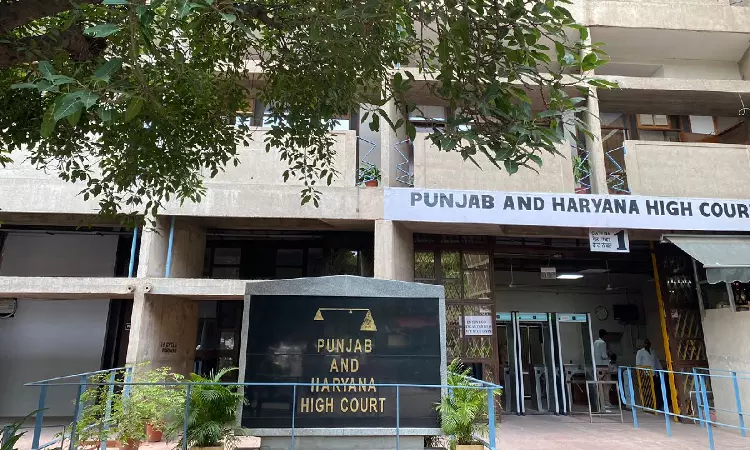
The Punjab & Haryana High Court recently granted anticipatory bail to a group of Chartered Accountants accused by the Serious Fraud Investigation Office (SFIO) in connection with the alleged ₹1,596.94 crore fraud by the SRS Group of Companies. The Court, by a common order, disposed of multiple pending bail applications of eight Chartered Accountants by classifying them into two...
This is a premium content
Available exclusively to
Our subscribers
Subscribe Premium 
INR 1099+GST
Your support helps us to bring you more content at
an affordable subscription scheme !!!
All payment options available
The Punjab & Haryana High Court recently granted anticipatory bail to a group of Chartered Accountants accused by the Serious Fraud Investigation Office (SFIO) in connection with the alleged ₹1,596.94 crore fraud by the SRS Group of Companies. The Court, by a common order, disposed of multiple pending bail applications of eight Chartered Accountants by classifying them into two categories — Statutory Auditors and Internal Auditors.
The Court, by a common order, disposed of multiple pending bail applications of eight Chartered Accountants.
In a 42-page order passed on October 28, the Court opined that, "The investigators should have summoned or arrested all the accused involved and taken steps to recover the proceeds of crime. Instead of arresting, they preferred to complete the investigation without recovering the material object — i.e., the money that was usurped — and are now hunting for someone to blame."
"If there were intentional lapses by Chartered Accountants, why were they not arrested and subjected to a custodial investigation before the complaint was filed? The siphoning of massive funds points to failures not only of the Chartered Accountants but also of the Regulators and Tax Authorities, as well as loopholes in statutes and rules," the judge added.
Background
The proceedings stem from a complaint filed by the SFIO before the Special Court at Gurugram against 81 accused persons for violations of various provisions of the Companies Act, 1956 and 2013. The complaint followed an order of investigation dated 01.08.2018 issued by the Ministry of Corporate Affairs under Section 212(1)(a) of the Companies Act, assigning the probe into the affairs of SRS Ltd. and its 88 group companies.
The investigation revealed that the SRS Group, under the control of its promoters Anil Jindal, Jitender Kumar Garg, Praveen Kumar Kapoor, Bishan Bansal, Nanak Chand Tayal, Rajesh Singla, and Sushil Singla, had allegedly diverted and siphoned off bank loans obtained from a consortium led by State Bank of India and other public sector banks.
Allegations Against the Petitioners
According to the SFIO, the Chartered Accountants, in their capacity as Statutory or Internal Auditors, allegedly certified falsified financial statements and failed to conduct proper due diligence as mandated under the auditing standards. Specific allegations were made against each auditor for their respective audit years and companies under the SRS Group.
In a detailed analysis of the investigation record, the complaint, and the replies of the lending banks. The Court observed:
"Chartered Accountants, had no role in obtaining bank loans. Thus, the only role this Court sees is the rotation of funds and the siphoning off of funds by the SRS Group of Companies. If the auditors were involved, there had to be a criminal conspiracy by the Chartered Accountants, including whether the Statutory Auditors or the Internal Auditors were the main controllers of the SRS Group, as mentioned..."
The judge opined that, "There is no evidence that any of the statutory or internal auditors were paid or given undue favors, which would serve as a motive to favor the company in return. In the absence of any such undue favors, the culpability is reduced to dereliction of duty, for which custodial interrogation is not required."
The Court further observed that, "Section 212 of the Companies Act, 2013 empowers the Serious Fraud Investigation Office to investigate into affairs of Company. The powers of bail are subject to rigors of §212(6)1 of the Companies Act, 2013. However, except in strict liability cases or civil offences which are quasi criminal for recovery of the money and valuables, the criminal jurisprudence puts the primary burden on the accuser and not on the accused."
The doctrine of reverse burden activates when any accused takes the burden on themselves or the statutes place the burden on such an accused. Even where the statutes put a burden on the accused, the burden on such an accused shifts only after the accusers have discharged the primary burden, it added.
Applicability of Section 212(6) of the Companies Act
The Court examined the rigours of Section 212(6) of the Companies Act, 2013, which imposes twin conditions for granting bail in offences under Section 447 (fraud). Referring to Serious Fraud Investigation Office v. Nittin Johari (2019) and Y.S. Jagan Mohan Reddy v. CBI (2013) 7 SCC 439, the Court reiterated that:
“While the statute makes bail stringent in economic offences, the primary burden still lies on the prosecution to establish a prima facie case of conspiracy or monetary gain.”
In the absence of such material, the Court held that the statutory bar on bail under Section 212(6) did not apply to the present petitioners.
Parity and Systemic Failure
The Court also took note that two co-accused Chartered Accountants — Ruchi Jain and Pankaj Mittal — had already been granted bail by the trial court. It emphasised the principle of parity, noting that all the petitioners were similarly placed.
Highlighting systemic lapses, the Court remarked:
"Regarding disbursal of loans from the loan taken by SRS Group from the consortium of banks, the non-inspection of statutory registers is to be seen in the light of the fact that the Income Tax department did not timely survey the individuals and corporate bodies who had obtained the loans."
The Court pointed that, "the manner in which the money was routed, rotated, and loans were disbursed points to a systematic failure by financial institutions, the Taxation departments, the Department of Income Tax, and the consortium of banks, all of whom failed to predict, track, and unearth such massive sham transactions."
In light of the above, the plea was allowed.
Title: Anuj Agarwal v. Serious Fraud Investigation Officer
Citation: 2025 LiveLaw (PH) 440
Tags


