Gravity Of Corruption Offence Alone Not Ground To Refuse Suspension Of Sentence Pending Appeal: P&H High Court
Aiman J. Chishti
23 Nov 2026 4:30 PM IST
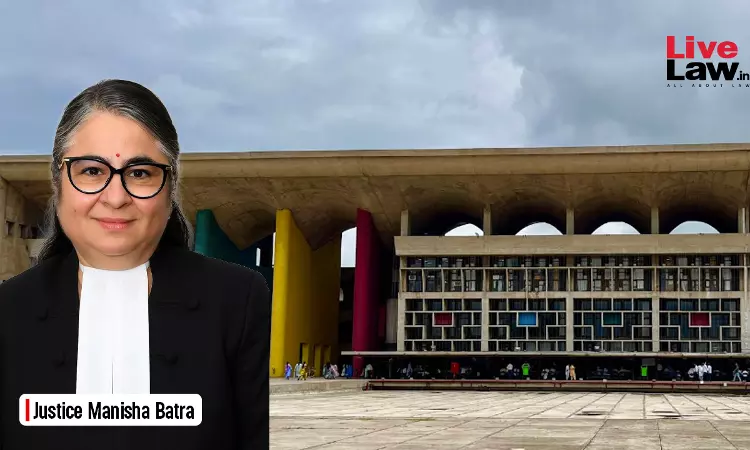
The Punjab and Haryana High Court suspended the four-year sentence of an Assistant in the explosives controller's office, who was convicted in a 2017 CBI bribery trap case.
The Court has held that the gravity of an offence under the Prevention of Corruption Act, though relevant, cannot by itself justify refusing to suspend a fixed-term sentence of four years while the appeal is pending.
Justice Manisha Batra observed, “No statutory restriction against suspension of sentence under the PC Act has been brought to the notice of this Court. The gravity of the offence, though undoubtedly a relevant consideration, cannot by itself be treated as an exceptional circumstance in a case of a fixed term of four years.”
The Court suspended the sentence of the appellant, who was an Assistant in the office of the Deputy Chief Controller of Explosives, Manimajra, Chandigarh. A Special CBI Court in Chandigarh had convicted him under Sections 7 and 13(2) read with Section 13(1)(d) of the PC Act.
According to the prosecution, the complainant, a blaster by profession, had applied to amend his licence. The appellant allegedly demanded a bribe of ₹8,000, saying ₹3,000 was for himself and ₹5,000 for the Controller of Explosives. The CBI laid a trap on 11.07.2017 and recovered the tainted notes from underneath the keyboard of the appellant's computer table.


The appellant was arrested on the day of the trap and released on bail on 23.08.2017. He stayed on bail throughout the trial. On 18.08.2026, the Special Judge convicted him. On 20.08.2026, he was sentenced to four years' rigorous imprisonment and a fine of ₹10,000 under each section, with the sentences to run concurrently.
Senior Advocate Bipan Ghai, for the appellant, argued that demand and acceptance had not been proved. He contended that the shadow witness said the demand on the day of the trap was made only by a gesture, the complainant admitted that no fresh demand was made that day. The spy camera did not show the bribe being accepted and the complainant is heard on the audio recording referring to a drawer, while the recovery is shown from under the keyboard slider.
Counsel added that the appellant had been on bail for about nine years without misusing his liberty, had no criminal antecedents, and had already spent about three months in custody. He said that because the sentence was a fixed term of four years and the appeal was unlikely to be heard soon, the appeal would become infructuous. He relied on the Supreme Court's decision in Sohail Gohar v. State of Madhya Pradesh (Criminal Appeal No. 2058 of 2025).
For the CBI, the Special Public Prosecutor argued that corruption offences “strike at the root of public administration”. He said the trial court had found demand and acceptance proved through the consistent testimony of witnesses, the recorded conversation, the voice report, the phenolphthalein test and the recovery of the notes. He argued that the discrepancies were minor, that suspension is not to be granted routinely after conviction, and that Sohail Gohar turned on its own facts because the appellant there had already served more than nine months.
Liberal Approach For Fixed-Term Sentences
The Court relied on Bhagwan Rama Shinde Gosai v. State of Gujarat (1999), where the Supreme Court held, “When a convicted person is sentenced to fixed period of sentence and when he files appeal under any statutory right, suspension of sentence can be considered by the appellate court liberally unless there are exceptional circumstances... Otherwise the very valuable right of appeal would be an exercise in futility by efflux of time.”
It also referred to Aasif @ Pasha v. State of U.P. (2025 INSC 944). The judgment describes that case as one where the Supreme Court set aside a High Court's refusal to suspend a four-year sentence, and held that only compelling circumstances showing that release would not be in the public interest can justify refusal.
The Court noted that in Sohail Gohar, the Supreme Court had granted bail to a person convicted under the same PC Act provisions, with a maximum sentence of four years, taking note of the huge pendency of criminal appeals. It observed that “the offences and the sentence in the present case are identical.”
Custody Period In Sohail Gohar Not Decisive
The Court rejected the CBI's argument that the nine months of custody in Sohail Gohar was what decided that case, “The argument that the custody of nine months in Sohail Gohar's case (supra) was the deciding factor is not well founded, as the Hon'ble Supreme Court primarily proceeded on the liberal approach applicable to fixed term sentences and the pendency of appeals, which holds equally good here.”
Nine Years On Bail Without Misuse
The Court also gave weight to the appellant's conduct while on bail, “More so, the appellant remained on bail for about nine years from 23.08.2017 and nothing has been brought to the notice of this Court to show that he misused the liberty or tampered with the prosecution evidence. This circumstance indicates that he is not likely to flee from justice. The record of the trial which continued for nine years is voluminous and the appeal is not likely to be taken up soon.”
The application under Section 430 BNSS was allowed. The sentence was suspended while the appeal is pending, and the appellant was ordered to be released on bail on furnishing bonds. He must not leave the country without the Court's permission.
Mr. Roshan Lal Saini, Advocate for the appellants.
Mr. Punit Jain, Advocate for respondent No.2 – Insurance Company.