



- Home
- /
- High Courts
- /
- Punjab and Haryana High Court
- /
- P&H High Court Quashes DSP's...
P&H High Court Quashes DSP's Dismissal Over Lawrence Bishnoi Jail Interview, Holds Alleged Non-Cooperation Can't Justify Dispensing With Enquiry
LIVELAW NEWS NETWORK
3 Sept 2026 12:25 PM IST
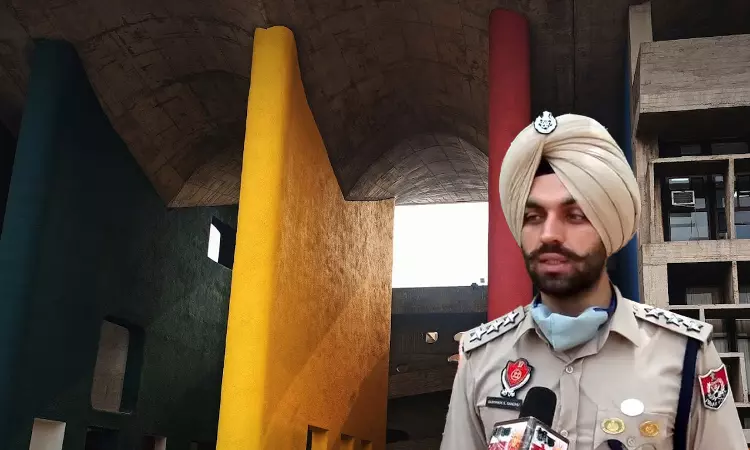
The Punjab and Haryana High Court has quashed the dismissal of a Deputy Superintendent of Police, who was removed from service by invoking the extraordinary power under Article 311(2)(b) of the Constitution in connection with the widely reported jail interview of gangster Lawrence Bishnoi, holding that alleged non-cooperation and evasion of a charge-sheet, even if true cannot by itself...
This is a premium content
Available exclusively to
Our subscribers
Subscribe Premium 
INR 1099+GST
Your support helps us to bring you more content at
an affordable subscription scheme !!!
All payment options available
The Punjab and Haryana High Court has quashed the dismissal of a Deputy Superintendent of Police, who was removed from service by invoking the extraordinary power under Article 311(2)(b) of the Constitution in connection with the widely reported jail interview of gangster Lawrence Bishnoi, holding that alleged non-cooperation and evasion of a charge-sheet, even if true cannot by itself satisfy the constitutional threshold for dispensing with a regular departmental enquiry.
Justice Namit Kumar noted, "Nothing has been placed on record to demonstrate that any genuine attempt was made to serve the charge-sheet upon the petitioner at his known permanent address at Jalandhar or through any other mode available in law. There is also no material to suggest that the petitioner had created a situation in which the holding of a departmental enquiry had become impracticable. Non-service of the charge-sheet at an address from which the petitioner had already been transferred cannot be equated with deliberate evasion of service, particularly when the respondents themselves were aware of his correct address and set the disciplinary machinery in motion by issuing show-cause notices, as well as charge-sheet..."
The Court added, "Once the department had considered it feasible to initiate and proceed with regular disciplinary proceedings, the subsequent decision to abandon that course and resort to Article 311(2)(b) of the Constitution required the existence of a subsequent or newly arisen circumstance making the enquiry not reasonably practicable. The impugned order does not demonstrate the existence of any such circumstance."
The petition was filed by a 2016-batch DSP in Punjab Police, was posted as DSP (Detective), SAS Nagar, around the time gangster Lawrence Bishnoi, then in custody at CIA Staff, Kharar in connection with the Sidhu Moosewala murder investigation, was interviewed by a news channel while in police custody. The interview, aired in March 2023, triggered a suo motu PIL before the High Court (Court on its own motion v. State of Punjab) on the use of mobile phones inside jails.
A Special Investigation Team found that not one but two such interviews had been conducted, and the Court directed registration of FIRs and a fresh SIT-led investigation.
The petition was filed by the then posted as DSP (Special Branch & Criminal Intelligence), SAS Nagar, cooperated with the SIT and was subsequently transferred. He was issued two show-cause notices (19.09.2024 and 14.10.2024) alleging lapses in supervising CIA Staff, Kharar, and responded to both.
He was thereafter suspended and issued a formal charge-sheet on 25.10.2024 which, on his case, was never properly served, as it was affixed at his old, vacated Chandigarh residence instead of his known permanent Jalandhar address. Before he could effectively respond, the State recommended his dismissal, and on 02.01.2025, he was dismissed by invoking Article 311(2)(b) of the Constitution, dispensing with the regular departmental enquiry on the ground that his "non-cooperative attitude" made holding an enquiry impracticable.
Notably, even after his dismissal, the joint departmental enquiry (conducted by Justice Rajiv Narain Raina, a former Judge of the High Court) covering the petitioner and eight other officers connected to the same episode continued, and the petitioner himself appeared before the Enquiry Officer through virtual mode on multiple dates and filed a reply to the charge-sheet, before proceedings against him were finally closed in May 2026 on account of his prior dismissal.
The petitioner's senior counsel inter alia argued that dismissal is a major penalty which ordinarily requires a regular enquiry, and that Article 311(2)(b) can be invoked only in genuinely exceptional circumstances rendering an enquiry "not reasonably practicable", not merely because an employee is uncooperative.
The State defended the dismissal, contending that the petitioner had evaded service of the charge-sheet and shown a non-cooperative attitude amid the gravity of the allegations, justifying dispensation of the enquiry, and that due process, including PPSC consultation had otherwise been followed.
The Court undertook a detailed review of the law on Article 311(2)(b), extensively tracing the Constitution Bench ruling in Union of India v. Tulsiram Patel, (1985) 3 SCC 398, which held that the power to dispense with an enquiry is exceptional and requires (i) a situation genuinely rendering an enquiry "not reasonably practicable," and (ii) reasons recorded in writing and that a disciplinary authority "is not expected to dispense with a disciplinary enquiry lightly or arbitrarily or out of ulterior motives."
It similarly relied on Jaswant Singh v. State of Punjab, Ex. Const. Chhote Lal, Tarsem Singh and Risal Singh for the proposition that the decision to dispense with an enquiry cannot rest on the "ipse dixit" of the authority and must be founded on objective material — such as threats to witnesses or the Enquiry Officer, rather than mere apprehension of non-cooperation.
In the light of the above, the Court found that on the record, the petitioner had actively participated at every stage until the charge-sheet replying to both show-cause notices and seeking documents undermining any claim that he had "disappeared from the proceedings."
Secondly, the charge-sheet was sent to an address the petitioner had already vacated, despite the department admittedly knowing his correct Jalandhar address (where earlier communications had been served). The Court held that non-service at a wrong address "cannot be equated with deliberate evasion of service."
The Court further pointed that the joint enquiry against the petitioner and eight other officers over the very same occurrence continued even after his dismissal, and that the petitioner himself appeared before the Enquiry Officer and filed his reply on 01.11.2025.
"The subsequent conduct of the petitioner is wholly inconsistent with the assertion that he was unwilling to participate in, much less obstruct, the departmental proceedings to such an extent that it was not reasonably practicable to hold an enquiry against him... the respondents cannot, on the one hand, contend that holding an enquiry against the petitioner was not reasonably practicable and, on the other hand, themselves proceed with the very same enquiry after his dismissal," it added.
The Court held the SIT report recommending departmental action was, at best, akin to a preliminary enquiry report and could not substitute for a regular departmental enquiry or independently justify invoking Article 311(2)(b).
It further referred to Punjab DGP's own 2022 guidelines, issued pursuant to an earlier High Court order in Ex. Constable Vikas v. State of Punjab, cautioning that Article 311(2)(b) orders must not be passed mechanically and cannot rest on ipse dixit, and noted a pattern of such orders being repeatedly struck down by the High Court,
Allowing the plea, the Court quashed the dismissal order dated 02.01.2025 and directed the reinstatement of the petitioner with all consequential benefits, clarifying that this was without prejudice to the State's right to continue the pending departmental enquiry against him before the Enquiry Officer, Justice Rajiv Narain Raina (Retd.).
Case Title: Gursher Singh Sandhu v. State of Punjab & others
Mr. D.S.Patwalia, Senior Advocate, assisted by
Mr. Bikramjit Singh Patwalia, Mr. Gaurav Jagota and Mr. Edward George Masih, Advocates, for the petitioner.
Mr. P.I.P. Singh, Addl. AG, Punjab, assisted by
Ms. Anisha, Mr. Amitoj Bir Singh, Ms. Sakshi Sehgal and Mr. Gurvishwraj Singh, Advocates, for the respondents.


