



- Home
- /
- High Courts
- /
- Punjab and Haryana High Court
- /
- Employees Appointed Before 2004...
Employees Appointed Before 2004 Eligible For Old Pension Scheme Even If Regularised Later: P&H High Court Rejects PGIMER's Plea
Aiman J. Chishti
16 Oct 2026 7:00 PM IST
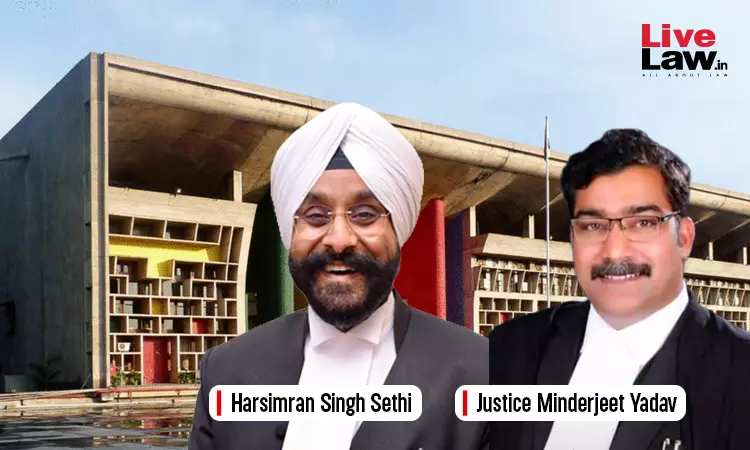
The Punjab and Haryana High Court has dismissed a writ petition filed by PGIMER, Chandigarh against a Central Administrative Tribunal (CAT) order granting the Old Pension Scheme to three employees. The employees were engaged as work-charged Mortar Mates in 1994 and regularised only in 2016.A Division Bench of Justice Harsimran Singh Sethi and Justice Minderjeet Yadav held that an...
This is a premium content
Available exclusively to
Our subscribers
Subscribe Premium 
INR 1099+GST
Your support helps us to bring you more content at
an affordable subscription scheme !!!
All payment options available
The Punjab and Haryana High Court has dismissed a writ petition filed by PGIMER, Chandigarh against a Central Administrative Tribunal (CAT) order granting the Old Pension Scheme to three employees. The employees were engaged as work-charged Mortar Mates in 1994 and regularised only in 2016.
A Division Bench of Justice Harsimran Singh Sethi and Justice Minderjeet Yadav held that an employee appointed before the New Pension Scheme came into force on January 1, 2004 is entitled to the Old Pension Scheme even if regularisation came after that date. The Bench also rejected PGIMER's objections that the employees were paid from the contingency fund and that no sanctioned posts existed.
The Court observed, “...once the appointment continues for a period of three decades, merely that the petitioners were paying the respondents out of the contingency fund, will not defeat the claim of the respondents to be treated under the Old Pension Scheme.”
The employees were engaged between January and June 1994 as temporary/work-charged Mortar Mates. They were placed in a regular pay scale and received annual increments from the date of appointment. Although first engaged for six months, they continued to work because the work existed, and their services were regularised under a decision dated August 6, 2016.
PGIMER refused to extend the Old Pension Scheme to them after regularisation. The CAT allowed their Original Application on September 9, 2025, relying on Harbans Lal v. State of Punjab (CWP-2371-2010, decided on August 31, 2010). PGIMER challenged that order before the High Court.
PGIMER conceded that the employees had been in a regular pay scale with yearly increments. It argued, however, that as work-charged employees they had been paid from the contingency fund, so the Old Pension Scheme could not apply.
It further argued that there was no sanctioned post of Mortar Mate when the employees were regularised in 2016, and so the Tribunal could not have granted them the Old Pension Scheme.
The Court noted that several facts were undisputed and he employees had worked continuously for 32 years in a regular pay scale with increments from 1994, they were regularised in 2016, and two of them had since retired.
The Court relied on Harbans Lal, in which a Division Bench held that an employee whose service began before January 1, 2004 is deemed to have been in government service before that date, even if regularised afterwards. Such an employee would not be governed by the new Defined Contribution Pension Scheme. The Court noted that the Supreme Court had upheld Harbans Lal in SLP No. 4769 of 2014.
It also referred to the Supreme Court's recent decision in Punjab School Education Board v. Satnam Singh, 2026 INSC 965. That judgment approved Harbans Lal and held that service rendered on contract, ad hoc or daily-wage basis before regularisation must be counted as qualifying service for pension.
Applying these principles, the Court held that the employees, having been appointed long before the New Pension Scheme came into force, were entitled to the Old Pension Scheme despite their later regularisation. It recorded that PGIMER's counsel “has not been able to dispute the settled principles of law.”
The Bench rejected the argument that no sanctioned post existed. It reasoned that if this argument were accepted, “then even the regularization could not have been ordered.” Since the employees had been regularised against other vacant posts despite there being no sanctioned Mortar Mate posts, those posts had to be treated as Mortar Mate posts “for all intents and purposes.” The argument could not be used to deny them the Old Pension Scheme.
Payment From Contingency Fund
On the contingency-fund argument, the Court noted that the employees had received a regular pay scale with annual increments from their initial appointment. It observed that if they had truly been engaged on a contingency basis, they would not have received this benefit, as such an appointment would be only a stop-gap arrangement for a specific purpose. An engagement lasting three decades could not be defeated merely because the salary was paid from the contingency fund.
Finding no ground to interfere, the Court dismissed the petition.
Appearance: Ms. Sukhmani Patwalia, Advocate (through VC), for the petitioner. Mr. Karan Singla, Advocate, for respondents No. 3 to 5.
Tags

Aiman J. Chishti
Aiman J. Chishti is a Principal Correspondent with LiveLaw, covering Punjab And Haryana High Court

