



- Home
- /
- High Courts
- /
- Punjab and Haryana High Court
- /
- S.528 BNSS | High Court's Inherent...
S.528 BNSS | High Court's Inherent Powers Can't Be Used As Disguised Second Revision: P&H High Court
Aiman J. Chishti
29 Sept 2026 12:40 PM IST
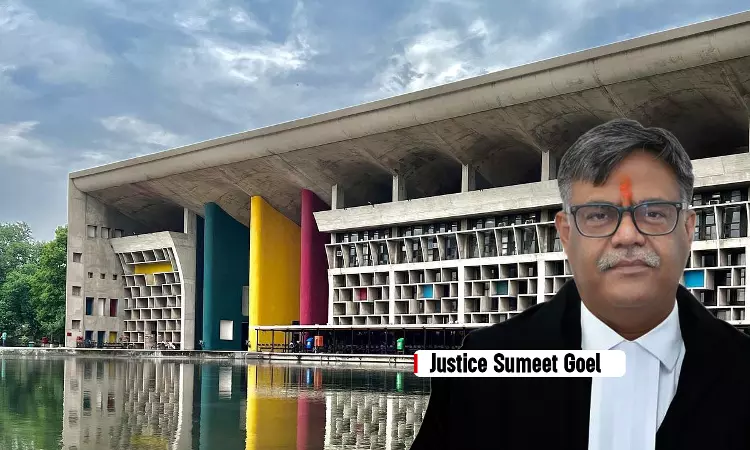
The Punjab and Haryana High Court has held that a petition under Section 528 of the Bharatiya Nagarik Suraksha Sanhita, 2023 (BNSS) to invoke High Court's inherent powers against an order passed by a Sessions Court in revision operates within an "extraordinarily constricted domain", and the petitioner must show an egregious failure of justice or a glaring jurisdictional defect.Justice Sumeet...
This is a premium content
Available exclusively to
Our subscribers
Subscribe Premium 
INR 1099+GST
Your support helps us to bring you more content at
an affordable subscription scheme !!!
All payment options available
The Punjab and Haryana High Court has held that a petition under Section 528 of the Bharatiya Nagarik Suraksha Sanhita, 2023 (BNSS) to invoke High Court's inherent powers against an order passed by a Sessions Court in revision operates within an "extraordinarily constricted domain", and the petitioner must show an egregious failure of justice or a glaring jurisdictional defect.
Justice Sumeet Goel dismissed a challenge to a Sub-Divisional Magistrate's order directing a receiver to hand over about 514 kanals of land in District Kaithal to a samadh. The petitioners had claimed the land under a 99-year lease executed in 1970.
"When a Court of Sessions has already tested the correctness of an order through revisional jurisdiction; restricting its own review to correcting patent illegality, procedural impropriety, or manifest miscarriage of justice; a petition under Section 528 BNSS virtually morphs into a disguised second revision, which is barred both in letter and spirit under procedural code (BNSS). Consequently, the petitioner shoulders a heavily accentuated burden to demonstrate an egregious failure of justice or a glaring jurisdictional defect, for inviting an interference by the High Court, in such cases."
The Court added further, "This restraint assumes heightened significance where the lis between the parties hinges upon intricate, disputed questions of fact, such as possession, title, and the legal construction or effect of a lease-deed, which are alien to summary proceedings."
The dispute concerns about 514 kanals 6 marlas of land in Village Gohana, District Kaithal. The petitioners claim rights under a registered lease-deed dated 06.06.1970, said to have been executed by the Mohatmim of Samadh Baba Nihal Gir for 99 years, from 1971 to 2070, for ₹60,000. They relied on a mutation of 1972 and later jamabandis (Record of Rights) and khasra girdawaris (possession records) to show continuous cultivating possession.
According to the petitioners, they learned in 2008 that the girdawari entries (possession records) had been changed in favour of the samadh. The Assistant Collector, 1st Grade, later corrected the entries in their favour, but on appeal the matter was remanded and is still pending.
The petitioners alleged that the respondents tried to take forcible possession on 18.05.2015, and they filed a civil suit for injunction. The private respondents started proceedings under Sections 145 and 146 CrPC. On 01.06.2015, the SDM, Kaithal, attached the land and appointed the Naib Tehsildar as receiver. On 11.12.2017, the Additional Sessions Judge set this order aside because the Magistrate had not recorded the satisfaction required under Section 145.
On a fresh application by the private respondents, the SDM, by order dated 04.01.2018, directed the receiver to deliver possession to Samadh Baba Nihal Gir through its Mahant. The Additional Sessions Judge, Kaithal, dismissed the petitioners' revision on 26.07.2024. He noted that the petitioners' civil suit had been dismissed on 29.08.2015 and their appeal on 10.01.2023, and that a regular second appeal was pending in the High Court.
The petitioners argued that the SDM had not properly considered the lease-deed, the revenue entries or the revenue authorities' reports showing their continuous possession. They said they could not be dispossessed except in accordance with law.
It was submitted that since the 2015 attachment order had been set aside, the later order directing delivery of possession was untenable. They also argued that their rights under a subsisting lease running to 2070 could not be defeated through proceedings under Sections 145 and 146 CrPC.
The State submitted that the dispute was essentially private and Senior counsel for the private respondents argued that the SDM's order had no illegality or jurisdictional error. He said the civil court had already decided the dispute against the petitioners, and the revisional court had considered the revenue record and the civil court's judgment.
Scope of Section 528 BNSS
The Court said inherent powers must be exercised sparingly, only to prevent abuse of process or to secure the ends of justice. It drew a distinction between two kinds of challenge. Where the High Court is approached directly against an order of the court or authority of first instance, it has "a broader canvas" to examine perversity or illegality. Where the challenge is to an order passed by a Sessions Court in revision, the High Court's review is far narrower.
Revision is itself confined to patent illegality, jurisdictional error and manifest perversity. A further challenge under Section 528 against a revisional order therefore amounts to a disguised second revision, which the BNSS bars. The petitioner in such a case "shoulders a heavily accentuated burden".
The Court added that this restraint matters even more where the dispute turns on contested questions of possession, title and the effect of a lease-deed, which are "alien to summary proceedings".
In the present case, the Court noted that the dispute had not stayed confined to the revenue record. The petitioners' civil suit and first appeal had both been dismissed, and a regular second appeal was pending. They could not seek "a complete re-adjudication" of the parties' rights through a quashing petition.
The Court held that the ASJ's order of 11.12.2017 did not help the petitioners, since it was based on the material and circumstances at that time. It held that the registered lease-deed could not, at this stage, be treated as conclusive of possession.
It found that the revisional court had not dismissed the revision mechanically, but had considered the later developments, including the civil and revenue proceedings. The petitioners had not shown that this reasoning was perverse or that any material document or statutory provision had been ignored.
The Court found no exceptional circumstance warranting interference and dismissed the petition. It clarified that its observations are not an expression of opinion on any substantive right or claim of the parties pending before a civil, revenue or appellate forum.
Case Title: Rampal and Others v. State of Haryana and Others
Mr. P.S. Dhaliwal, Advocate for the petitioners. Mr. Gurmeet Singh, AAG Haryana.
Mr. S.K. Garg Narwana, Senior Advocate with Mr. Nitin Sachdeva, Advocate for respondent Nos.4, 5, 8, 9, 11 to 15, 17, 18, 20, 22 and 24 to 40)
Aiman J. Chishti
Aiman J. Chishti is a Principal Correspondent with LiveLaw, covering Punjab And Haryana High Court

