



- Home
- /
- High Courts
- /
- Rajasthan High Court
- /
- Daily-Wage Workers Can't Afford...
Daily-Wage Workers Can't Afford Unpaid Weekly Offs: Rajasthan HC Rejects 26-Day Wage Formula, Seeks Correction Of Govt Order
Nupur Agrawal
11 Feb 2026 11:40 AM IST
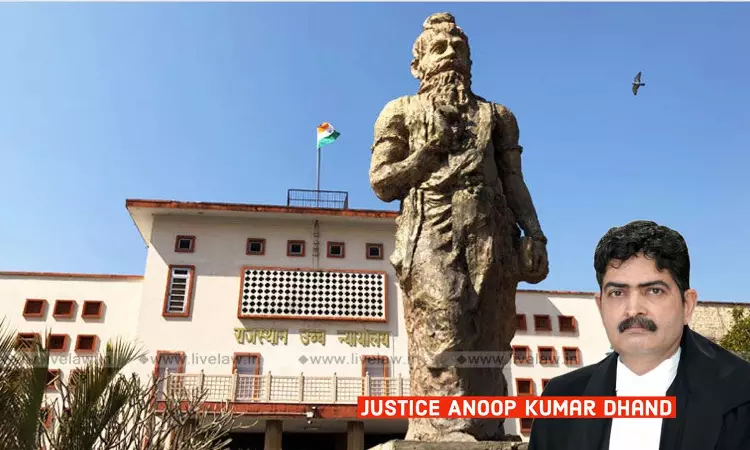
While underscoring the ground realities of working conditions for daily-wage workers, Rajasthan High Court held that not every daily wage worker received paid-rest day every week. Hence, they cannot afford such unpaid rest day. Therefore, calculation of a daily wage worker's monthly wage should not happen based on 26 days, rather than 30 days. The bench of Justice Anoop Kumar Dhand observed...
This is a premium content
Available exclusively to
Our subscribers
Subscribe Premium 
INR 1099+GST
Your support helps us to bring you more content at
an affordable subscription scheme !!!
All payment options available
While underscoring the ground realities of working conditions for daily-wage workers, Rajasthan High Court held that not every daily wage worker received paid-rest day every week. Hence, they cannot afford such unpaid rest day. Therefore, calculation of a daily wage worker's monthly wage should not happen based on 26 days, rather than 30 days.
The bench of Justice Anoop Kumar Dhand observed that the 26-day rule was followed based on a notification/circular issued by the Ministry & Department of Labour, which presumed that such labour remained on holiday for one day every week, based on mandates of Labour Laws that required workers to get at least one day off per week.
However, the Court highlighted that the ground reality was completely different wherein not a single daily wager got paid for any of the rest days. And in this light, considering the financial situation of such labour, they cannot afford to take rest days which were unpaid.
In this background, the Court held that the notification/circular by the Ministry was inappropriate and needed suitable and necessary corrections, such that the minimum wages of daily wage workers should be counted for 30 days instead of 26 days.
“In the considered opinion of this Court, daily wage earners, who often live in hand to mouth situation, face severe financial distress when they take unpaid weekly holidays or offs, as they do not receive guaranteed pay for those days on which they did not work. While labour laws often mandate that at least one weekly off must be given to such labours. Daily wagers typically receive payment only for the days actually worked by them, meaning thereby a holiday usually results in a loss of income to them.”
The Court was hearing an appeal challenging the compensation awarded by the Accident Claims Tribunal to the claimant in relation to an accident that resulted in 13% permanent disability in his leg.
Two arguments were raised by the appellant. Firstly, it was submitted that the appellant was working as a “Beldar” which was treated as an unskilled labour, however ought to have been treated as a skilled labour. Secondly, it was argued that the minimum wages were calculated for 26 days, while a daily wage worker was supposed to work for 30 days a month.
After hearing the contentions, the first argument was rejected by the Court basis notifications issued by the Department of Labour that categorized “Beldar” as unskilled labour.
In relation to the second argument, the Court agreed with the appellant, and made the observations mentioned above.
“Labour laws in India mandate that workers get at least one day off per week… But, unfortunately the labour are not paid for any holiday or leave taken by them. Hence, they have no option, except to work regularly for seven days in every week to earn bread and butter for their family. Hence, by any stretch of imagination, it cannot be presumed that every daily wager would remain on leave for one day in each week of every month.”
It was held that such labour had no leisure to take unpaid leave, and hence the general presumption was that they work on each day of the month.
In this light, the appeal was allowed partly wherein the compensation amount was enhanced by calculating the minimum wages for 30 days instead of 26 days.
Further, the order was directed to be sent to the concerned departments at the Union as well as the State, so that appropriate steps could be taken to modify the notification/circular dealing with payment of minimum wages to daily wage workers for 30 days instead of 26 days.
Accordingly, the appeal was disposed of.
Title: Laxman Kumawat v Madan Singh & Anr.
Citation: 2026 LiveLaw (Raj) 55
Tags


