



- Home
- /
- High Courts
- /
- Rajasthan High Court
- /
- Motor Accident Compensation Can't...
Motor Accident Compensation Can't Be Based Solely On Basic Salary; Employment-Related Allowances Must Be Included: Rajasthan High Court
Nupur Agrawal
6 Oct 2026 10:20 AM IST
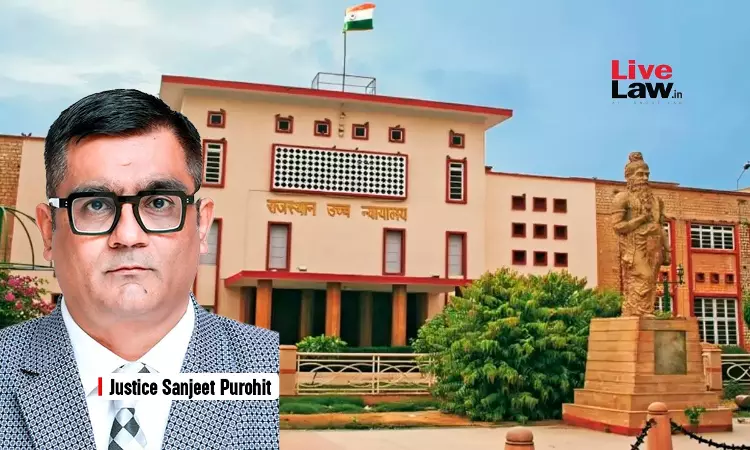
The Rajasthan High Court has held that employment-related allowances forming part of a deceased employee's regular earnings must be taken into account while assessing his income for computation of motor accident compensation, and cannot be excluded merely because they are described as allowances.The bench of Justice Sanjeet Purohit observed that the assessment of income cannot be confined to...
This is a premium content
Available exclusively to
Our subscribers
Subscribe Premium 
INR 1099+GST
Your support helps us to bring you more content at
an affordable subscription scheme !!!
All payment options available
The Rajasthan High Court has held that employment-related allowances forming part of a deceased employee's regular earnings must be taken into account while assessing his income for computation of motor accident compensation, and cannot be excluded merely because they are described as allowances.
The bench of Justice Sanjeet Purohit observed that the assessment of income cannot be confined to the basic salary reflected in a salary certificate where the evidence establishes that the employee was regularly receiving additional monetary benefits as part of his service conditions.
The Court accordingly included the deceased's ₹2,000 monthly telephone and petrol allowances while assessing his monthly income at ₹6,800, and enhanced the compensation from ₹6,15,500 to ₹13,18,650.
The Court was hearing an appeal against the order of the Accidents Claims Tribunal (the “Tribunal”), filed by the claimants, challenging the quantum of the compensation.
For context, the deceased was working as a supervisor at an art emporium and was receiving a monthly salary of Rs. 4800/- as per his salary certificate. Furthermore, based on the statement of his employer, he was also receiving telephone and petrol allowances of Rs. 2000/- per month.
However, at the time of computing the compensation, the Tribunal assessed his monthly income only at Rs. 4800/-, while ignoring the allowances. This was one of the grounds on which the amount of compensation was challenged by the petitioners.
On the contrary, it was argued by the respondents that the telephone and petrol allowances were in the nature of expenses incurred in the course of employment and thus could not be treated as part of the income of the deceased for computing compensation.
After hearing the contentions, the Court opined that while assessing the income of a deceased for computing compensation under the Motor Vehicles Act, the Court was required to consider the real earnings and pecuniary benefits that the deceased was getting from his employment.
Reference was made to the Supreme Court case of Triveni Kodkany v. Air India Ltd., in which it was held,
“income of the deceased for the purpose of computation of compensation has to be assessed on the basis of the entire remuneration and benefits receivable by the employee and that allowances forming part of the employment package cannot be excluded merely because the salary is bifurcated under different heads.”
In this background, the Court held that Tribunal should have considered the monthly salary of the deceased to be Rs. 6800/- instead of Rs. 4800/-/
Accordingly, while considering other arguments of the petitioners, ultimately the compensation was enhanced from around Rs. 6 Lakhs to around Rs. 13 Lakhs.
Tags


