



- Home
- /
- High Courts
- /
- Rajasthan High Court
- /
- Single Blunt Blow Causing Grievous...
Single Blunt Blow Causing Grievous Injury Not Attempt To Murder Without Homicidal Intent: Rajasthan High Court
Nupur Agrawal
21 Jan 2026 10:00 AM IST
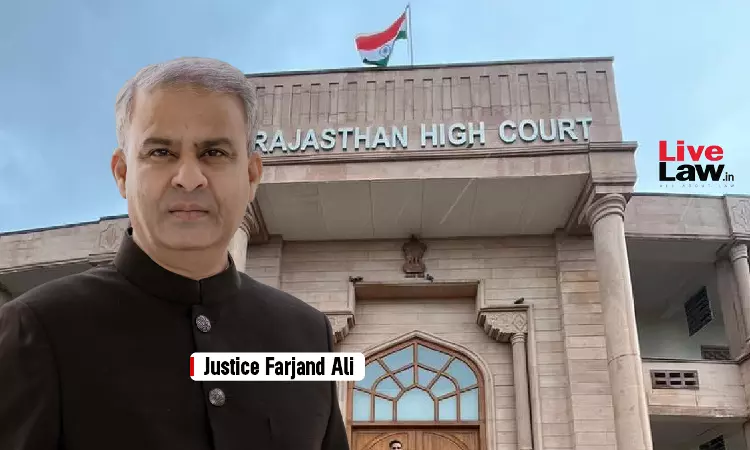
The Rajasthan High Court has ruled that a single blow on head with a blunt object resulting in grievous injury does not quality as an attempt to murder in absence of repeated blows with such ferocity that reflect a deliberate design to extinguish life, since mens rea of a homicidal degree is sine qua non for the offence of attempt to murder. The bench of Justice Farjand Ali further observed...
This is a premium content
Available exclusively to
Our subscribers
Subscribe Premium 
INR 1099+GST
Your support helps us to bring you more content at
an affordable subscription scheme !!!
All payment options available
The Rajasthan High Court has ruled that a single blow on head with a blunt object resulting in grievous injury does not quality as an attempt to murder in absence of repeated blows with such ferocity that reflect a deliberate design to extinguish life, since mens rea of a homicidal degree is sine qua non for the offence of attempt to murder.
The bench of Justice Farjand Ali further observed that every inimical relationship or alleged animosity does not ipso facto translate into an intention to kill. For the offence of attempt to murder, the animosity has to be so acute and intense that it reasonably leads to the inference that one party intended to eliminate the other.
The Court was hearing a revision petition challenging framing of charges by the Trial Court that included attempt to murder.
The parties to the case belonged to the same family and were embroiled in long pending civil and criminal litigations in relation to property disputes that had allegedly resulted in harbouring of animosity by the petitioners against the respondents.
After hearing the contentions, and perusing Section 307, IPC (attempt to murder), the Court opined that the decisive and indispensable requirement of the provision was the existence of a homicidal intention or knowledge at the time of commission of the act.
The Court highlighted that the legislature had carved out a well demarcated classification of bodily injuries ranging from hurt to grievous hurt, and such classification was not ornamental but substantive that intended to ensure proportionality between culpability and punishment.
It was held that in this framework, Section 307 was on a distinct qualitative plane from the offences of hurt and grievous hurt, irrespective of superficial overlap in the resultant physical injuries.
“The existence of such an elaborate framework militates against a casual or mechanical escalation of offences into the realm of Section 307 IPC…The provision criminalises the attempt, not the consequence; it punishes the dangerous proximity of the act to the commission of murder, judged through the prism of intention, knowledge and surrounding circumstances. It is for this reason that the law has consistently held that even grievous, life-threatening or permanent injuries do not, ipso facto, attract Section 307 IPC, unless the mental element accompanying the act demonstrably reflects a design to cause death or such bodily injury as is sufficient in the ordinary course or nature to cause death.”
In this background, the Court analysed the material on record, and held that it did not disclose such intention or knowledge on part of the petitioner. Even though the single lathi blow on the respondent's head was grievous, the blow was not repeated with such ferocity to suggest that the petitioner adopted a method which unmistakably reflected deliberated design to murder.
The Court also considered the factual background, and highlighted that the parties belonged to the same family with several litigations pending.
“While animosity and inimical relations are alleged, it is well-settled that every inimical relationship does not ipso facto translate into an intention to kill. Animosity is a double-edged sword; it may provide motive for false implication as much as it may explain the occurrence. For invoking Section 307 IPC, the animosity must be of such an acute and intense degree that it reasonably leads to the inference that one party intended to eliminate the other.”
In this background, it was held that the trial court committed an error in framing the charge of attempt to murder.
Accordingly, the petition was partly allowed, and the charge under Section 307 was dropped against the petitioner.
Title: Radhakishan & Anr. v State of Rajasthan & Anr.
Citation: 2026 LiveLaw (Raj) 29


