



- Home
- /
- High Courts
- /
- Rajasthan High Court
- /
- Rajasthan High Court Slams Lawyers'...
Rajasthan High Court Slams Lawyers' Strike Over Working Saturdays, Says Boycott Of Courts Violates Litigants' Rights Under Article 21
Nupur Agrawal
28 Jan 2026 10:00 AM IST
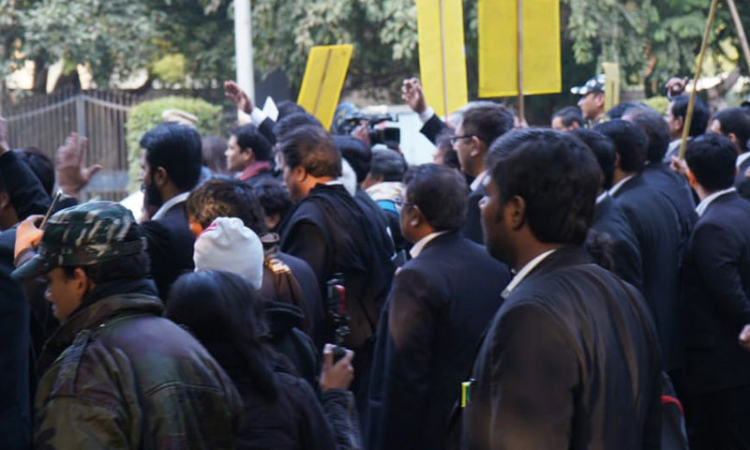
The Rajasthan High Court has frowned upon lawyers' strike to protest against its decision making two Saturdays working in every month, reiterating that lawyers have no right to strike especially when the matter involves personal liberty of citizens.The bench of Justice Anoop Kumar Dhand held that when lawyers boycott Courts, it results in direct violation of the litigants' rights to...
This is a premium content
Available exclusively to
Our subscribers
Subscribe Premium 
INR 1099+GST
Your support helps us to bring you more content at
an affordable subscription scheme !!!
All payment options available
The Rajasthan High Court has frowned upon lawyers' strike to protest against its decision making two Saturdays working in every month, reiterating that lawyers have no right to strike especially when the matter involves personal liberty of citizens.
The bench of Justice Anoop Kumar Dhand held that when lawyers boycott Courts, it results in direct violation of the litigants' rights to speedy justice guaranteed under Article 21 of the Constitution. The Court opined that the right to protest has to be balanced with the rights of other citizens such as the right to life and personal liberty.
The Court was hearing an application by a convict who was in jail for almost 8 years after being convicted under the NDPS Act. A release order was passed by the trial court in October 2025, however, since the applicant was not able to fulfill one of the monetary conditions imposed for the release, he was still in prison.
While expressing displeasure over the strike by the lawyers at the Court following the resolutions passed by three different Bar Association, the Court referred to the Supreme Court case of Ex-Capt. Harish Uppal Vs. Union of India & Another, which held that lawyers had no right to strike and that such abstention from work held the litigants at ransom.
The Court highlighted that the cause list for such Saturdays clearly indicated that the presence of counsels shall not be mandatory. Even otherwise, it was stated that a committee was already constituted to look into the grievances of the bar, whose decision was still awaited.
“Going on strike and remaining absent from Court work is not a solution. All problems have solution and can be settled by debates and dialogues. Every challenge has a solution. Debates and dialogues can lead to a better understanding and also necessary for achieving any solutions… Inspite of above, a call of strike/remaining absent from work by the lawyers is not warranted.”
The Court further held that right to dissent or expressing opinions was a fundamental right, however, such right was not absolute and was generally expected to be exercised peacefully without causing public disorder or hampering the cause of justice.
In this background, the application was disposed of in the favour of the applicant, ordering his release.
Title: Rajesh Kushwah v State of Rajasthan
Citation: 2026 LiveLaw (Raj) 35
Tags


