



- Home
- /
- High Courts
- /
- Rajasthan High Court
- /
- Dying Declaration Lacking Medical...
Dying Declaration Lacking Medical Certification Unsafe For Conviction: Rajasthan High Court Acquits Man Booked For Setting Wife Ablaze
Nupur Agrawal
27 Feb 2026 10:45 AM IST
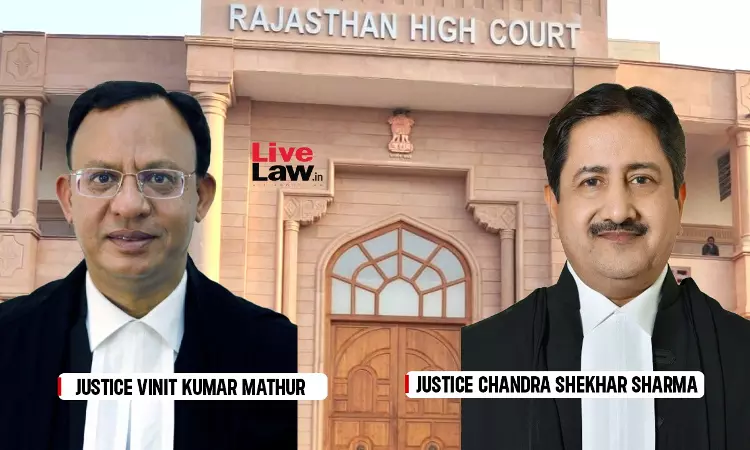
The Rajasthan High Court has acquitted a man convicted for his wife's murder by setting her on fire, in light of the fact that there was no medical endorsement on the dying declaration certifying that the deceased was conscious, oriented and in a mentally fit state to make a statement. The division bench of Justice Vinit Kumar Mathur and Justice Chandra Shekhar Sharma further observed that...
This is a premium content
Available exclusively to
Our subscribers
Subscribe Premium 
INR 1099+GST
Your support helps us to bring you more content at
an affordable subscription scheme !!!
All payment options available
The Rajasthan High Court has acquitted a man convicted for his wife's murder by setting her on fire, in light of the fact that there was no medical endorsement on the dying declaration certifying that the deceased was conscious, oriented and in a mentally fit state to make a statement.
The division bench of Justice Vinit Kumar Mathur and Justice Chandra Shekhar Sharma further observed that no records of pulse rate, blood pressure or extent of burns, at the relevant time, was produced, neither the declaration was recorded or certified by any executive or judicial magistrate despite their offices being located just 500 feet away.
The Court was hearing an appeal filed against the order of the Additional Sessions Judge that convicted the appellant for murdering his wife who succumbed to 90% burn injuries, allegedly caused by her husband's act of pouring kerosene on her, and setting her on fire.
The primary evidence of the prosecution case was the dying declaration of the deceased recorded by the Investigating Office (“IO”) of the case.
It was the case of the appellant that the dying declaration was not recorded by an executive or judicial magistrate, despite them being just 500 feet away from the hospital. Further, there was no cogent evidence put forth to establish that the deceased was in a fit physical and mental state to give a statement. It was also submitted that contradictions existed in other evidences too.
On the contrary, the public prosecutor argued that the dying declaration was recorded in the presence of a doctor and stood corroborated by the testimonies of the IO and the medical witness.
After hearing the contentions, the Court highlighted that it was IO's admitted position that neither any written endorsement was taken from the doctor certifying deceased's fit state to give a statement, nor any written requisition was made to the doctor in this regard. It was only a verbal inquiry.
Further, no document was put on record, written by a medical officer that indicated the pulse rate, blood pressure or percentage of burns suffered by the deceased. It was also an admitted position that offices of executive/judicial magistrate were nearby, but they were not contacted for recording the statement of the deceased.
The Court further considered the statement of the medical officer in whose presence the alleged dying declaration was taken and highlighted that it was admitted by him that he did not make any endorsement or verification on the dying declaration regarding the fitness of the deceased for giving the statement, since he was busy attending to other patients.
In this light, it was held that such testimonies did not conclusively establish that the deceased was in a mentally or physically fit condition to make a statement.
After assessing other testimonies and evidence, the Court opined that the prosecution case suffered from serious infirmities.
“…a dying declaration, if found to be voluntary, truthful and recorded in a fit state of mind, can form the sole basis of conviction. However, the converse is equally true: where the dying declaration is surrounded by suspicious circumstances, lacks procedural safeguards and is not free from doubt, it would be unsafe to place implicit reliance upon it.”
In the background of lack of medical endorsement; lack of record on pulse rate and other vitals of deceased; and lack of involvement of magistrate who was in close proximity, the Court opined that the alleged dying declaration could not inspire confidence.
Taking a holistic view of the alleged dying declaration and other evidence of the prosecution, the appeal was allowed, and the husband was acquitted of all charges.
Title: Soma v State
Citation: 2026 LiveLaw (Raj) 78
Tags


