



- Home
- /
- High Courts
- /
- Rajasthan High Court
- /
- Revised Pay Rules | Doctors...
Revised Pay Rules | Doctors Consciously Engaged In Private Practice Can't Seek Non Practicing Allowance Attached To Surrender: Rajasthan HC
Nupur Agrawal
31 May 2026 10:00 AM IST
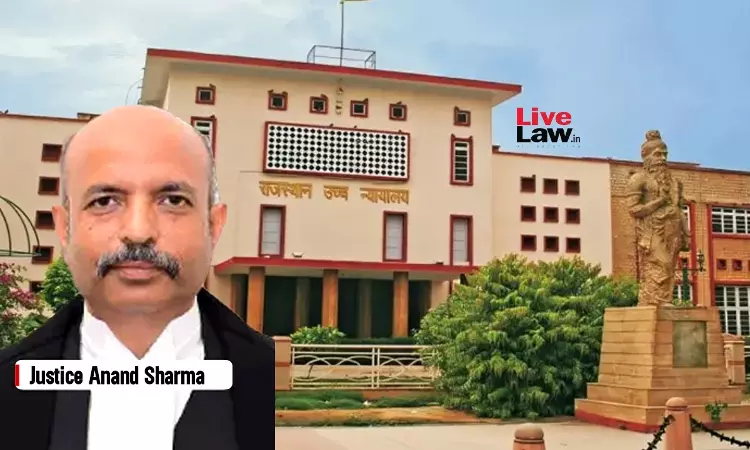
Rajasthan High Court set aside the order that directed the State to step up the pay of those Medical Officers who had not opted for Non-Practicing Allowance (NPA), to ensure their pay parity with their juniors who had opted for the NPA.For context, the law provides for payment of NPA (calculated at 20% of the Basic Pay) to those Medical Officers who choose to not undertake any private...
This is a premium content
Available exclusively to
Our subscribers
Subscribe Premium 
INR 1099+GST
Your support helps us to bring you more content at
an affordable subscription scheme !!!
All payment options available
Rajasthan High Court set aside the order that directed the State to step up the pay of those Medical Officers who had not opted for Non-Practicing Allowance (NPA), to ensure their pay parity with their juniors who had opted for the NPA.
For context, the law provides for payment of NPA (calculated at 20% of the Basic Pay) to those Medical Officers who choose to not undertake any private practice, and were subjected to disciplinary action in case of any violation. While those Medical Officers who choose to continue their private practice are not entitled to NPA.
Justice Anand Sharma observed that Rajasthan Civil Services (Revised Pay Scale) Rules recognized two separate classes of medical officers, with and without NPA, for pay fixation. Once the distinction was statutorily recognized, it could not be pleaded that both categories were similarly situated for the purpose of revision of pay.
“Consequently, a Medical Officer, who did not opt for or was not drawing NPA on the relevant date, cannot claim parity with a Medical Officer, who was actually receiving NPA…Therefore, there exists no similarity or equivalence between the employees governed by Rule 11(A) of the Rules of 2017 and those governed by Rule 11(B) of the Rules of 2017 for the purpose of revision and fixation of pay. Hence, under these circumstances, stepping up of pay cannot be claimed by those, who are covered by Rule 11(A) of the Rules of 2017, qua those, whose pay fixation has been made by virtue of Rule 11(B) of the Rules of 2017…”
It further said:
"The Court also finds substance in the contention raised by the petitioners that doctors declining NPA continue to enjoy the benefit of private practice and corresponding monetary gain therefrom. Therefore, comparison solely on the basis of salary drawn from Government service would be wholly artificial and incomplete. A doctor, who consciously elects to continue private practice, cannot thereafter seek the financial advantages attached to surrender of such practice".
The Court was hearing a bunch of matters wherein the State had challenged an order by the Rajasthan Service Appellate Tribunal, directing State to step-up pay of those Medical Officers who were being paid lesser than their juniors due to NPA.
It was alleged by the respondent-Medical Officers that NPA was merely an allowance, and could not be merged with the basic pay. Further, it was submitted that juniors with NPA were illegally getting higher pay.
Hence, it was pleaded that the respondents be granted notional addition of NPA or a step up of pay to be at par with the juniors since seniors could not be paid lesser than their juniors.
On the contrary, it was argued by the State that the pay fixation was not an anomaly but a direct consequence of the option consciously exercised by every Medical Officer.
After hearing the contentions, the Court highlighted that the entire case of the respondents was based on the argument that despite declining NPA, they should be treated at par with those who opted for NPA.
While calling this argument “fundamentally misconceived”, the Court opined that grant of NPA was not attached to any post, but wholly dependent upon the concerned employees exercising that choice, followed by fulfilment of mandatory procedural and substantive conditions.
Hence, the distinction between the two set of employees was founded on conscious and voluntary exercise of options.
The Court further highlighted that such pay parity could not be considered “pay anomaly” because such anomaly arose between two identically situated set of employees. In the present case, one category of employees voluntarily surrendered private practice and accepted NPA, while the other consciously chose to continue private practice by declining NPA.
In relation to the argument that juniors could not draw higher pay than the seniors, the Court held that,
“…mere seniority does not guarantee identical pay where difference arises due to operation of statutory rules, grant of additional allowances, special incentives or exercise of options by employees themselves. The higher pay being drawn by juniors in the present case is not on account of arbitrary action of the State but due to a lawful benefit available only to those doctors who had opted for NPA.”
Accordingly, the Court allowed the petitions, while setting aside orders of the tribunals in all these matters.
Title: State of Rajasthan & Anr. v Dr. Dinesh Kumar Sharma, and other connected matters
Citation: 2026 LiveLaw (Raj) 209
Counsel for Petitioners: Mr. Archit Bohra Additional Government Counsel with Mr. Yashwant Singh Advocate & Mr. Rahul Verma Advocate, Mr. Vikas Kabra Advocate through Video Conferencing. Mr. Ashok Bansal Advocate, Mr. Tanveer Ahamad Advocate & Mr. Amir Aziz Advocate
Counsel for Respondents: Mr. Ashok Bansal Advocate. Mr. Vikas Kabra Advocate through Video Conferencing. Ms. Chelsi Agarwal Advocate on behalf of Mr. Mahi Yadav Additional Advocate General.
Tags


