



- Home
- /
- High Courts
- /
- Rajasthan High Court
- /
- Rape By Father 'Transcends Ordinary...
Rape By Father 'Transcends Ordinary Criminality'; Victim-Daughter's Testimony Sufficient: Rajasthan High Court
Nupur Agrawal
9 Jan 2026 3:35 PM IST
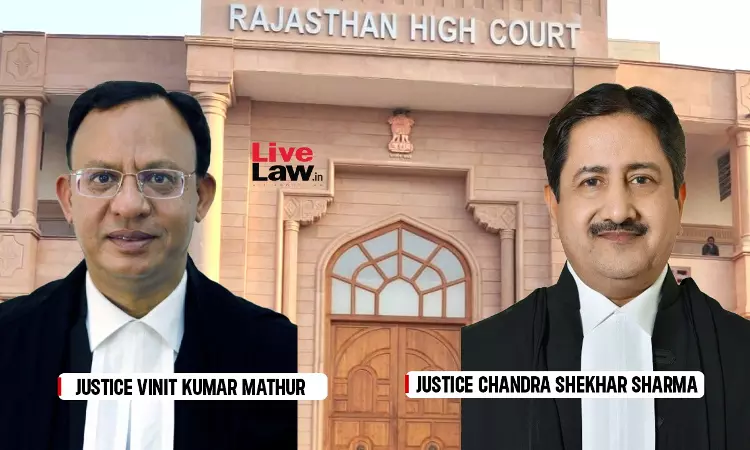
While dismissing an appeal against a rape conviction in a POCSO Case, the Rajasthan High Court held that the testimony of the victim herself, being the daughter of the convict, constituted the best possible evidence of the occurrence, since there was no reason for her to falsely implicate her own father. The division bench of Justice Vinit Kumar Mathur and Justice Chandra Shekhar Sharma...
This is a premium content
Available exclusively to
Our subscribers
Subscribe Premium 
INR 1099+GST
Your support helps us to bring you more content at
an affordable subscription scheme !!!
All payment options available
While dismissing an appeal against a rape conviction in a POCSO Case, the Rajasthan High Court held that the testimony of the victim herself, being the daughter of the convict, constituted the best possible evidence of the occurrence, since there was no reason for her to falsely implicate her own father.
The division bench of Justice Vinit Kumar Mathur and Justice Chandra Shekhar Sharma further opined that the delay in lodging the FIR was satisfactorily explained in light of social stigma, family circumstances, and gravity of allegations, and mere delay in such circumstances could not be a ground to discard the prosecution case.
The Court observed that sexual offences against children inflicted trauma that not only confined to physical injury but penetrated deeply into the psychological and emotional core of the victim, eroding trust, security and human dignity.
“Where the offender is the father—the very person entrusted as the child's natural protector—the offence transcends ordinary criminality and assumes an abhorrent and grotesque character.”
The mother of the victim had filed a complaint against her husband, alleging that he had committed rape upon their daughter on several instances. Based on this complaint, an FIR was lodged, which culminated in the conviction of the petitioner. This conviction was challenged before the Court.
It was the case of the petitioner that the complaint was false, which emanated from the marital discord between the petitioner and his wife, owing to which the wife wanted to seek a divorce. Further, it was argued that even the FSL and DNA report had negative results, which were not considered by the lower court.
After hearing the contentions and perusing the records, the Court concluded that the prosecution had successfully established its case beyond a reasonable doubt.
Apart from the observation mentioned earlier, the Court also highlighted that the medical evidence adduced by the prosecution corroborated its case that the victim was subjected to sexual intercourse.
Further the Court held that since the victim was a 12 year old minor, the question of consent did not arise at all in light of the statutory presumption under Section 114(a) of the Indian Evidence Act. As per this provision, once the victim stated in her evidence that she did not consent to the sexual act, the presumption arose that there was no consent.
In this background, the Court observed that the act committed by the petitioner was not only grave but a complete betrayal of most sacred and natural relationship between a father and daughter.
“Crimes of such nature warrant the strongest judicial censure and the imposition of deterrent punishment commensurate with their gravity. Any indulgence or misplaced leniency extended towards such moral depravity would not only undermine the administration of justice but would amount to a grave abdication of the constitutional and statutory obligation to safeguard children from sexual exploitation.”
In this background, the appeal was dismissed, and the Court directed the State to pay a sum of Rs. 7 lakhs to the victim as compensation under the Compensation Scheme for Women Victims Survivors of Sexual Assault/other Crimes.
Title: Manoj v State of Rajasthan & Anr.
Citation: 2026 LiveLaw (Raj) 9
Tags


