



- Home
- /
- High Courts
- /
- Rajasthan High Court
- /
- Preliminary Enquiry Can't Be Sole...
Preliminary Enquiry Can't Be Sole Basis For Dismissal Once Regular Enquiry Fails: Rajasthan High Court Reinstates Constable
Nupur Agrawal
19 Dec 2025 1:17 PM IST
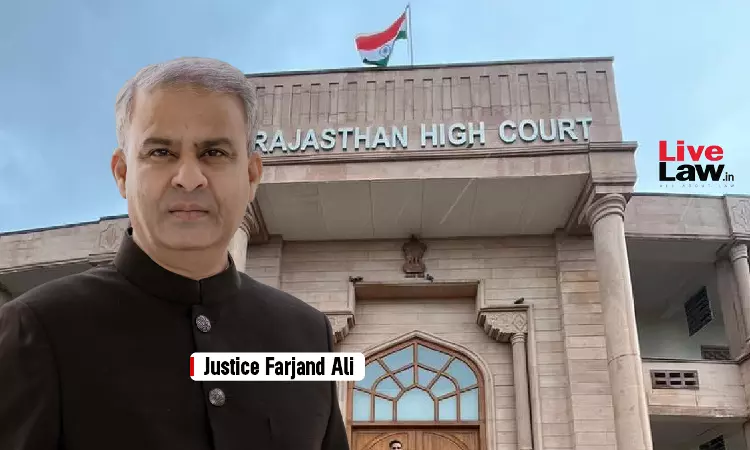
Rajasthan High Court set aside the dismissal of a police constable imposed by senior police authority while exercising suo-motu review powers under Rule 32 of the Rajasthan Civil Services (Classification, Control and Appeal) Rules, opining that preliminary enquiry could not be made sole basis of punishment when such material did not come on record during the regular enquiry.The bench of...
This is a premium content
Available exclusively to
Our subscribers
Subscribe Premium 
INR 1099+GST
Your support helps us to bring you more content at
an affordable subscription scheme !!!
All payment options available
Rajasthan High Court set aside the dismissal of a police constable imposed by senior police authority while exercising suo-motu review powers under Rule 32 of the Rajasthan Civil Services (Classification, Control and Appeal) Rules, opining that preliminary enquiry could not be made sole basis of punishment when such material did not come on record during the regular enquiry.
The bench of Justice Farjand Ali held that the reviewing authority committed serious error while basing the ultimate punishment almost entirely on the preliminary enquiry despite the fact that the prosecution case collapsed during the regular disciplinary proceedings.
“It is a trite and settled proposition of service jurisprudence that the purpose of a Preliminary Enquiry is only to ascertain whether a prima facie case exists to warrant a detailed investigation or a regular departmental enquiry under Rule 16 of the CCA Rules. Once the formal enquiry is initiated, the charges must be proved by the prosecution through legally admissible evidence led during the regular proceedings.”
The petitioner was appointed as constable in 2008, when he was issued a charge sheet with the allegation of demanding Rs. 1.3 lakhs from someone promising them appointment as a constable, and also receiving Rs. 50,000 as advance.
After the departmental inquiry culminated in his guilt, penalty was imposed of stoppage of two annual increments. The Appellate Authority found the punishment to be inadequate and remanded the matter wherein the punishment was increased to stoppage of 4 annual increments.
Then the Inspector General of Police, acting as the Reviewing Authority invoked the suo-motu review power alleging that the order of Disciplinary Authority was non-speaking and not based on reasonable grounds. Herein the extreme punishment of dismissal from service was imposed which was challenge before the Court.
It was argued on behalf of the petitioner that the order of the Disciplinary Authority was of 27 pages and very detailed, hence, the invocation of review powers in itself was factually incorrect reflecting non-application of mind.
Further, it was submitted that the reviewing authority relied exclusively on the preliminary enquiry report while ignoring the evidence led during regular department enquiry wherein the prosecution's key witnesses turned hostile.
It was argued that the fact that the same reviewing authority, while acting as appellate authority earlier remanded the matter for enhanced punishment, and then subsequently took suo-motu review and dismissed the petitioner, indicated that he acted in a pre-determined and biased manner.
After hearing the contentions, the Court accepted the arguments put forth on behalf of the petitioner, and highlighted that the fundamental flaw was reviewing authority's reliance on preliminary report.
“Once the formal enquiry is initiated, the charges must be proved by the prosecution through legally admissible evidence led during the regular proceedings…relying on statements recorded during the Preliminary Enquiry, while ignoring the clear testimony and retraction provided by these prosecution witnesses in the formal inquiry, amounts to condemnation based on no legal evidence, rendering the finding of guilt unsustainable.”
The Court further agreed with the argument that challenged invocation of review powers in light of detailed order by the disciplinary authority and held that the fact that same authority earlier remanded the matter and then invoked the review powers raised serious doubt about the objectivity and fairness of the process.
“The power to review must be exercised judiciously, not capriciously or with a pre-determined goal to ensure awarding a particular punishment. Such an action amounts to an arbitrary exercise of discretion, thus, violative of Article 14 of the Constitution of India.”
In this background, the Court observed that the reviewing authority could not be expected to substitute his opinion against the material fact on record, and opined that owing to such “egregious procedural and evidentiary flaws”, the dismissal order could not be sustained.
Accordingly, the matter was remanded back to Inspector General of Police to conduct a fresh review, and the petitioner was directed to be reinstated in service.
Title: Shankar Ram v the State of Rajasthan & Ors.
Citation: 2025 LiveLaw (Raj) 422
Tags


