



- Home
- /
- High Courts
- /
- Rajasthan High Court
- /
- Section 311 CrPC | Accused Can't Be...
Section 311 CrPC | Accused Can't Be Denied Cross-Examination Due To Counsel's Illness: Rajasthan High Court
Nupur Aggarwal
13 Jan 2026 12:00 PM IST
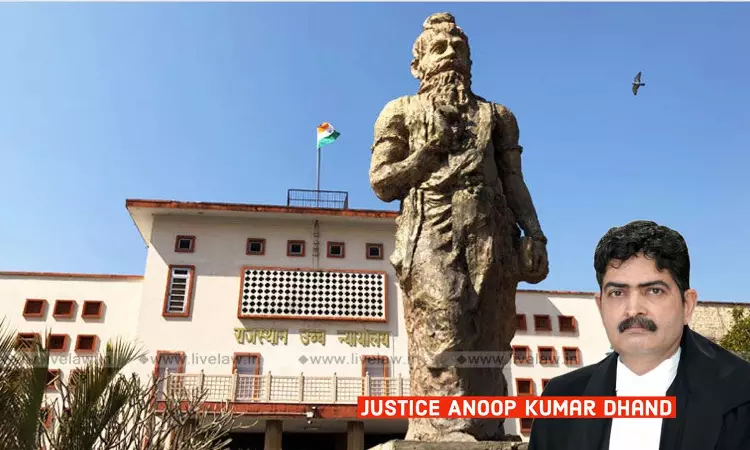
While underscoring the wide amplitude of powers available to Courts under Section 311 CrPC, the Rajasthan High Court has held that an accused cannot be denied the opportunity of cross-examination owing to the counsel's illness and resultant inability to attend the scheduled court date.The bench of Justice Anoop Kumar Dhand was hearing a petition challenging the decision of the trial court...
This is a premium content
Available exclusively to
Our subscribers
Subscribe Premium 
INR 1099+GST
Your support helps us to bring you more content at
an affordable subscription scheme !!!
All payment options available
While underscoring the wide amplitude of powers available to Courts under Section 311 CrPC, the Rajasthan High Court has held that an accused cannot be denied the opportunity of cross-examination owing to the counsel's illness and resultant inability to attend the scheduled court date.
The bench of Justice Anoop Kumar Dhand was hearing a petition challenging the decision of the trial court that closed the opportunity of the petitioner for cross-examining the prosecution witnesses, and also rejected the application filed under Section 311 CrPC.
Section 311 CrPC empowers any court at any stage in any inquiry/trial or other proceedings to summon any person as a witness or to examine any person in attendance, even though not summoned as witness or to recall or re-examine any person already examined.
The petitioner was under trial for the offence of repeated rape, wherein on the first day of recording statements of prosecution witnesses, petitioner's counsel could not appear as he was suffering from an ailment. An application was submitted seeking opportunity to cross-examine the witnesses on some other day.
However, the application was rejected by the trial court, and the petitioner's opportunity for cross-examining the witnesses was closed. Furthermore, an application under Section 311 was submitted by the petitioner, which was also rejected by the trial court. Hence, the petition was moved before the Court.
After hearing the contentions, the Court underscored the significance of the statutory right to cross-examine, and held that the trial court ignored the importance of provisions relating to summoning and examining the witnesses.
“…cross-examination is the statutory right of the accused. Unless and until this opportunity is provided to the petitioner-accused, he would not be in a position to put his defence in a proper way. For conducting a fair trial, proper opportunity is required to be given to the accused, but in the instant case, the petitioner has been deprived of such fair opportunity.”
The Court perused Section 311 CrPC, and observed that the provision vests widest powers on the courts when it comes to summoning, recalling or re-examining a witness.
It observed that while exercising the power to recall and re-examine a person already examined, the court shall necessarily consider and ensure that such recall or re-examination is essential for the just decision of the case, in the opinion of the court.
“…while such a widest power is invested with the court, it is needless to state that exercise of such power should be made judicially and also with extreme care and caution.”
It was held that by using the prefix “any” to various expressions in the provision, it was intended that all that was required was court's satisfaction in relation to such evidence that it was essential for the just decision of the case.
“It is, therefore, imperative that the invocation of Section 311 CrPC and its application in a particular case can be ordered by the court, only by bearing in mind the object and purport of the said provision, namely, for achieving a just decision of the case as noted by us earlier. The power vested under the said provision is made available to any court at any stage in any inquiry or trial or other proceeding initiated under the Code…”
In this background, the Court held that re-summoning of prosecution witnesses was necessary in the present case for a just and fair decision.
Accordingly, the petition was allowed, and the trial court directed to re-summon the prosecution witnesses.
Title: Pooranmal Yadav v State of Rajasthan
Citation: 2026 LiveLaw (Raj) 7


