



- Home
- /
- High Courts
- /
- Rajasthan High Court
- /
- State Cannot Exploit Workers By...
State Cannot Exploit Workers By Keeping Them In 'Perpetual Temporariness': Rajasthan High Court Orders Regularisation Of Part-Time Employee
Nupur Aggarwal
14 Jan 2026 12:20 PM IST
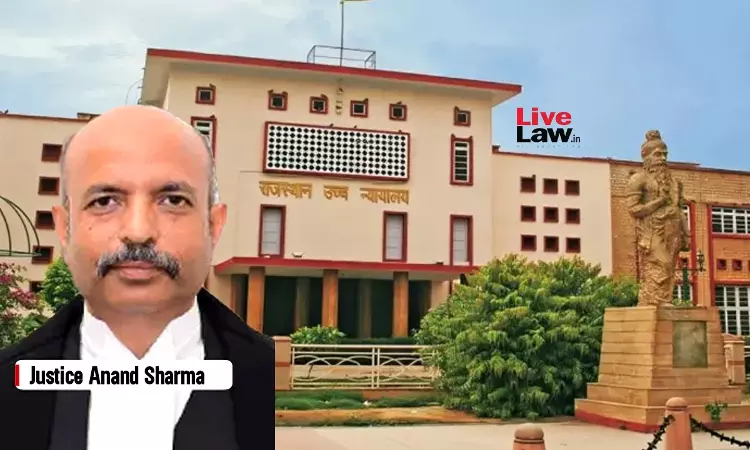
The Rajasthan High Court directed regularization of the petitioner engaged by the State on a part-time basis, who continued uninterrupted services for several years and performed identical duties to that of regularly appointed employees, opining that not being appointed on a sanctioned post could not be a ground to deny benefit of regularization to the petitioner. The bench of Justice...
This is a premium content
Available exclusively to
Our subscribers
Subscribe Premium 
INR 1099+GST
Your support helps us to bring you more content at
an affordable subscription scheme !!!
All payment options available
The Rajasthan High Court directed regularization of the petitioner engaged by the State on a part-time basis, who continued uninterrupted services for several years and performed identical duties to that of regularly appointed employees, opining that not being appointed on a sanctioned post could not be a ground to deny benefit of regularization to the petitioner.
The bench of Justice Anand Sharma held that even though regularization could not be claimed as a matter of right, the constitutional principles did not permit the State to exploit labour by keeping them in a state of perpetual temporariness while extracting regular and continuous work.
“A conjoint reading of the aforesaid judgments demonstrates that while Uma Devi (supra) continues to prohibit regularization of illegal appointments, it does not authorize the State to perpetuate ad-hocism, avoid creation of posts, or exploit labour under the guise of constitutional compliance. The focus has decisively shifted from the form of appointment to the substance of employment, namely the nature of duties, length of service, existence of sanctioned work, and the conduct of the employer.”
The Court was hearing a petition seeking regularization of services by the petitioner who was initially engaged on a part-time basis by the State to meet administrative and functional requirements. Despite the description of the services being part-time, the petitioner continued in service uninterruptedly for more than 10 years and performed duties identical to those of regularly appointed employees.
In 2009, a notification was issued by the government for considering cases of regularization for those who completed 10 years of service. When the petitioner submitted his representation in this regard, the same was rejected on the ground that he was never appointed on a duly sanctioned post. Hence, the petition was moved before the Court.
It was submitted on behalf the State that the petitioner was engaged purely on part time basis, and that did not confer any right to regularization. It was argued that regularization was contingent upon the existence of a sanctioned post, and adherence to applicable service rules, and could not be granted merely based on continuity of service.
After hearing the contentions, the Court considered the nature of services rendered by the petitioner and highlighted that those were identical to the ones performed by regularly appointed employees. It was stated that the petitioner was working under the direct control and supervision of the State.
While underscoring the constitutional mandate of Article 14 and 16 in relation to public employment, the Court held that, “…regularization cannot be claimed as a matter of right and that appointments made in flagrant violation of recruitment rules cannot be sustained merely on the basis of length of service. However, it is equally well established that constitutional principles do not permit the State to exploit labour by keeping employees in a state of perpetual temporariness while extracting regular and continuous work.”
Reference was made to the jurisprudential evolution of the concept of regularization by a series of judgment of Supreme Court, and the Court observed that while the regularization of illegal appointments were prohibited, State was not authorized to exploit labour under the guise of constitutional compliance.
In this background, the Court observed that the petitioner had rendered long, uninterrupted services, possessed requisite qualifications, and performed duties of perennial & essential nature under the direct control of the State.
It was opined that refusal to regularize the petitioner could not be sustained and permitting the State to do this would amount to endorsing exploitation which would defeat the constitutional guarantee of fairness, equality and dignity of labour.
“The continued engagement of the petitioner without initiating regular recruitment or considering regularization reflects administrative arbitrariness and is contrary to the constitutional obligation of the State to act as a model employer.”
Accordingly, the State was directed to regularize the services of the petitioner against a sanctioned post.
Title: Satu Lal v State of Rajasthan & Ors.
Citation: 2026 LiveLaw (Raj) 17


