



- Home
- /
- High Courts
- /
- Rajasthan High Court
- /
- Relief Can't Be Denied Just Because...
Relief Can't Be Denied Just Because Officer Didn't Approach Court: Rajasthan High Court Quashes Stigmatic Remarks
Nupur Agrawal
6 Feb 2026 10:30 AM IST
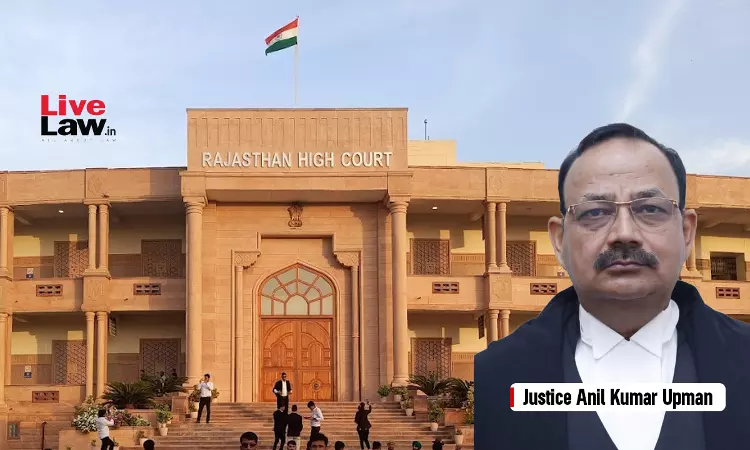
The Rajasthan High Court has granted relief of expunging adverse remarks made by the trial court not only against the petitioner police officer, but also against another officer who did not approach the court for relief.The bench of Justice Anil Kumar Upman held that just because the other officer did not approach the court, it could not be said that the adverse remarks made against him...
This is a premium content
Available exclusively to
Our subscribers
Subscribe Premium 
INR 1099+GST
Your support helps us to bring you more content at
an affordable subscription scheme !!!
All payment options available
The Rajasthan High Court has granted relief of expunging adverse remarks made by the trial court not only against the petitioner police officer, but also against another officer who did not approach the court for relief.
The bench of Justice Anil Kumar Upman held that just because the other officer did not approach the court, it could not be said that the adverse remarks made against him were correct. It was held, based on the principle of parity, when a specific action was found to be legally infirm, the benefit extended to one party had to be extended to others similarly placed.
The Court was hearing a petition by a police officer, challenging the order of the trial court in an NDPS case, in which castigating remarks were passed by the court along with directions for initiation of disciplinary and legal action against the petitioner.
It was argued by the petitioner that such remarks were passed without affording any opportunity of hearing which violated principles of natural justice.
After hearing the contentions, the Court referred to the Supreme Court case of Manish Dixit & Ors. v State of Rajasthan, in which it was held that before the court passed any adverse remarks against any person, especially when such remarks could lead to serious consequences on future career of the person, s/he had to be given opportunity of hearing. Without that, the remarks would be violative of principles of natural justice.
In this light, the Court highlighted that the challenged order and adverse remarks also referred to another individual meaning thereby that even such individual was not afforded any opportunity of hearing. Hence, he also stood at the same footing as that of the petitioner. The Court observed,
“Just because he has not raised a petition to get the castigating remarks expunged, like that presented by the current petitioner, it cannot be said that the castigating remarks passed by the learned Court specifically against him are correct. Following the principle of parity, when a court finds that a specific action suffers from a definitive legal infirmity, the benefit extended to one party must be extended to others similarly situated. A criminal court must decide like cases alike to avoid any form of discrimination.”
The Court held that being a constitutional court, it had to ensure that the right under Article 21 was not violated by not providing same relief to this other individual.
In this background, the Court set aside the order of the trial court, to the extent such castigating remarks were passed against both the petitioner and the other individual, and directions were made to initiate disciplinary and legal proceedings against them.
Accordingly, the petition was disposed of with liberty to the disciplinary authority to examine the matter independently.
Title: Vimal Singh v State of Rajasthan & Ors.
Citation: 2026 LiveLaw (Raj) 48
For Petitioners: Mr. Anurag Sharma; Mr. Akshat Sharma; Mr. Anoop Meena
For Respondents: Mr. M.S. Shekhawat


