



- Home
- /
- High Courts
- /
- Rajasthan High Court
- /
- Order 37 CPC | Failed Settlement...
Order 37 CPC | Failed Settlement Can't Revive Defendant's Right To Defend Summary Suit After Service Of Summons: Rajasthan High Court
Nupur Agrawal
6 Nov 2026 12:20 PM IST
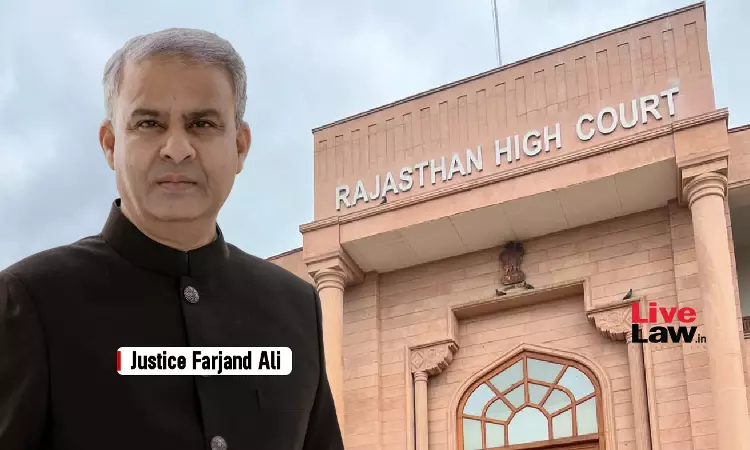
The Rajasthan High Court has set aside the order of the trial court that directed re-issuance of summons under Order 37 Rule 3 CPC, to the respondent, after the settlement entered into between the parties did not result in discharge of respondent's liabilities, in the background of the fact that summons were already issued before the parties started negotiating a compromise. The bench of...
This is a premium content
Available exclusively to
Our subscribers
Subscribe Premium 
INR 1099+GST
Your support helps us to bring you more content at
an affordable subscription scheme !!!
All payment options available
The Rajasthan High Court has set aside the order of the trial court that directed re-issuance of summons under Order 37 Rule 3 CPC, to the respondent, after the settlement entered into between the parties did not result in discharge of respondent's liabilities, in the background of the fact that summons were already issued before the parties started negotiating a compromise.
The bench of Justice Farjand Ali opined that once the summons were already issued, subsequent endeavour of parties to amicably resolve the matter, could not by itself evade the legal consequences which were already set in motion by issuance of summons earlier.
For context, a summary suit for recovery was filed by the appellant against the respondent under Order 37, CPC, in which summons were issued by the court. After the service of summons, the respondent acknowledged his liability and the matter was referred to ADR.
The parties entered into a compromise as per which the money had to be returned in instalments. This factum of this compromise was apprised to the Court which mentioned in the order sheet that if the respondent failed to discharge the liability, the amount already repaid shall be taken into account and the suit would continue as it stood prior to settlement.
After paying the first instalment, the respondent started making defaults. Hence, when the matter was taken up before the court, the trial court ordered issuance of fresh summons to the respondent, despite the fact that before entering into the compromise, the summons were already served upon the respondent. This order was challenged by the appellant.
After hearing the contentions, the Court observed that it did not agree with the course adopted by the trial court. It was held that once the summons were issued, the statutory consequences flowing from such service and defendant's failure to seek leave to defence within the prescribed period, could not be diluted merely because the parties chose to explore settlement.
For context, as per Order 37 Rule 3(5), CPC, post service of summons, the defendant was required to apply for leave to defend the summary suit within 10 days, and where no such application was filed, the statutory consequences follow.
The Court opined that after availing the opportunity of settlement and failing to honour its terms, the defendant, could not, merely on account of such intervening proceedings, claim an automatic revival of procedural opportunities that had already arisen under the statutory scheme.
“In these circumstances, the issuance of fresh summons under Order XXXVII Rule 3 CPC, without accounting for the earlier service thereof and the statutory consequences arising therefrom, cannot be sustained. The mandate of law cannot be made subservient to the procedural course adopted by the parties during the pendency of litigation. A settlement may afford the parties an opportunity to resolve their dispute, but it cannot, in the absence of any enabling provision, operate to suspend, erase or indefinitely defer the consequences prescribed by the statute.”
Accordingly, the Court set aside the trial court's order to the extent it ordered re-issuance of summons. It was stated that it shall be deemed that after issuance of summons, the defendant failed to seek leave to defend, and the suit shall proceed as per mandate of Order 37.
Counsel for petitioners: Mr. Avin Chhangani; Ms. Anjali Garg
Counsel for Respondents: Mr. R.S. Mankad


