



- Home
- /
- High Courts
- /
- Rajasthan High Court
- /
- Mechanical Transfer Of Caregiver...
Mechanical Transfer Of Caregiver 1000 Kms Away From Thalassemia Patient 'Inhumane', Violates Article 21: Rajasthan High Court
Jayanti Pahwa
8 Oct 2026 2:45 PM IST
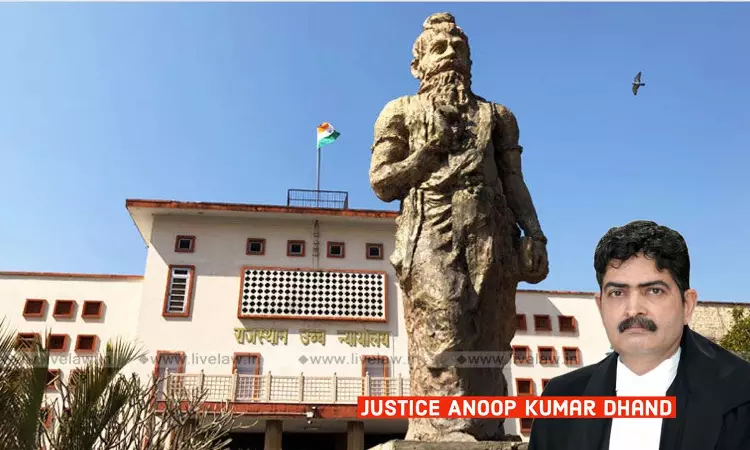
The Rajasthan High Court has set aside the order by UCO Bank wherein the caregiver of a Thalassemia patient was transferred 1,000 kms away without reasonable consideration and through mechanical application of the transfer policy. Remarking that the transfer order was "inhumane and violative of Article 21 of the Constitution", the bench of Justice Anoop Kumar Dhand observed:"Transferring...
This is a premium content
Available exclusively to
Our subscribers
Subscribe Premium 
INR 1099+GST
Your support helps us to bring you more content at
an affordable subscription scheme !!!
All payment options available
The Rajasthan High Court has set aside the order by UCO Bank wherein the caregiver of a Thalassemia patient was transferred 1,000 kms away without reasonable consideration and through mechanical application of the transfer policy.
Remarking that the transfer order was "inhumane and violative of Article 21 of the Constitution", the bench of Justice Anoop Kumar Dhand observed:
"Transferring a care-giver of a person suffering from Thalassemia, who requires blood transfusion on every 15-20 days, to a place 1000 KMs away, where no such facility or family support is available, without any reasonable consideration, is not only arbitrary but also inhumane and violative of Article 21 of the Constitution of India, which includes right to health and right to live with dignity of both the disabled dependent and the petitioner".
A writ petition was filed by the caregiver challenging the order of September 8, 2026, wherein his representation against his transfer order was rejected. The counsel for the petitioner argued that his younger brother is suffering from said disease with a 75% permanent disability. It was submitted that the petitioner was the primary caregiver of his brother.
The petitioner further relied on Clause 7 of the Equal Opportunity Policy, which was formulated by the Bank, specifying that any employee who is a caregiver of any dependent with specified disability of not less than 40% should be exempt from routine exercise of transfer.
The counsel for the State argued that, per the Transfer Policy for officers, the petitioner is required to be transferred as he was promoted from Scale I to Scale II officer. It was argued that there was no malice in passing the transfer order and the said order was passed due to administrative exigencies.
The court noted that the petitioner is a serving officer of the Bank, noting that the new posting after transfer was about 1,000 km away from the present place of posting.
Further, the bench noted that the factum of dependency was duly declared by the petitioner and recorded in the service record/HR record. The bench further noted that the Bank had formulated an Equal Opportunity Policy following the mandate of Article 21 of the Rights of Persons with Disabilities Act, 2016.
Examining clause 7 of the special policy, the court noted that the bank had mechanically applied the transfer policy. The court therefore set aside the impugned order, remarking that it was a "non-speaking order".
Observing that the policy was formulated under Section 21 of the Rights of Persons with Disabilities Act, the bench emphasised, "The Special Policy framed by the respondent-Bank is, therefore, not an act of charity but a statutory obligation. It has a binding force. The respondent-Bank cannot be allowed to frame a policy for public display and then act contrary to it".
The court further examined clause 7, noting that the said provisions are to be interpreted purposively and harmoniously to operate as measures of reasonable accommodation. The bench highlighted;
"The expression 'administrative constraints' cannot be construed as an omnibus or mechanical exception so as to render the protective object of the provisions nugatory. Rather, any departure from the exemption must be founded upon genuine, relevant and demonstrable administrative exigencies".
Additionally, the court held that the special policy would prevail over the general policy of transfer. The bench also noted that if the petitioner is transferred to such a distant place, the survival of his dependent brother would fall into jeopardy.
However, the bench maintained that the petitioner cannot claim immunity from all future transfers indefinitely and held that
"Transfer is an administrative exigency. The only protection available to the petitioner is that his case must be considered in the light of the Special Policy and he must be accommodated at a place where adequate medical facilities for his dependent brother are available".
Accordingly, the court set aside the transfer order and directed the Bank to allow the petitioner to continue at his present place of posting.
For Petitioner: Advocates Jhabar Swami, Hitesh Kumar and Ajay Swami
For Respondent: Advocates Anita Aggarwal, Laxmikant, Vibhanshu Sharma and Kalpana
Tags

Jayanti Pahwa
Jayanti Pahwa is a Correspondent with LiveLaw, covering the Madhya Pradesh High Court

