



- Home
- /
- High Courts
- /
- Rajasthan High Court
- /
- Merely Recording Employee's Reply...
Merely Recording Employee's Reply Was 'Considered' Is An 'Eye Wash'; Serious Misconduct Can't Excuse Lack Of Reasons: Rajasthan High Court
Nupur Agrawal
29 Sept 2026 9:45 AM IST
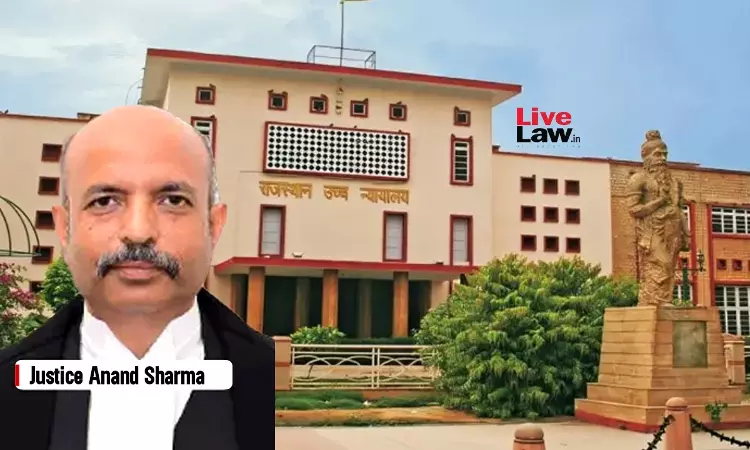
The Rajasthan High Court has set aside an order imposing penalty on the Zonal Chief Engineer of Jaipur Discom, as well as the appellate order affirming such penalty, since no consideration was given to the contents of the reply in defence that was submitted by him.The bench of Justice Anand Sharma affirmed that merely using the words that the content was considered in the order, was an...
This is a premium content
Available exclusively to
Our subscribers
Subscribe Premium 
INR 1099+GST
Your support helps us to bring you more content at
an affordable subscription scheme !!!
All payment options available
The Rajasthan High Court has set aside an order imposing penalty on the Zonal Chief Engineer of Jaipur Discom, as well as the appellate order affirming such penalty, since no consideration was given to the contents of the reply in defence that was submitted by him.
The bench of Justice Anand Sharma affirmed that merely using the words that the content was considered in the order, was an empty formality and an eye wash. Consideration meant active application of mind as well as thinking over, pondering and weighing the relevant material.
For context, the Court was hearing a challenge against the penalty order passed by the Zonal Chief Engineer, Jaipur Discom, stopping his one annual grade increment. This order was also upheld by the appellate authority.
The petitioner was working as a Junior Engineer with the Department, when a transformer got damaged. He was served with a notice with allegations of irregularities as well as attempting to cause heavy losses to the respondent.
A reply was submitted by him, categorically denying all the charges post which the respondent passed the penalty order which was upheld by the appellant authority too.
The petitioner argued that bare perusal of the order made it clear that the contents of his reply were ignored and without any analysis of the fact verification report, the disciplinary authority found the petitioner guilty.
On the contrary, the state argued that the charges against the petitioner were of serious misconduct. Further, the recital in the orders made it clear that it was only after careful consideration that the penalty was imposed. There was a clear reference of consideration of reply.
Further, the state submitted that even otherwise, the reasons for passing penalty order and appellate order were very much in the file of the corporation, and hence the allegation of non-consideration was totally misplaced and could not be quashed on such grounds.
After hearing the contentions, the Court referred to the case of Rajesh Kumar Tiwari v the Jaipur Vidyut Vitran Nigam that dealt with an identical factual scenario and held that, consideration of the defence put forth by the delinquent employee in a disciplinary proceedings was not an empty formality nor something to be completed merely for the sake of compliance with procedural requirement.
It was opined that such consideration had to be reflected from the penalty order itself by way of cogent reasons. It was further held that,
“Contentions of learned counsel for the respondents that reasons may not be reflecting in so many words in the impugned order, yet they are clearly mentioned in the note-sheets of the files lying in the office of respondent-Corporation, are totally unsustainable and unfounded. Penalty order and the appellate order causes serious prejudice and miscarriage of justice to the delinquent employee as it also reflects in the service record and also causes adverse impact on his future promotions/benefits etc. Therefore, the reasons for holding the delinquent guilty as well as to arrive at a particular conclusion for imposing penalty, are bound to be part of the disciplinary order as well as the appellate order.”
The order also observed that the gravity or seriousness of the charges could not be used as a justification to dispense with the requirement of recording reasons. Even in cases involving serious misconduct, authority was duty bound to demonstrate through reason, how the charges were proved.
In this background, the Court expressed agreement with the aforementioned ruling, and held that in absence of reasoned consideration at both disciplinary and appellate stages, the penalty order or the appellate order could not be sustained.
Accordingly, the orders were set aside, and the petitioner was held entitled to the consequential relief to be released to him within 60 days.
Title: Deepak Meena v the Chairman cum Managing Director, JVVNL & Ors.
Citation: 2026 LiveLaw (Raj) 404
Counsels for Petitioners: Mr. Abhishek B. Sharma
Counsels for Respondents: Mr. Sarvesh Jain


