



- Home
- /
- High Courts
- /
- Telangana High Court
- /
- Party Can't Subsequently Cure...
Party Can't Subsequently Cure Foundational Defects To Validate Institution Of Suit: Telangana High Court
LIVELAW NEWS NETWORK
8 July 2026 9:30 AM IST
The Telangana High Court has held that parties cannot seek to remove or cure foundational defects at a subsequent stage in order to validate the institution of the Suit. [2026 LiveLaw (Tel) 98]In doing so the court set aside a trial court order which had permitted the plaintiff to ratify an earlier resolution, in order to replace the original basis of authority for institution of the Suit...
This is a premium content
Available exclusively to
Our subscribers
Subscribe Premium 
INR 1099+GST
Your support helps us to bring you more content at
an affordable subscription scheme !!!
All payment options available
The Telangana High Court has held that parties cannot seek to remove or cure foundational defects at a subsequent stage in order to validate the institution of the Suit. [2026 LiveLaw (Tel) 98]
In doing so the court set aside a trial court order which had permitted the plaintiff to ratify an earlier resolution, in order to replace the original basis of authority for institution of the Suit which the court said the plaintiff could not have done.
The court made the observation in a plea challenging a commercial court's order allowing two applications filed by the plaintiff company in its recovery suit.
The first application was filed seeking permission for one Archit Reddy to represent the plaintiff Company as its duly authorised signatory and the second application was for filing a board resolution of the plaintiff company dated 18.06.2025 ratifying an earlier resolution along with the list of documents enclosed with the Plaint.
The Commercial Court allowed both the applications holding that the defect in the earlier document was a curable one and that no prejudice would be caused to the petitioners/defendant Nos.1 to 4, if the document is allowed. Against this petitioners-defendants moved the high court.
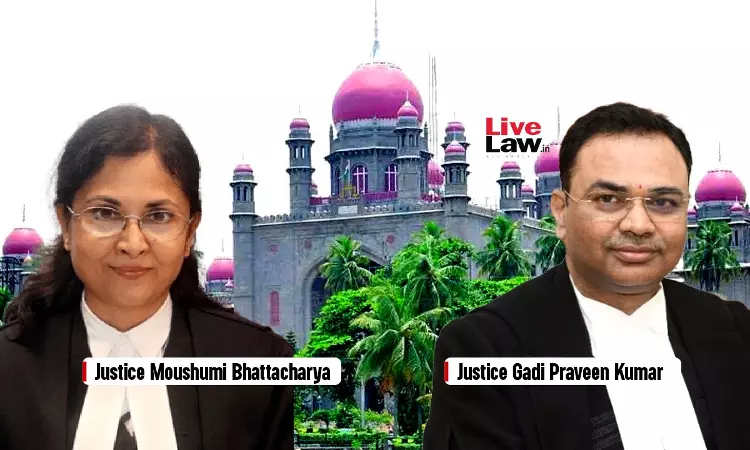
A division bench of Justice Moushumi Bhattacharya and Justice Gadi Praveen Kumar observed:
"There is a marked distinction between a procedural correction of facts and a defect which strikes at the foundation of a pleading or the institution of a suit. There are several instances of defects which can subsequently be corrected/cured. Such instances would include defective verification, defective signing, or even a delayed filing of an authorisation. However, these examples cannot be equated with an absence of authority at the very inception of filing of the document".
Observing that the present case falls under category of a defect which strikes at the foundation of a pleading or the institution of a suit, the court thus observed that Archit Reddy had no authority at the time of filing of the Suit on behalf of the respondent/plaintiff.
"This is by reason of the fact that the subsequent Resolution dated 18.06.2025, for ratifying the earlier Resolution dated 29.08.2016, seeks to replace the original basis of the authority altogether. Hence, this is not a mere substitution or procedural correction but an erosion of the very foundation of the authority on which Mr. Archit Reddy filed the Suit on behalf of the plaintiff in 2016," the court emphasized.
It said that the company had knowledge, that at the relevant point of time in 2016, Archit Reddy did not have the authority to file the Plaint under the Resolution dated 29.08.2016 since he was not a Director of the Company at the time. Hence, the plaintiff was naturally aware that the Resolution dated 29.08.2016 contained an error in the description of Archit Reddy as a Director of the plaintiff Company, the court said.
"In other words, this was not a defect which was discovered subsequently or one that occurred through inadvertence in 2016...Hence, supplanting the earlier Board Resolution dated 29.08.2016 with the later Board Resolution dated 18.06.2025 is not a mere instance of curing a defect, but a deliberate attempt to subsequently clothe an incompetent person with authority for the purpose of regularising the institution of the Suit. In essence, the Suit was instituted with a foundational defect and one which could not be rectified by substituting the earlier Board Resolution with the later one...
Even if the issue of the dispute not being a commercial dispute is to be, accepted, which this Court declines to do, the principle remains that a party cannot seek to remove a foundational defect or convert a non-Director into a Director for the purpose of validating the institution of the Suit. The above discussion leads us to the inescapable conclusion that the Resolution of the Board of Directors of the plaintiff Company dated 18.06.2025, which was subsequently allowed to be brought on record by the impugned order, was not a mere ratification. It was an attempt on the plaintiff's part to replace the original basis of authority for institution of the Suit, that too after completion of evidence. The Trial Court failed to appreciate the distinction between a curable procedural irregularity and a defect affecting the validity of the institution of the Suit itself".
The court referred to Order XI of CPC–as amended by the Commercial Courts Act pertaining to Disclosure, Discovery and Inspection of Documents in Suits before the Commercial Division of a High Court or a Commercial Court
As per Rule 1, it is mandatory for plaintiff to file a list of all documents and copies thereof, in the plaintiff's power, possession, control or custody pertaining to the Suit along with the Plaint. The court further noted under Rule 1(5) plaintiff cannot later rely on documents which were not initially disclosed with the plaint, except with the leave of the court if plaintiff establishes reasonable cause for non-disclosure.
On the provisions the court said, "sub-rule (5) does not expressly contemplate filing of documents beyond the cut-off period of thirty days from the date of filing of the Suit under sub-rule (4). Hence, even if the plaintiff was to rely upon a document, without having disclosed it with the plaint or filed it before the Commercial Division/Commercial Court, the plaintiff would still be required to establish 'reasonable cause' for the non-disclosure of the said document to the satisfaction of the Court".
The court said that in essence, the plaintiff had sought to ratify its earlier Resolution dated 29.08.2016, which had authorised Archit Reddy to represent the plaintiff Company despite him not being a Director of the Company on that date.
The plea was thus allowed and commercial court's order was set aside.
Case title: M Divya And Three Others v/s M/s. Pavani Estates Private Limited
CIVIL REVISION PETITION NO.3848 OF 2025
Click Here To Read/Download Order
Citation: 2026 LiveLaw (Tel) 98


