- Home
- /
- High Courts
- /
- Telangana High Court
- /
- 'Sweeping Generalisation':...
'Sweeping Generalisation': Telangana High Court Rejects PIL Claiming 70-90% Reservation In Municipalities, Finds No Supportive Data
Ananya Tangri
9 April 2026 4:53 PM IST
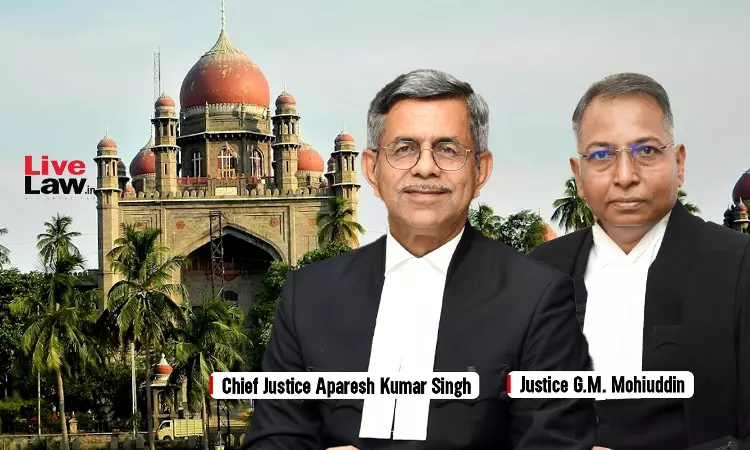
The Telangana High Court dismissed a PIL challenging ward-wise reservation notifications issued for ' 2nd Ordinary Elections to Municipalities and Municipal Corporations 2026', holding that the allegation that reservation in several municipalities ranged between 70% and 90% was not backed by “comprehensive or verified data.”A Division Bench of Chief Justice Aparesh Kumar Singh and...
This is a premium content
Available exclusively to
Our subscribers
Subscribe Premium 
INR 1099+GST
Your support helps us to bring you more content at
an affordable subscription scheme !!!
All payment options available
The Telangana High Court dismissed a PIL challenging ward-wise reservation notifications issued for ' 2nd Ordinary Elections to Municipalities and Municipal Corporations 2026', holding that the allegation that reservation in several municipalities ranged between 70% and 90% was not backed by “comprehensive or verified data.”
A Division Bench of Chief Justice Aparesh Kumar Singh and Justice G.M. Mohiuddin observed:
"It is to be noted that the foundation of the present case rests upon the assertion that reservation in several municipalities ranges between 70% and 90% However, upon examination of the very District Gazette Notifications annexed by the petitioner, the data does not substantiate the sweeping allegation in the manner projected. The petitioner has not furnished a comprehensive tabulation of all municipalities to support the generalized claim. When the factual premise itself racks precision and demonstrable support, the claim of large-scale public injury becomes tenuous"
Noting that no case for interference was made out the court further said:
“The petitioner's principal allegation that reservation ranges between 70% and 90% across several municipalities is not supported by comprehensive or verified data. The petitioner has also not established any violation of the statutory framework or non-compliance with the parameters laid down by the Hon'ble Supreme Court in relation to reservation in local bodies. The petition, having been instituted at a belated stage when the election process was already underway, and being unsupported by precise and demonstrable data, does not warrant interference under Article 226 of the Constitution.”
The Court, however, clarified that the order would not preclude any genuinely aggrieved person, armed with “specific, verified and quantifiable data,” from pursuing appropriate remedies in accordance with law.
Significantly, on a specific query from the Court, learned counsel for the petitioner fairly submitted that the figure of 70% to 90% was only an “approximation based on a general overview of the notifications” and not on any precise mathematical computation. It was also conceded that no tabulated statement, chart, or district-wise or municipality-wise analysis had been prepared or placed on record to support their claims.
The PIL was filed by Gade Ramana Reddy, a retired Assistant Professor of Chemistry, questioning the ward-wise reservation notifications issued for municipal elections in Telangana. His case was that in several municipalities, reservation had been fixed between 70% and 90%, leaving only 2 to 4 wards unreserved in municipalities having 15 to 20 wards, and thereby violating Articles 14 and 243-T of the Constitution.
The petition also assailed Government Order (GO) dated 12.01.2026 and G.O. dated 13.01.2026, issued by the Municipal Administration and Urban Development (MAUD) Department, on the ground that the State had allegedly eliminated or substantially reduced the open category while fixing reservations for SCs, STs, OBCs and women.
The petitioner contended that the principle of horizontal reservation for women had been wrongly added over and above vertical reservation. It was contended that the exercise was contrary to the Supreme Court's ruling in Vikas Kishanrao Gawali v. State of Maharashtra (2021).
The apex court in its judgement had emphasised the Triple Test requirement for providing reservation to Backward Classes in local bodies, namely:
- Setting up a dedicated Commission;
- Specification of proportion of reservation based on empirical data; and
- Ensuring that total vertical reservation does not exceed 50%.
It was also pointed out that the Telangana State Election Commission had on 27.01.2026 called upon voters of 116 Municipalities and 7 Municipal Corporations to elect ward members, fixing the date of poll as 11.02.2026. The PIL was filed only on 06.02.2026, by which time the election process was already underway.
Opposing the petition, the State submitted that total reservations for SCs, STs and Backward Classes did not exceed the aggregate percentage mandated by the Supreme Court, and that the State was proceeding strictly within the framework laid down in Vikas Kishanrao Gawali. It was argued that GOs itself reflected compliance with the Triple Test requirement for reservation to Backward Classes, and that the petitioner's contentions were mere allegations unsupported by any quantifiable data.
The Bench first examined the maintainability of the PIL and noted that PIL is meant to vindicate the rights of those unable to approach the Court themselves, and is not to be casually invoked without adequate foundation. Referring to the settled parameters governing PILs, the Court found that the present petition suffered from “substantial deficiencies.”
On the belated filing of the PIL, the court observed that in election matters, delay is a relevant consideration while declining relief. It further noted that the challenge was directed against district-specific ward reservation notifications issued by several District Election Authorities across the State, yet the concerned authorities had not been impleaded as parties. According to the Bench, the absence of such necessary parties materially affected proper adjudication.
On merits, the Court held that while in municipalities with a smaller number of wards the percentage of reserved wards may appear relatively higher on account of limited ward strength, the overall pattern emerging from the material on record did not, on its face, support the "sweeping generalisation" that reservations went up to 90% in several municipalities. The Court noted that the petitioner had not furnished any consolidated tabular statement covering all 116 municipalities and 7 municipal corporations, nor any demographic data correlating reservation percentages with population figures.
The Bench also rejected the petitioner's premise that horizontal reservation for women had been added over and above the vertical reservation categories. It observed that such an understanding was “misconceived,” since horizontal reservation operates within the respective vertical categories and is not to be cumulatively added for determining the 50% ceiling applicable to vertical reservation.
Dealing with the reliance placed on Vikas Kishanrao Gawali, the Court said the judgment required contextual understanding. It noted that the Triple Test framework for providing reservation to Backward Classes in local bodies required the setting up of a dedicated commission, specification of proportion of reservation based on empirical data, and ensuring that total vertical reservation does not exceed 50%.
From the material placed by the State, it appeared that a Dedicated Commission had been constituted and Rules framed providing that aggregate reservation for SCs, STs and BCs shall not exceed 50%. The petitioner, the Court said, had placed no material demonstrating non-compliance with these requirements in any specific municipality.
Dismissing the PIL the court left it open to the petitioner to institute appropriate proceedings in future placing on record specific, verified and quantifiable data.
Case Title: Gade Ramana Reddy v. State of Telangana & Ors.
Case No.: W.P. (PIL) No.4 of 2026
Appearance: Sri Rapolu Abhinav, representing Sri Rapolu Bhaskar, for the Petitioner; Sri Sudharshan Reddy, Advocate General, for Respondent No.1; Sri E. Venkata Reddy, GP for MAUD, for Respondent No.3.
Tags